

I don’t know about you, but as of recently my social media feeds are filled with horse girl content. Not the ones about ladies being enthusiastic about horses. But rather the Umamusume variety.
Yeah, anime racehorse girls, who are also idols, that also go to school. That kind.
Umamusume: Pretty Derby has now released in English globally, a few years late from its debut in Japan. But the free-to-play mobile game (read: gacha game) has enamoured quite the audience, from stalwarts who have been following the fandom from it manga and anime series that also played the JP version of this game, to newcomers completely oblivious at why are people so hyped about horses (including the developer behind Horse Race Test who made a whole game about watching racehorses).
If you are trying to rack your brain at why are people suddenly fawning over racehorses all of a sudden, this is an explainer from a person who couldn’t care less about idol culture, wasn’t too interested in the IP but is interested in racing games, racing and motorsport.
Umamusume: Pretty Derby is unassumingly a really hype racing game if you can accept the anime girls more than just at face value. If you consider yourself a fan of racing, sports, and competition, this game will show ever so often that it too understands what drives that passion, and highlight the competitive nature of humans (via racehorse school girl idols) in its best light. This gacha game manages to express the passion for racing more fervently than I’ve seen a racing game done in years by fusing idol culture elements into a celebration of Japan’s rich history in horse racing.
A Game Loop Unlike Other Typical Gacha Games
Umamusume: Pretty Derby tasks you as the trainer of an up-and-coming star racer from the Tracen Academy. Like any gacha game, you start with a handful of characters to get you started.
But the game loop is not your typical mobile-RPG, and not quite like the new wave of action gacha games pioneered by Hoyoverse, either. Sure, you spend in-game energy that recharges in real-time to enter the Career Mode, the main game loop, but Umamusume: Pretty Derby lets you enjoy the whole run uninterrupted, which could last for hours depending how long you spend reading through the visual novel, which can also be fast-forwarded if you are so inclined.
The Career Mode is structured essentially as a visual novel, where dialogue is plenty and not fully voiced, with a few dialogue choices that can change the ending of a scene. The goal here is to help achieve your chosen star racer, your trainee as the game calls it, achieve their dream, which is mostly to enter and win in specific races throughout a 3-year career.
Most of the girls aim to race and possibly win the Triple Crown of Japan’s horse racing. Some might want to contest the Triple Tiara, the other set of races that makes up the Classics. Few of the more memorable careers are those that takes some odd twists and turns, not following convention for whatever reason. For instance, Vodka really, really wants to contest the Japanese Derby but isn’t really set out to win the Triple Crown. She rather race more against her rival and roommate Daiwa Scarlet, who’s taking the traditional Triple Tiara route. Meanwhile, haughty nepo baby King Halo will see you take her to the Triple Crown route only to pivot in her senior year as she realise her aptitude for sprints, humbling herself to a lower class of racing. And then you have everyone’s favourite loser (affectionately), Haru Urara, who’s just happy to be there.
Fiction Based On Reality
Umamusume: Pretty Derby’s stable of characters all have odd names that you would see on a race horse. And that’s because they are, in fact, based on actual Japanese race horses, dead or alive. It’s like a racing game that features licensed cars where car culture goers geek out about every car, so too are Umamusume’s depiction of racehorses as school girl idols that compete in track running.
How Azur Lane personifies warships into anime girls and how Girls Frontline’s dolls used to be named after actual guns, Umamusume is like that for race horses.
And the character design, character dynamics, and even the story are all homages to Japan’s rich history of horse racing. As the more you dig into the horse lore, you’ll start seeing so many of nods, references and little hints that show the developers and creators behind this IP genuinely love the culture they are depicting. The real Vodka and Daiwa Scarlet do have beef. The chaotic randomness that is Gold Ship is just as chaotic random to her real horse counterpart. Before you know it, you’ll be looking up horse names at your nearest local derby just to see if anything can top the silly names of Japan’s racehorses like Special Week, Silence Suzuka or Mejiro McQueen.
(Malaysia has Char Kway Teow, which is pretty rad for a racehorse name. Imagine the commentator shouting like they’re shouting an order in a mamak restaurant.)
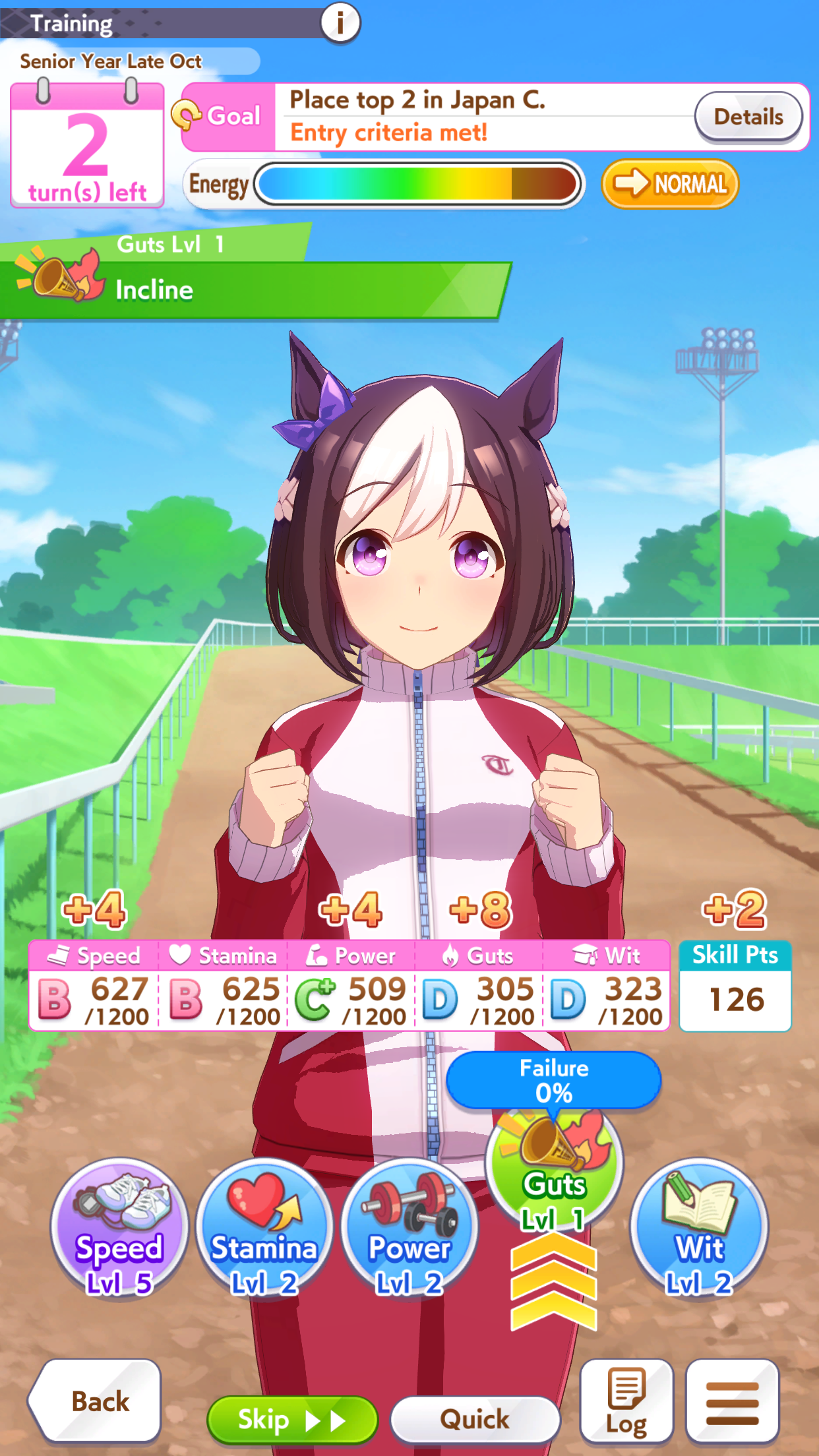
The game loop of Umamusume has you decide how to spend each turn to achieve their next goal in this 3-year career, where each turn takes up half a month. You have six months and a half to prepare for your trainee’s debut, and you decide the training regiment. This aspect feels the most visual novel of it all, and it reminds me of the one and only visual novel game I actually bought on Steam, God Save The Queen. You’re essentially preparing your horsegirl for the inevitable skill check that is a race.

Umamusume: Pretty Derby Makes Racing Hype
And let’s talk about the race. Because the raceday presentation is what most of us normies see gets shared around. For good reason. It’s universally hype.
You don’t need to understand the pre-race ceremonies of a racehorse raceday, the way they run or even the different strategies racehorse can run. You just see the last spurt dash where the orchestra swells and the Japanese commentators suddenly speak even faster and shout the horse girls names even loud, all of that is instantly a dopamine hit. How is that one horsegirl with white hair from the back suddenly go fast? Why is there another white-haired horsegirl coming out of nowhere? Can that one lead horsegirl with the stylish pink golf cap hold on the lead?
The camera angles also does an amazing job at selling the hype. You see stationary shots where you see the girls gallop through a corner, shaking the cam a bit like it’s camera shot right out of NASCAR or IndyCar. You have the wide pan shots that set the scene before entering the final corner. The close-up shots lean into anime bullshit to maximum, showing the ladies in a dutch angle, with frantic dash lines and wobbly camera is peak. Even more so when the girls are at their limit and they have the most scrunchiest of faces as they dig deep into the Guts stats for that final spurt. And the game always, without fail, strategically cut the wide shot of the final few meters to zoom into your horsegirl just to obscure a bit more if she made the winning pass, or if she managed to hold to the slimming lead. Proper suspense builder.
Yes, this is a game about school girls idols as much as it is about horse racing. But racing is a universal construct. If they are pushing themselves to the limit to go very fast, whether it is by using a vehicle with hundreds of horsepower or, well, the power of one literal horse(girl), seeing who can come up top is still a thrill.
And it helps that in horse racing, there is a way for those at the back to make a comeback unlike in modern racing where late surging strategies don’t really exist anymore, undercutting/overcutting and pit stop strategies in F1 have become marginally different that it becomes hard for the casual racing goer to appreciate the racing without having to go through a crash course or two of top-level car racing. Funny how the earliest form of racing, horse racing, which was usurped by auto racing, is now making a comeback thanks to a gacha game. Just like how EmpLemon posits that “if you watch [NASCAR] long enough, everything always come full circle,” so too is racing in general.
Umammusume: Pretty Derby does a splendid job at showing how thrilling racing can be, and the fact they are cute anime girls running in pompous and overly-designed garments helps it stand out from being just another weird racing game.
It’s Not Just About The Racing, It’s About The Racers
But the presentation of its horse(girl) racing is just half of what makes this game compelling. The schoolgirl idol shtick it has on the other side of this equine equation, is really what will make people stick around. Even folks who don’t like idol culture can appreciate and understand why its fans are stans. It’s the parasocial relationship aspect.
But in this game, it goes further, you’re basically the manager of an idol schoolgirl scheduling her training regime, and see slices of life of the various girls that study at the Tracen Academy. And it’s not just cute, girly thing happening here, those are there too. But the story moments can be unhinged (a good friend described training Gold Ship is akin to a Malkavian playthrough in Vampire: The Masquerade- Bloodlines). It can be steeped in melodrama (King Halo tries her damn hardest to beat the nepobaby allegations with her goals one of the hardest to clear if you’re starting out without a stable of good support cards and legacies). And plenty of rivalries, of different variety.
The reason Formula 1 is now a household name is often cited by the Netflix documentary series, Drive To Survive. At least one game thought replicating the storytelling style and presentation was enough to make a good racing game. But that’s the wrong lesson to learn. The real reason was how much the audience grown attached to the personalities on camera. The result of that is we now see a new generation of F1 fans doing fanart, fawning over drivers like they’re celebrities, gushing over the most minute interactions they have with each other caught on camera, even fancam edits, because we now see drivers not as just some guy, but our guy that we root for and support. It’s only a matter of time before F1 fans uses the term “oshi.”
Similarly, Umamusume: Pretty Derby’s Career Mode narrative offers opportunity for you to get emotionally attached to one of the horsegirls in a purely platonic but affectionate trainer-trainee relationship. And you won’t be able to see the full story when you start out, the skill checks to win each race ramps up dramatically, so you’ll likely see the girls at their lowest, which is enough to motivate you into doing more runs, getting better at picking what stats to train, just to ensure they are happy and achieve their dream. It sounds corny on paper, but it feels genuine. And having those dreams tied to more tangible, relatable goals like being the fastest racer or winning specific races should resonate with more folks compared to the usual idol shtick.
Hey, if folks are getting teary learning real horse lore, to the point they’re jokingly want to travel back in time and change the fate of the horse their beloved horsegirl is based of, and want to undertake a pilgrimage to see any of the still-alive racehorses are in person to the point that Cygames need to provide official guidelines, that’s enough to say Umamusume: Pretty Derby has made people care deeply about the characters, and in turn, care about racing.
I still think the podium celebration being the top 3 performing a concert, so the horsegirls are effectively battling to the be the top girl in an idol group performance, is silly though. You can skip those, and I get why, it’s just not my thing. Like how I only care about Vtubers when they stream playing games and dip when they start doing karaoke. But I get it. I see the vision. Just seeing the race play out and you have completely no control of the outcome and all you can do is to do what idol fans do? Yeah, I get it. I’d argue even race fans will act that irrationally. Passion. It’s what drives these two different industries, racing and idol groups.
Umamusume: Pretty Derby Is Also Technically A Roguelike Deckbuilder
On top of the excellent raceday presentation and the compelling storytelling, the relatively fresh (for a gacha game that penetrated the mainstream) gameplay loop seals the deal. Umammusume: Pretty Derby’s career mode is a reverse visual novel, in that instead of a story that continues to branch further, it’s the other way around. The objectives you must achieve through the career starts lenient (finish in the top 5, accumulate fans) before it gets increasingly more strict (finish top 3, top 2, win). So the story will converge into an ending where your trainee succeeds, usually after a winning a tough race at the end of the 3-year career. In a way, it’s like Ridge Racer Type 4, where the requirement to progress gets incrementally tougher, but you’re incentivized to win early on as the benefits you get can snowball into an easier path towards that final victory.
But you would be surprised to know that Umammuysme Pretty Derby is also technically a roguelike deckbuilder. Hear me out.
Before you start a career mode, you pick six support cards. These will guarantee a set of otherwise random events to trigger sometime during your trainee’s career, and they will also be your trainee’s training partner. So picking the right cards to match your trainee’s ability becomes like a deckbuildier in that way.
And you can consider a career mode playthrough a “run” too. At the end of the career mode, the trainee thankfully doesn’t end up in the glue factory, but becomes a veteran Umamusume, with her trained stats and skills in tact, saved for use in other activities. They can also be used as legacies, where your next trainee can be inspired by them and inherit stats and skills. It’s the closest thing to horse breeding as they can get in this game. Yeah, that expect of horse racing is represented here somehow.
So you want to regularly do runs and see if you can get a higher score, and produce a stronger Umamusume for use in daily races, specials races and the like. And you need to do these activities if you want the resources to upgrade your support cards which then can produce stronger veteran Umamusume. It’s a strong game loop, with the only downside is that support cards are tied to gacha, so you need to be regularly be playing the game (and suffer through so many failed runs) to scour for every free premium currency drops the game offers right now, or well, pay for more pulls.
Thankfully, it is possible to clear the career mode as long as you play it smart.
(Side note: unlike most gacha games, Umamusume: Pretty Derby doesn’t put the micro-transaction front and center. You really have to want to spend money to find where to pay for the premium currency Carats, and at least for now, that’s the only thing the game is charging you for. A breath of fresh air compared to others which will make you at least window shopping to the premium store to pick up some freebies, a subtle push into getting one to pay up.)

Closing Thoughts
All in all, Umamusume: Pretty Derby is getting all this buzz for the right reasons. It’s a genuinely a great game that does racing well, does visual novel well and it has a different style of gacha that doesn’t feel like you’re just playing one of those cookie-cutter RPGs. And the fact that it has also help expose the rich lore of Japan’s horseracing scene, where new audience have found a newfound appreciation of pre-auto racing, is commendable.
If anything, racing game developers should take some note.
No, “put anime girls” isn’t the main lesson here. But it’s putting efforts in presenting the racing action as hype as you can and giving players a strong drive and attachment to the characters. If there is a filter to make the horse girls just be horses I would still consider Umamusume: Pretty Derby one of the best racing games released this year.
If this game isn’t nominated for Best Sports/Racing game at The Game Awards later this year, it’s a travesty. This is genuinely a good sports/racing game that isn’t held back by gacha elements. And I have laid my case.
Umamusume: Pretty Derby is out now on PC (Steam), iOS and Android.