


Team Ninja is on a roll with their brand of soulslikes, which they refer to as “masocore” action-RPGs. The makers of the Nioh series and last year’s Stranger Of Paradise: Final Fantasy Origins know how to not only make these sorts of games, but also be distinct enough with their flavour.
With Wo Long: Fallen Dynasty, Team Ninja is shaking it up a bit more. This game’s fantasy take on the Three Kingdoms saga (now with more demons!) brings a new direction for its combat system that’s fresh and fun. But its uneven spikes of difficulty and the samey-ness of the gameplay structure hold it back from true greatness.

Presentation
Wo Long: Fallen Dynasty is set in the world of ancient China during the Three Kingdoms period. The Han Dynasty has fallen, specifically, but with demonic forces coming to play. So the setting is during times of war. And as a result, expect to see many, many desolate buildings, ruined castles and burning cities and villages.
The game tries to spice things up by having each level change up its main colour hues, but I just cannot stop seeing how drab and uninspiring everything looks. It’s justified due to its setting, I get it, but it just feels all too samey too quickly.
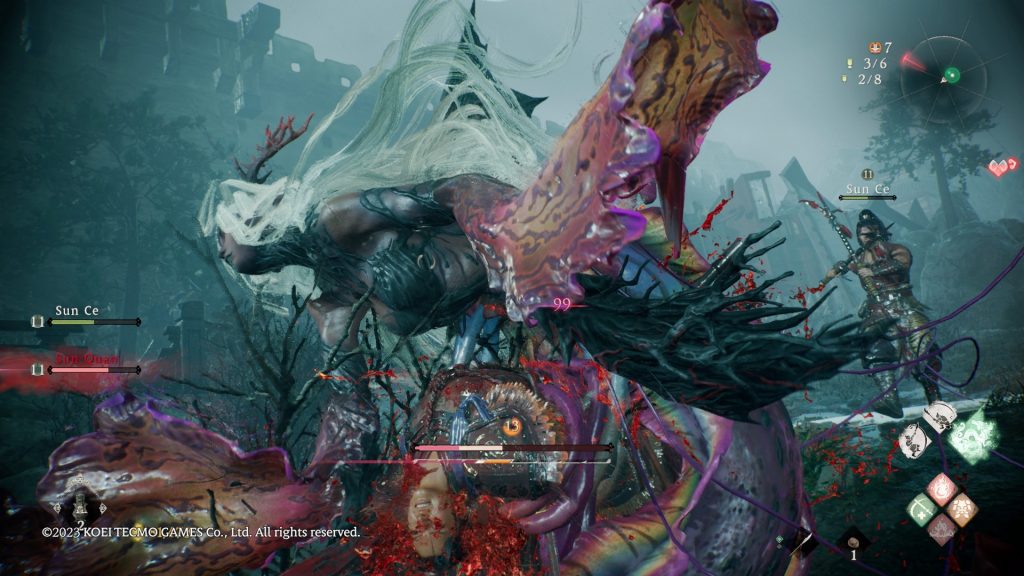
The enemy variety isn’t that much either, which also contributes to the samey-ness.
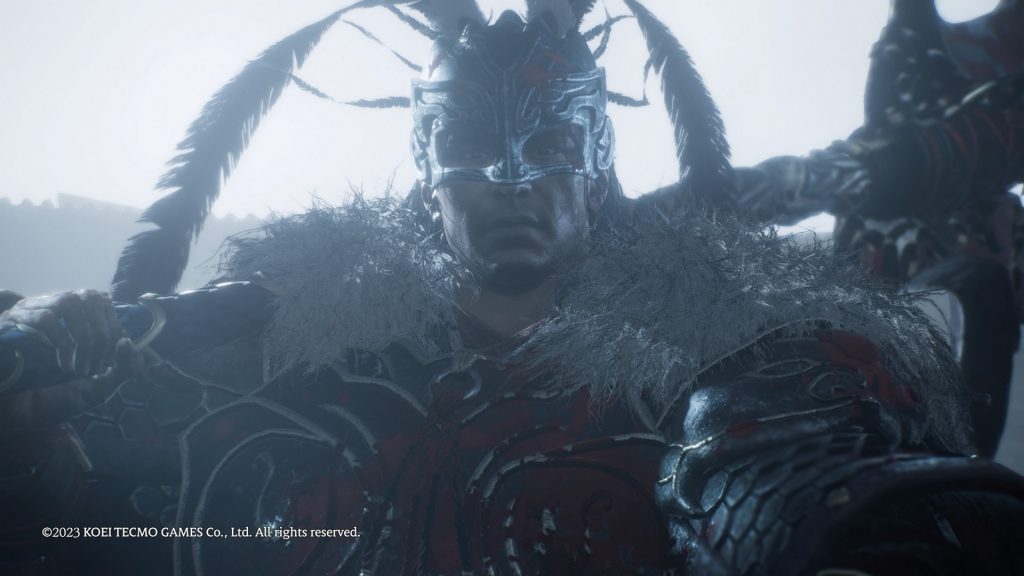
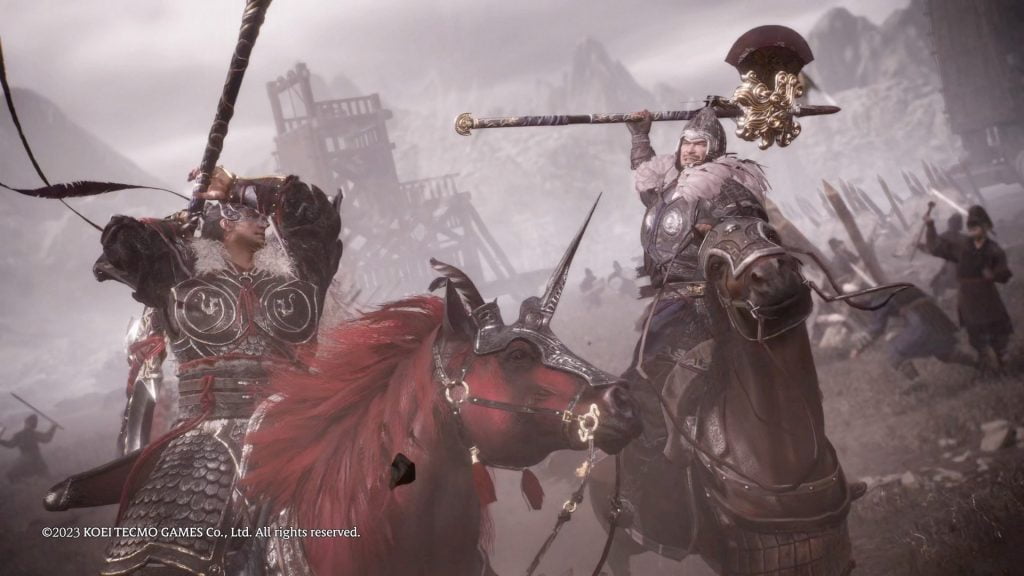
But at least the cast of characters, many of the legendary figures (or Dynasty Warriors characters- depending on how you want to look at it) are here and they look great in their big armour sets and weaponry. And for extra authenticity, the game has Chinese voice-overs as well.
The music also feels too dire and muddled in the background on most levels. Again, it’s due to the wartime theme. There are hints of memorable melodies here and there, when no one is shouting and crossing swords. The village theme in the early parts of the game is great at evoking a sense of tranquillity you get from the safety of a hub world, away from the bloodshed of war and power struggles. The war march anthem that exists when you open the travel menu is also great. The rest of the soundtrack? Your mileage may vary, and for me, they don’t register as well.
On the PS5, the performance mode is great at maintaining a stable framerate at around 60fps or so, at the cost of visibly low-res textures if you stop and stare at the scenery.
I’ve heard reports of Wo Long not doing as well performance-wise on PC, but at this rate, it’s a Koei Tecmo game staple for the PC version not being as optimised at launch. Hopefully, it does get better in the coming months.
Gameplay
In Wo Long: Fallen Dynasty, the Han Dynasty has fallen. In this take of the fabled Three Kingdoms saga, factions are warring for control of Elixirs that are able to harness the power of demonic Qi. You are some anonymous warrior that somehow got caught up in the war, and will be assisting the many other fabled figures during this era to not only win the war and bring back peace but uncover the mystery of this demonic force that has plagued the lands.
If you’ve played a Team Ninja soulslike before, you can expect the game structure to be familiar. In the fact that the levels are compartmentalized as levels and they are not as sprawling as other soulslikes out there. The pacing of the story is also old-school. Start a level, intro cutscene plays, gameplay, then a boss fight at the end, end-of-level cutscene plays, and rewards for completing the level drops.
I don’t mind the level structure being this rigid. But it could use a few more curveballs to keep players guessing a bit and not be numbed into monotony.
Team Ninja brings a different flavour to Wo Long when compared to either the typical FromSoft soulslikes or its own Nioh series. Wo Long’s design is based on momentum, on the micro-level and the macro-level.
On the micro-level, the combat system ditches the stamina bar for a Spirit Gauge, displayed in the lower center of the screen alongside your health bar. It behaves like the posture meter in Sekiro: Shadows Die Twice where you build meter by landing and deflecting hits. You can lose meter for taking hits, or you can use weapons kills, wizardry magic and spirit attacks that cost meter.
Essentially, the core combat revolves around landing solid strings of hits that build the Spirit meter, then cash out with a spirit attack ender. That’s your bread-and-butter combo. More often than not this offensive-heavy, gun-jumping, unga-bunga playstyle will carry you through most parts of the game (until it doesn’t). It’s supremely satisfying to go on a relentless assault, to go ham, to press square, square, square, square, square triangle repeatedly. You don’t get to do much of that in a soulslike where the tradition is methodical play. But Wo Long lets you let loose.
However, you’ll learn soon enough that mashing buttons, as fun and as consistent as it may be, isn’t the only way to play. In fact, you have to learn the other way to play, and that is the methodical approach like any soulslike. But with a twist.
In Wo Long, you can deflect attacks. It’s a parry in all but name. But Wo Long’s parry not only lets you block physical attacks, it can also deflect any attack. Yes, that means projectiles and magic attacks can be parried as well. The timing is tight but consistent, and if you somehow decide to parry a long-ass string of quick hits, you can if you’re good enough. Get that rush of pulling a sort-of Daigo parry or your own Evo Moment 37, you legends with your excellent hand-eye coordination.
Parries can also deflect Critical Blows, the red-glowing unblockable attacks that can do massive damage. Get the timing right, and you’ll turn the tides, get the momentum with loads of Spirit meter, and take your turn in the fight.
Parries are so important in Wo Long that all the tutorial bits the game teach you are the importance of deflects, to the point that it neglects the guard button. A traditional block is available as well, it guards all damage but that cost of losing Spirit meter. If the Spirit meter is full on the negative side, you’ll be staggered and open to damage. Enemies also can be staggered this way too. So you can opt to not go unga-bunga and play patiently, parries only. Once staggered you can pull off an unblockable attack on enemies that guarantees massive damage, if they don’t die on hit.
There will be hard instances (read: boss fights) where Wo Long changes gears and ask, no, demand you to play patiently and parry. The game just wants you to parry all the time, parry all the time, parry all the time like Eddie Murphy once sang (Editor’s Note: that’s “party” not “parry”). If you don’t parry, and don’t know how to parry, you have to figure it out. Or you’ll be facing what seems to be an impossible battle as these specific bosses will heavily punish you for not knowing how to parry.
There’s a specific timing to parry Critical Blows- a little sound effect and a glowing glint of red should be your guiding stars. And certain weapons makes the parry window more lenient than others. And you can in a way spam the parry button, so it’s easier to nail the timing than you would first expect.
On the macro scale, the momentum-based design in Wo Long is manifested in the way the Morale system works. You begin each level at Morale Rank 0. Enemies can have different Morale Ranks and the higher it gets relative to your Morale Rank, the stronger they are. It affects damage scaling more or less. Enemies at higher levels than you hit harder and more tanky.
You can raise your Morale Rank in two ways. One is the obvious: slay the enemies. As you continue to take down foes, you build up portions of the rank until you rank up. And if you manage to defeat enemies with higher ranks than yours, you’ll get to rank up faster. So, if you can keep the momentum going, not dying, and making others dead, you’ll be snowballing to the max rank of 25 in no time. Keep in mind that morale rank can drop if you get hit by Critical Blows (more incentives to get them parries right), taking damage and of course, if you end up dying. Dying resets the morale rank to your Fortitude Rank, which is your base Morale Rank essentially.
That’s the other way to keep Morale Rank up, by increasing the Fortitude Rank. This is done by exploring the map and raising your battle flags. The major ones act as your campfire/shrine equivalent where you can rest, reset all the enemies, level up and many other functions. The minor ones are rewards for exploring the map. The max Fortitude Rank will usually cap at 20 if you raise all the flags, and usually, the end-of-level boss will have a Morale Rank of 20, so it’s worth exploring, taking the scenic route and getting stronger.
The momentum-based gameplay, both on the micro and macro level, is an interesting experience. It gives this adrenaline rush of maintaining a good streak, because the consequences of messing up will be losing all the snowball momentum you had going and the game starts becoming difficult again. It will always ramp up and down like that at the start of every level. Dying too many times by mooks when you’re rank 0, and moving on up until you’re just styling on everyone by mashing buttons and nailing the parries. Die and the cycle starts anew.
It’s an interesting idea that moves away from the soulslike conventions and makes Wo Long’s flavour of “masocore” distinct. The stakes at play are less about getting back the souls you drop (which still is a factor in some ways), but hoping you can keep the momentum high so that you can just roll on the boss at the end of the level without sweating.
Because if you don’t, immediately repeating the boss with lower Morale Rank will make the encounter ever more so difficult, and you have to do laps around the map taking down enemies (or get around to raise all the battle flags) to get back where you left off.
In a way, Wo Long: Fallen Dynasty is relatively “easy”. Keeping morale high and playing a bit safe is how I, who never played a soulslike game until the end, managed to blaze through Wo Long’s many levels. It’s because I use the game’s version of an easy mode.
Another way Wo Long can be relatively easy (the word “relatively” is key here- it’s easier compared to other soulslike I tried, but not to say it’s easy in general) is NPC companions. If you don’t want to summon friends of other players via online co-op, you can have the many Dynasty Warriors of the Three Kingdoms join forces with you, just Like Stranger Of Paradise. The AI of the companions can be a bit stupid at times, but if you need another character to draw aggro and chip a bit of an enemy’s health, they’re good enough.
The gameplay is exceedingly tight, with about 13 different weapon types that have different move sets. Even if you don’t use them all, you’ll encounter them all from enemies using them. Combat is fast-paced, hectic, and aggressive. The only bit I still find issues is with item usage. The animation for healing using the healing item is significantly shorter than from the early demo (it’s great that Team Ninja takes fan feedback into account). What I find to be a problem is the item usage button not triggering when you use too quickly after taking a big hit. The window of “character is getting back up animation where no input is registered” to “you have full control of the character” I find to be a bit nebulous. So there are many times when I thought I have hit the button to heal only not to heal and remain stationary for no good reason. Maybe it’s a skill issue, but I find that the only problem I had was with the combat.
The exploration and traversal aspects are a bit too loose. The jumps are wonky that they don’t feel like it can reach high places when in reality they could. It lacks the air control that makes jumps in jump-focused games like platformers feel good. The level design is just okay. The levels are all self-contained and are actually small and concise when you just run around them without care. The trickery and trolling aren’t as deviously naughty as how the folks at FromSoft do them. Which also contributes Wo Long being relatively easy.
The whole loot and menu system is a mess though. It’s hard to find the right menu to mark an item be your favourite. You get way too much loot which makes managing them and finding the ones to keep or sell/salvage cumbersome. The default sort is terrible. And there are way, way too many RPG stats and passives to wrap your head around and the bonuses don’t seem significant. I barely change the jewellery passives (mostly because figuring out why a passive cannot be selected wasn’t communicated clearly- apparently you have to match the shape of the slots). Loot and RPG stats can be cool, but the way Wo Long does it seems to make it feel trivial and not fun.
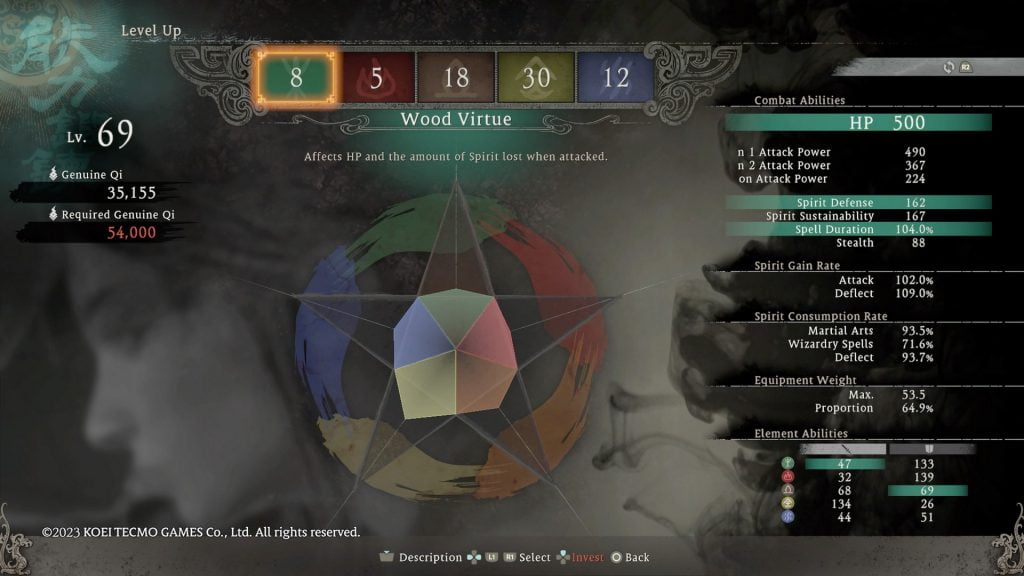
The stats are interesting though. Wo Long ditches the usual RPG character stats like Strength and Dexterity and substitutes them for the Five Phases, to further follow the ancient China theming. Each of the Five Phases (Wood, Fire, Earth, Metal, Water) governs two major stats as well as providing elemental bonuses to attacks and defence. It’s a clever use of lore and history, and will definitely have soulslike veterans to think a bit rather than beeline the usual stat to dump points to. You can respec later on at no cost, gear has no stat requirements but weapons have specific elements they scale their damage output to.
Wo Long: Fallen Dynasty can be tight in places and loose in others. It can be too easy at times and then swing to become too hard. But overall, its flaws aren’t to the detriment of the overall player experience. That combat system is fun when you get the hang of it, and ultimately what makes this game really good.
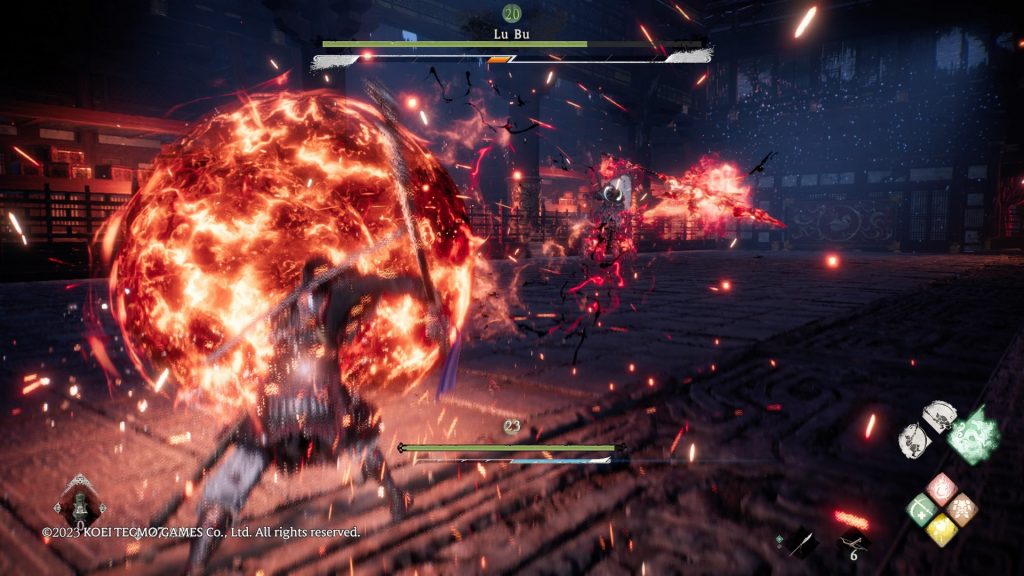
Look, you can parry fireballs back and forth like you’re playing ping pong. With oversized fireballs of doom. It’s wicked.
Content
I’ve finished the main campaign of Wo Long: Fallen Dynasty right at the 30-hour mark. The playtime is extended from retrying boss battles multiple times (LU BU!). So it’s not a long sprawling RPG. In fact, it’s more bite-sized given how the game is structured into separate, rigid levels. There are 16 main levels.
There are more side quest levels if you want to keep playing Wo Long for longer. And after the credits roll, you’ll unlock a higher difficulty setting in case you’re a masochist to the core.
The story is what it is, it spins a bit of the Three Kingdoms saga to weave in the demons bit. But you can expect the warriors to talk, argue, and get emotional in various ways. And you’re there to bear witness to it all.
Personal Enjoyment
I never played a soulslike until the end. I dabbled with them, I currently still playing Elden Ring for instance, and before this year, I never really want to play a soulslike. Wo Long: Fallen Dynasty somehow clicks with me. It showed me that there is a power fantasy in this masochist paradise (and a nightmare to some others. What do you mean you play hard games for fun?)
The story is just there for me, maybe because I’m not caught up with the Three Kingdoms lore. But exploring the winding paths, mashing buttons on the demons and soldiers, and remembering to hit the parry button at the same exact moment every time, is satisfyingly fun.
The moment-to-moment gameplay grips me hard. And only that bit only. The rest of the package is okay.
Verdict
Wo Long: Fallen Dynasty brings a fresh new flavour into the soulslikes action-RPG mix. Its brand of fast-paced combat with a major focus on parrying, and its momentum-based gameplay that tethers between being easy and hard is a challenging but rewarding experience. Its levels may be small and its loot system too busy, but at its core is truly a game fans of the genre should give a shot.
Played on PS5. Review copy provided by the publisher.
Wo Long: Fallen Dynasty
Wo Long: Fallen Dynasty brings a fresh new flavour into the soulslikes action-RPG mix. Its brand of fast-paced combat with a major focus on parrying, and its momentum-based gameplay that tethers between being easy and hard is a challenging but rewarding experience. Its levels may be small and its loot system too busy, but at its core is truly a game fans of the genre should give a shot.
- Presentation 7
- Gameplay 9
- Content 7.5
- Personal Enjoyment 9