

The narrative that captures our hearts and minds delivered in video game form
The nominees for the David Cage Award for Best Story are:
- Cyberpunk 2077
- Final Fantasy 7 Remake
- Frog Fractions: Game of the Decade Edition
- Watch Dogs: Legion
- Yakuza: Like A Dragon
Deliberation Summary
Despite the namesake, we are unironically awarding well-written or well-written stories the GM crew enjoy the most this year, or stories deserving of a highlight.
The deliberation as documented in the podcast goes into spoilers– so be warned. However, this summary will keep it spoiler-free.
Two of these contenders bring wild twists that for us, makes it brilliant. Frog Fractions: Game Of The Decade Edition asks you if an iconic hat is worth paying for. And brilliantly, the answer to that is a yes. The developers of this educational game about frogs learning fractions and maths have learned some hard lessons, and the Hop Iconic Hat DLC is a great introspective look of Frog Fractions, as well as them finding their mojo again since the original Flash game a decade ago.
The other is Final Fantasy VII Remake. The story is faithful to the Midgar portion of the original JRPG- but to a point. The twist is a bit blatant- hence the polarising response from fans in this regard- but it’s setting up for the next part of this game to go in different ways.
As seen before, cyberpunk themes are rated highly this year. Two of the other nominees, Watch Dogs: Legion and Cyberpunk 2077 are prime cyberpunk stories. And surprisingly explores similar plot points. Watch Dogs finally walked the line of the super-serious first game and the jolly-fun second entry, with a plot that has room for cheeky fun but a strong plot with stakes at play. Cyberpunk 2077’s story is, for better or worse, a cyberpunk story. It hits all the hallmarks of the theme, but as a result, can feel rather trope-y. Yes, most of us have seen the main plot to completion for this deliberation.
(Note: Final Fantasy VII Remake is technically also a cyberpunk story- something we totally forgot to bring up during the deliberation)
What we all agreed on, however, is after a long spoiler talk about one cutscene in Yakuza: Like A Dragon. It’s a scene in Chapter 3 that started as a silly gag, then leads to a revelation of a new character, which then became a scene of arguing ideals, that wraps up with showing more of our hero Kasuga’s character, as well as developing the plot for the overarching story. Typical Yakuza story in a nutshell.
Like previous entries, Yakuza’s main plot is “a serious crime drama”. A serious, talk-heavy plot dump about the criminal underworld in Japan. In that regard, it’s business as usual and may not be as special. But what this entry brings more than ever is it’s empathetic lens it has cast of the world.
Like A Dragon explores the grey areas of society and the flawed nature of looking at man-made laws in a black-and-white manner. It humanises homeless folks and illegal immigrants, and shows how authorities can be corrupted. But it also shows why folks either on the black or white side of the law – be it the politicians or the yakuza- choose to go grey. They may not necessarily doing it for self-greed (but it’s not wrong to assume so).
The important lesson from Ichiban Kasuga’s journey of being an ex-con literally down in the dumps, building a new life with new friends and later get entangle again in a serious crime drama, is that it’s important to listen to many different people. Even if it is lavishly long plot dumps.
Yakuza: Like A Dragon’s portrayal of a morally grey world around us is really moving- especially for us here. Seeing folks being overly angry against the presence of immigrant workers is a common thing here in Malaysia this year- and it hurts to see as such. Which is why we resonated so much on this story here compared to the other, also great nominees.
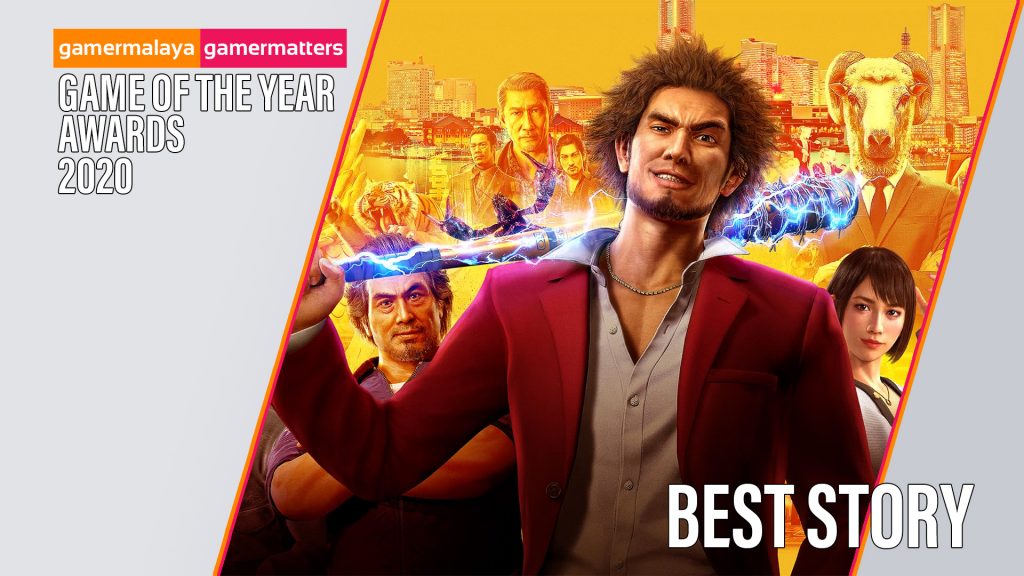
Congratulations to Yakuza: Like A Dragon, the winner of The David Cage Award for Best Story!
Tomorrow’s award reveal will be for the Most Surprising Game award.