

When Ninja Theory dropped Hellblade: Senua’s Sacrifice in 2017, it was lauded by many. An indie game with the production of a AAA blockbuster. A gripping story that tackles the surreal yet grounded in historical facts and real psychology science. It’s the best game the UK developers have ever made, previously known for their okay-ish character action titles like DMC: Devil May Cry (the reboot for Capcom’s stylish character action game that spits on its legacy to the chagrin of its fans) and Enslaved: Journey To The West.
People were arguing how long a video game should be- as the game was famously known to run for under 10 hours.
Ninja Theory was then scooped by Xbox to be a first-party studio. The team that previously made the PlayStation exclusive Heavenly Sword is now making Hellblade as an Xbox exclusive. Someone probably didn’t like the idea of writers making “from heaven to hell”, as the series is technically now referred to as Senua’s Saga.
The acquisition is a big deal. Xbox now has a tentpole developer to make their cinematic blockbuster exclusives. It’s such a big deal that Senua’s Sage Hellblade II was the first game revealed coming to the Xbox Series X when that console was announced. That was in 2019.
And here we are in 2024, Senua’s Saga Hellblade II is now out. And it just… came and went? This review is over a month later from release, and at this time, the gaming community has more or less moved on with Hellblade II with nary a discourse or huge raving word of mouth like the original was. It doesn’t help that Xbox’s goodwill is at a new low after it closed down four studios from Bethesda.
After playing, more or less, the game myself, I can safely say that Ninja Theory went all-out with this sequel. But unlike the original, the stars just didn’t align to catch that zeitgeist, as gamers have seemed to move on from this style of game.
Presentation
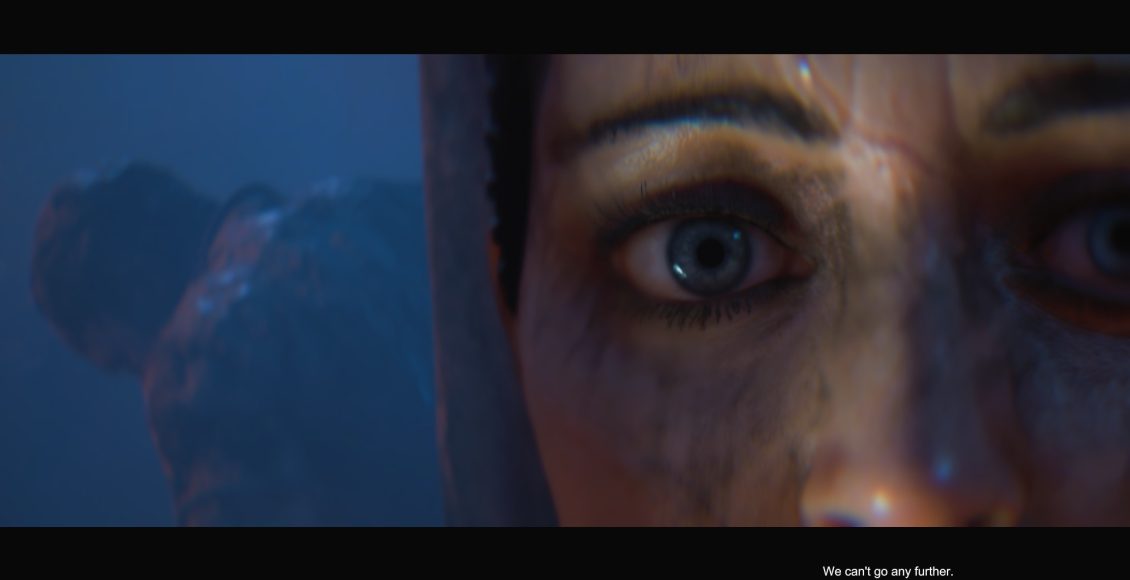
Even at low settings on PC, Senua’s Saga Hellblade II looks unreal. It is powered by Unreal Engine, pushing photorealism and just about avoids the uncanny valley. Senua and the handful of characters feel life-like, not only due to how they look and sound, but also the way they move and act. The performance capture here really sells the life-like cinematography this game is going after.
Speaking of cinematography, Hellblade II permanently has horizontal black bars to emulate that cinema feel. And the game has seamless loading with no cuts of the camera (assuming you didn’t reach a game over state). Very cinematic AAA game. It’s like God Of War (2018) but with the gameplay stripped out to its bare essentials. Or if The Order 1886 was good in selling that cinematic blockbuster experience.
The audio is of course the star of the show. Senua’s mental condition means she can hear “the furies”, two voices in her head talking over everything, sometimes motivating her, sometimes deriding her, sometimes performing some backseat gaming for your benefit. The game uses 3D audio to its potential by having soft voices fading in and out and around the headphones to really unsettle you.
And that’s the keyword about Hellblade II. It’s unsettling. There’s horror elements and gore, but it’s not scary like a survival horror game. And it’s not disturbing via excessive violence. But it’s unsettling because the game has the ability to suck you into an immersive experience where all of the sensations Senua see, hear, and even smell, can be impart to the player.
There are supernatural elements in this game, we’re talking of gods and giants of Nordic folklore and mythology here. And because of so many elements this game is grounded to reality- the way it looks, sounds and play- it makes the supernatural stuff feel real, and that in part makes this quite an unsettling experience for me. I got genuine goosebumps from going through this ordeal.
Also, the game makes use of no HUD. Everything you need to know when it comes to gameplay interactions are communicated diegetically. And that includes drabs of white paint on traveral-able points, glowing attacks, and a glowing mirror where a special resource bar can be displayed without breaking immersion.
Presentation-wise, Hellblade II is top-notch. The graphics, audio and actor performance are peak.
Gameplay
Senua’s Saga Hellblade II continues the story of the first game. A long recap of the previous game opens before you find our leading lass, Senua, tied up on a slaver boat. She washes ashore on a new land, modern day Iceland which the locals call Midgard. And from here, our warrior who has some form of psychosis, continues her saga.
The gameplay of Hellblade II, like the original game, sure takes the back seat. If someone would deconstruct this game, they will be surprised to find out how little gameplay it has surmounts to a theme park ride.
And it is. It’s basic. Standard. You walk around. See the sights. And then suddenly you are stopped by either a perspective puzzle (where you have to keep walking around to find the right angle where shapes would align) or a sequence of fights. The fights are one-on-one affairs with some DNA of Ninja Theory’s past character action history. But it’s pretty straightforward.
I think many folks these days have seen through the facade and broke their own illusion of the so-called theme park ride if they say the gameplay of Senua’s Saga is basic. It’s true. There’s no upgrade system. No extra mechanics. Collectibles are sort-of there but if you don’t know what to look for there’s no reason to other than for the achievements. And walking, even running, feels laborious. And so many parts of the game has the usual gameplay cliches of walking through a narrow thing to disguise loading or to transition into a cinematic moment.
But I look at this the other way. The simple gameplay aspects it has are all in service to the immersive, cinematic experience. It’s a movie where there are bit you do get to play and the bits you get to play are not rudimentary quick-time-events, but competent combat. And maybe laborious puzzles. But even then, the puzzles being as they are does reflect Senua’s inner struggles. I buy it.
And should you decide to keep the keyfabe on and just experience it for what it is, Hellblade II sure is an intense cinema.
The pacing is a bit all over the place- a lot of plodding around and walk-and-talks before the action ramps up. If you don’t care about the story, these are just long, long walks through admittedly beautiful scenery.
The action moments however are excellently built up, sometimes catching you off-guard though usually it serves as a climax to particular story beats. Fights seamlessly start and end and continue.
There’s a lot of cinema magic to make you not see the combat fights as video game-esque fights where a new wave of encounter is announced proudly in most character action games. It just flows. Whether playing well by timing the parries and dodges or currently struggle and just button mashing through it, the combat feels visceral and weighty. Maybe it’s the way Senua screams and ruthlessly swings her sword. Maybe it’s the little video game-esque hit-stop when you block, parry or land a hit. Maybe it’s the juxtaposition of those walking and puzzle sections that makes this ramp in intensity such a thrill. Maybe it’s all of them and more, that makes these combat encounters great. Even if they are, mechanically, basic.
Content
Senua’s Saga Hellblade II is a short game, under 10 hours long. Most can complete in just six hours.
But this is the sort of game where you wouldn’t even want it to be stretched out for long. It has simple gameplay, there’s not much you can work with it before it gets stale.
And it’s for the best this game is at this length. I really had to catch my breath after every chapter. There’s a lot going on. The voices in your head, the unnerving, unsettling scenes you have to go through where things can be real or surreal. My senses feel overloaded by the experience that I simply cannot play this in one sitting. I appreciate that it’s going for the short-but-intense kind of experience. It’s more “one concentrated shot of espresso” than “a Venti-size serving of Americano”.
The story is fascinating and elegantly told but it’s not a compelling argument to get this game for. It relies so much on the walk-and-talk to drive the plot forward. Though it does have thrilling cinematic set-pieces.
I don’t think the story is a good enough hook to entice players to play this. It doesn’t help that this just feels like something that we either have seen in a video game (there’s another particular active game series where the plot revolves an outsider interacting with Norse lore). And while the portrayal of Senua’s mental condition was remarkable seven years ago, it doesn’t seem as novel the second time around.
Personal Enjoyment
I didn’t play the original Hellblade. I had no intention of doing so. But I remember vividly how everyone I know and the world at large was raving for that game. Look at this indie team being able to do AAA blockbuster (in a reasonable scale)! Finally, this team got their big break! They’re getting full backing as a first-party studio now? Well deserved! And I too cheer with the crowd on the sidelines, as a non-Hellblade player.
So much has happen seven years later, huh?
As someone who don’t watch enough movies or TV, I mostly enjoyed the experience of playing Senua’s Saga Hellblade II. Though I wouldn’t say I had “fun”, I don’t think the aim for this game was to make a really strong gameplay hook. But rather, it’s to tell a specific story and experience only the medium of video games are able to. Even if it does lean heavily on cinema as its guiding light.
This is the sort of game that’s out of my wheelhouse, yet I do find some value out of it. Though I don’t think I would be excited for the next game in this series to come out being just this format again. If Senua’s Saga is to continue, it needs some fresh ideas to pique my interest again.
Because to me, the unnerving experience in Hellblade II feels vapid. It didn’t leave a strong impression in me once I’m done playing. It has its moments, and the devs clearly put their soul into this avant-garde project. But painfully it just didn’t resonate with me as much. This is a “it’s not you, it’s me” thing. It’s not my cup of tea. Or to use a modern Malay phrase of speech: this doesn’t hit my soul.
Verdict
Senua’s Saga Hellblade II delivers in being an intense cinematic experience that few other games can match. And it does so at the cost of being a video game that most people would play.
Now not an indie darling anymore, it’s a shame this game isn’t as highly raved like the original, as Hellblade II definitely refined that experience evermoreso. The world has changed so much seven years later, and the appeal of another Hellblade has significantly diminished.
For those that has an Xbox Game Pass or PC Game Pass subscription, it’s definitely worth checking out. It’s uniquely an experience that can thrive on Game Pass.
If you’re looking for a different gaming experience, one that leans more on story and atmosphere with leaner and more focused gameplay, you might be surprised by Senua’s Saga Hellblade II. For those that have played Hellblade, this is more of that. For better or worse.
Played on PC. Review copy provided by the publisher
Senua's Saga Hellblade II
If you're looking for a different gaming experience, one that leans more on story and atmosphere with leaner and more focused gameplay, you might be surprised by Senua's Saga Hellblade II. For those that have played Hellblade, well this is more of that. For better or worse.
- Presentation 10
- Gameplay 7
- Content 7.5
- Personal Enjoyment 7