

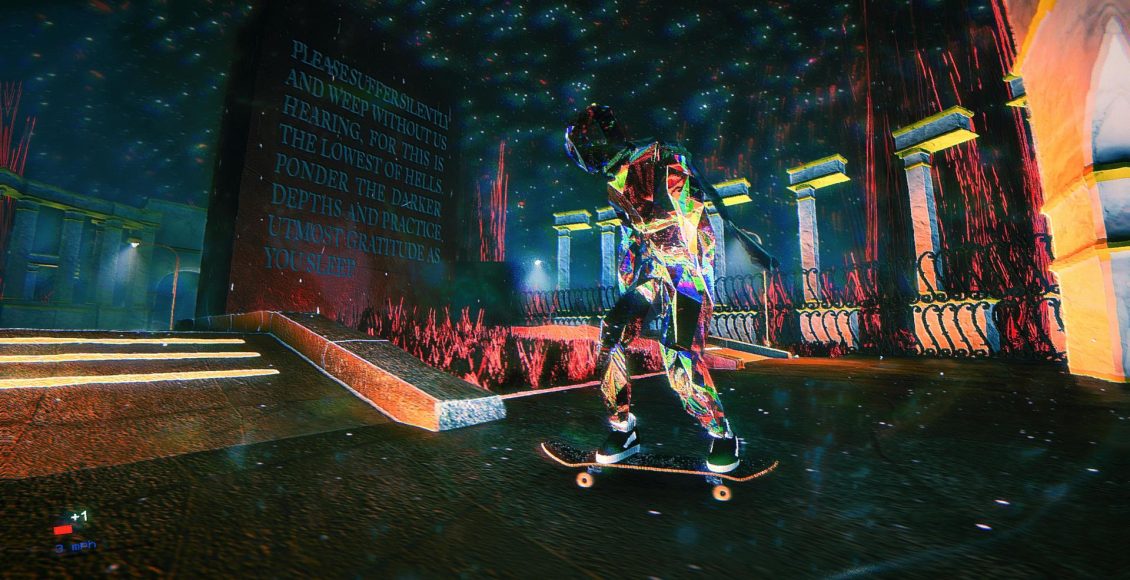
Skate Story has one of the coolest one-sentence elevator pitch. “You are a demon made of glass and pain and yet you must skate.” That’s enough to built intrigue for anyone to check out an indie skateboarding game. But it has more than just that.
Skate Story, this video game primarily developed by Sam Eng (with support of various contributors from music to localisation and QA) is a work of art, one with a strong auteurial vision. It’s an avant-garde story of a New York City-shaped Underworld filled with the prose of a starving poet, yet it’s also paired with one of the most intimate and authentic portrayals of skateboarding in a video game.
You have to play this game. Let me try and convince you.

Presentation
Skate Story is both an ethereal limbo where souls are eternally damned to a pastiche of NYC, permanent scaffoldings in front building facades and all, but also a celebration of the fine elements of skateboarding culture.
Yeah, it’s odd to say the latter as here you are playing as a demon made of glass and pain but have you seen the kicks the Skater rocks? The fever dream of the world makes perfect pairing with the visual cornerstone of skateboarding media: fish-eye camera down low with copious amount of chromatic aberration. The bleeding colour effects gamers frantically turn off when an option appears in the settings is pretty much welcome here. It adds to the trippiness of the Underworld.
And it takes a person of a good sense of taste to really pull off Skate Story’s seemingly simple aesthetic. The whole game for the most part just uses that one same font, but they appear gritty and textured that gives both a counter-culture feel which skateboarders ride or die by, but also that unnerving spookiness of a semi-horror theme and enough authority that it fits those “noun-verbed” effect as made prevalent by Demon’s Souls and Dark Souls. The font is even used as literal texture maps for floors. It’s that gritty and textured.

Similarly, the music done by NYC-based outfit Blood Cultures can be both hauntingly eerie, serenely calming, and even both at the same time. The great use of synths, breakbeat-style drumming, and chill/chilling vocals really brings out the world of Skate Story to life. They dropped a whole album’s worth of a soundtrack. You know those jokes about a new Mick Gordon album happened to drop with a sick game? Likewise, Blood Cultures fans got a new game to pair with their latest record.
It also helps that the little sound effects from skateboarding really pops. The sound those four little plastic wheels make when they roll, the subtle note changes as you gain speed, the way the skateboard pops when you pop a pop shuvit. The sounds you’d expect from a real skateboard ridden by a skateboarder who knows how to skate are all there.
All of these are enough to excuse Skate Story’s lack of voice acting. It doesn’t need it, for reasons I explain in a bit.
The graphics may seem simple, but it can appear busy. Particle effects and light flashes frequently fill the screen on high intensity segments of the game, which can be a bit overwhelming. But at least on PS5, the framerate remains steady even at high loads so the game runs smooth in that regard.
The surreal world of Skate Story, and the real skateboarding it portrays are all well done here. It’s a fresh new aesthetic to have graced the world of video games.

Gameplay
It’s already explained earlier what Skate Story is about. But what does it really entail? So, none of this will make sense but just roll with it. You, the demon that will be dubbed as the Skater, signed a deal with the Devil to eat seven moons so that your soul will then be free. The contract is binding in that the Skater wears it as a scarf. And off you go to find those moons and consume them. By skating.
Okay but what do you actually do in Skate Story? A lot of skating, obviously. But that’s the best part.
Skate Story doesn’t play exactly like any other established skateboarding games. In the Tony Hawk games, skateboarding is an arcade experience—press a face button and a direction and some complicated move just appears. The Skate series leans closer to be a skateboarding sim with the stick-flicking—flick the analog stick in a certain direction, sometimes a chain of multiple flicks, and you can perform the flip tricks which those flicks approximate.
Skate Story shifts the paradigm of how you control a skater in a skateboarding game in that it doesn’t follow either of the big skating games. The triggers and bumpers adjust the footing, the stance, of the Skater. And you have to time the jumps, where the timing for each trick are all different.
By doing this, pulling flip tricks in Skate Story feels more intentful compared to other skateboarding control schemes. You need to commit to a trick, not just preload the jump and press button/flick the stick mid-air in some random direction to get a trick out. No, you want a kickflip, you have to enter the stance first. Every trick’s timing is a little different so if you want to optimally pop you need to judge your current speed and get into position at the right time and hope that you get the perfect timing just as you ollie at the edge of a ramp. It’s tricky to get used to, like any new thing, but Skate Story gently nudges you into discovering other ways on how to do tricks so it never feels overwhelming.
And with the unique control scheme, Skate Story gets to do one thing skateboarding games can rarely do, have experienced players learn something from zero and learn how to skate again. Some of the more advanced tricks are not something you can mash buttons and have it appear well ahead from the tutorial. But they’re there.
The option to do a Nollie is always there, but you need to know how to lean forward to the nose (naturally, by pressing up on the d-pad) so you can pop a nose ollie. Advanced tricks requires you to adjust the footing multiple times before popping, and some of the foot stance changes cancel off each other (Hitting L2 and R2, to enter the heelflip and kickflip stance respectively, cancels out each other, as these are two opposing tricks where you longitudinally flip the skateboard in two opposing directions).

You’re not a skateboarding god like you’re in Tony Hawk, pulling 100+ combos with 1 million points as you infinitely grind and manual the whole map doing multiple laps. It’s much closer to Skate (maybe the OG Skate, before things get too wacky) where performing a kickflip over a small hump is already a feat. Heck it’s closer to real skateboarding, as the main enemies in Skate Story are uneven kerbs where you must ollie over or be shattered into a million shards of glass where you then immediately respawn and skate again.
The coolest thing you can do in Skate Story is subdued, grounded, street skating.
And I love that it does this.
As someone who don’t skate but always infatuated by the sport, it never dawned on me how impressive real skateboarding is and how video games have power scaled the level of impressiveness that I didn’t appreciate how hard it is do a simple ollie until now.

Recently, I’ve been watching Kasso, a game show where pro skateboarders from Japan and around the world compete in ridiculous obstacle challenges (it’s Takeshi’s Castle for skateboarders). The first challenge is just a downhill course with some jumps, obstacles and turning. It looks sketchy as all hell and these men and women keep on pumping speed and just hang on is an amazing feat! Especially when you do see some that couldn’t hold on and got their face on the asphalt.
The best parts of Skate Story is when it indirectly makes you feel like you’re going through a Kasso’s downhill jam, where you just barrelling downwards at an average speed of 27mph (about 43 km/h) down some linear but tricky path, praying that you can spot any uneven kerbing so you can ollie over in time, and hope that you have enough room to powerslide if there’s a sharp turn ahead. It’s exhilarating when you can feel the speed, and more importantly, its imminent danger.
Skate Story successfully communicated to me how skateboarding like this is, despite what other video games may have depict, an act that defies all sense. No mere mortals should dare do this. Yet you are a demon, made of glass and pain, and you must skate. And skating can be scary.
In most of the levels, you do get some chill time to just skate around the unique hubs available. Most of the geometry of the Underworld are built for street skateboarding so you’ll find a lot of low-risers, ramps, fun boxes and rails littered around the Underworld. Place a session marker, create your own line, pull of your own combo. Chill and get your groove on.

But there is, surprisingly, combat. And it’s all expressed through skateboarding.
Skate Story also takes a more lenient approach to what counts as a combo. You don’t need to immediately be on a manual or reverting after hopping of a grind to keep the combo going. There’s a generous timer that allows you some leeway, enough to get some pumps in and build back speed as some tricks do slow you down dramatically. But you also continue to build a score even if you drop the combo. You only cash out that score when you stomp, declaring a combo ender.
That’s how you do damage against enemies (the “fuss” because any anti-establishment movement should believe in 1312 also it’s good wordplay, the nerve those fussy beings disrupting you skating) and also bosses. Build a your combo and cash it out. The trick is that some enemies can only be damaged when you’re at a particular highlighted spot. A spotlight, rather. And no, you can’t just build a 2 million combo and expect to insta-win when you call the ender in. Bosses have segmented health bars to avoid one-combo-hit-kills, so you need to constantly pull combos rather than get on big juicy one. All that while under a time limit. And that’s also not counting whatever gimmick the boss might have, which they do have plenty.
The skateboarding aspects in Skate Story is absolutely mint. The linear downhill jam sequences, chill skating and tense boss fights makes perfect sense and works mostly well. Its use of a unique control scheme that makes players more aware of how skateboarders interact with the board to do tricks is an awesome feature to have.
The skateboarding can be a bit janky, though. I have seen my fair share of the Skater somehow ended up flat 90-degrees on the side of a fun box after missing what would have been a grind. But for the most part it works well! Well enough.

Content
Skate Story offers a 5+ hours journey into this abstract, surreal take on the Underworld. What if Dante’s Inferno is seen through the lense of a skateboarding New Yorker?
The story is both simple yet also fill with metaphors and allusions that may either go on top of most people’s heads. Or maybe it is just a simple story but people will try to find meaning when there isn’t any. But expect surreal turns and twists. From helping a bird find five-letter words across the map (no, it doesn’t spell out SKATE) to finding a subway pass inside some pile of garbage. It’s weird, but not in-your-face, shock value farming weird. Just weird. Or a more accurate term here, surreal, as mentioned previously.
But there’s weight to the story in Skate Story, carried by the quality of writing on display. The prose on all the dialogues and monologues has a good balance of poetic beauty and absurd punchlines. Those end-of-level screens has a beautiful summation of events, told in poems with the verbosity and uses of em dashes that distinguishably fleshmade. Coherent storytelling, yet vividly imaginative with its choice of words and sentence structure. It’s beautiful.
And can also be funny. With the writing being so intentful the sudden appearance of the word “smartphone” followed by a visual gag of a punchline is one of the jokes that got me good. Also, I know for some this is all too real and not a laughing matter, but “DEPORT THE DEMON” is a unexpectedly funny line to me. It’s something you don’t expect from a hellish setting. Apparently the Underworld is full of bureaucracy, which itself a good joke and commentary.
There are secrets to discover in Skate Story, but should you beeline through to the finish, it’s still a wonderful time spent seeing a visionary spinning their story thread into a tapestry. An odd-looking tapestry, but still one that you should see unfold yourself.
That said, the one final thing you need to do before rolling credits was really odd. The game has a habit of not signalling well enough when there’s nothing you can interact with right now, but that last hurdle was definitely not intuitive enough for me to figure out on my own. If I played this before guides were available I would have thought the game was bugged or I got the bad ending or something. The epilogue more than makes up from that one peculiar road bump, though.

Personal Enjoyment
Skate Story hooked me on that reveal trailer alone, so if anything, Skate Story can only disappoint me by how high my expectations are for it.
So I’m glad to say that it has cleared that bar. It popped just high enough.
There’s a lot that I love about Skate Story. From the choice of aesthetic to the commitment in only showcasing street skateboarding. From the love and respect to the skateboard culture to the sharp pokes and jabs of real concepts that would fit right in hell where it arguably should belong.
This is one of those games where I feel the people making it put some parts of themselves in the process and it comes across to the player. It feels like an intimate work of art. It feels like the creator is saying something, which may or may not get across into most people’s hearts and minds. But they’re brave enough to make something not for everyone, but a few someones out there that get it.
I came out of Skate Story feeling enrichen from experiencing it. In what manner, I can’t really describe it in full. I appreciate the finer details of skateboarding, something other video games have glossed over without really imparting how rad these flip tricks can be. I come to appreciate good writing, where the sparse, efficient use of words can be elevated with good prose. I also appreciate seeing a legendary anime reference out of seemingly nowhere. But it does more than just that to me, what exactly is something I still can’t grasp or articulate. Maybe I just vibe with this game hard at the end of it while others see it as some pretentious work.
As it is, I truly enjoyed what I’ve experienced out of Skate Story.

Verdict
Underneath its surreal visuals, Skate Story is an authentic depiction of skateboarding, portrayed in a way not seen before in video games. Its reverence to skateboarding and skateboarding culture is unwavering in this absurd journey into an NYC-ified version of hell.
Skate Story shows that you can portray the art of skateboarding beyond the normal confines of traditional counter-culture, it can be an absurdist tale of demons contractually obligated to skate. It can also be beyond the confines of the expected control schemes seen in established skateboard franchises. It may not match the scale and scope of the big skateboarding games out there, but it does so much more with so little.
Skate Story brings a paradigm shift to the skateboarding game genre, and along with it is a mesmerising aesthetic that will endure the test of time.
Played on PS5. Review copy acquired by the reviewer via PS Plus subscription.
Additional reading: check out our first impressions of Skate Story based on the demo here.
Skate Story
Underneath its surreal visuals, Skate Story is an authentic depiction of skateboarding, portrayed in a way not seen before in video games. Its reverence to skateboarding and skateboarding culture is unwavering in this absurd journey into an NYC-ified version of hell.
- Presentation 9
- Gameplay 8.5
- Content 8
- Personal Enjoyment 10