

Funcom has been around for so long that their legacy is largely attached to making MMORPGs. The Secret World. The Age Of Conan games. Their latest game, Dune: Awakening, is also initially labelled an MMO survival game, but the developers really, really want you to know that it’s actually an open world survival game.
What better statement to signal that Dune: Awakening is not an MMO by making multiplayer entirely optional.
I’ve spent 15 hours on a review build of Dune: Awakening on PS5, playing completely solo, and even more baffling, as someone who really haven’t engaged directly with the sci-fi world first penned by Frank Herbert and now a major blockbuster film series by Legendary Entertainment. This is a newcomer’s experience into the world of Dune, an alternative timeline that does not necessarily adapt word-by-word the events of its source material. And 15 hours is not enough to even get a glimpse of the endgame. So this isn’t a full review, that one’s coming later.
But I spent enough time alone in the desert to find that the game’s perfectly playable solo.

A Harsh, Ruthless, Cinematic World
One of the things I was completely caught off-guard at is how cinematic Dune: Awakening can be. The opening cutscene where Paul Atreides describes the alternative world where he didn’t exist and the scene right after creating the character where you are interrogated by having to put one hand in the box are just proper stuff. The right tone-setter to get things going.
The game loves to throw a lot of jargon, all those pseudo-Arabic names and phrases are probably key-jingling fanservice that the devs need to hit just to get fans of the series the assurance that they’re being faithful. But to me, it’s rather overwhelming.
The game expects you to be somewhat familiar with the source material. Funny enough, the game has the RPG staple of dialogue options where you can ask for a lore dump, and more often that not the people here on Arrakis look at you with scorn, sometimes dissing you for your ignorance before commencing the obligatory lore dumping sequence.
You know, what? Fair. I do wish more NPCs in games push back on player characters exhausting dialogue options for the sake of it. And this is the game that does it. Not all the time, but enough times that will make you not go auto-pilot when picking these options.
It’s not too hard to keep up with all the lore and story of Dune: Awakening, it’s just that it doesn’t want to handhold you like a baby and expect you to keep up with the pace of the fans that do.
I picked the option that gives you a guided hand, a tutorial essentially, that slowly walks you through the various tech unlocks as you figure out all of the survival mechanics. Water is hard to come by and you better stay hydrated. Don’t be out in the sun for too long or you’ll get a heat stroke and start dehydrated faster (in other words, cooked). Resources are need to craft just about everything from weapons and ammo to base building. All well and good. Your guide, Zantara, isn’t the friendliest voice, but he walks you through the game’s many systems.
Leaving You Hanging After The Tutorial
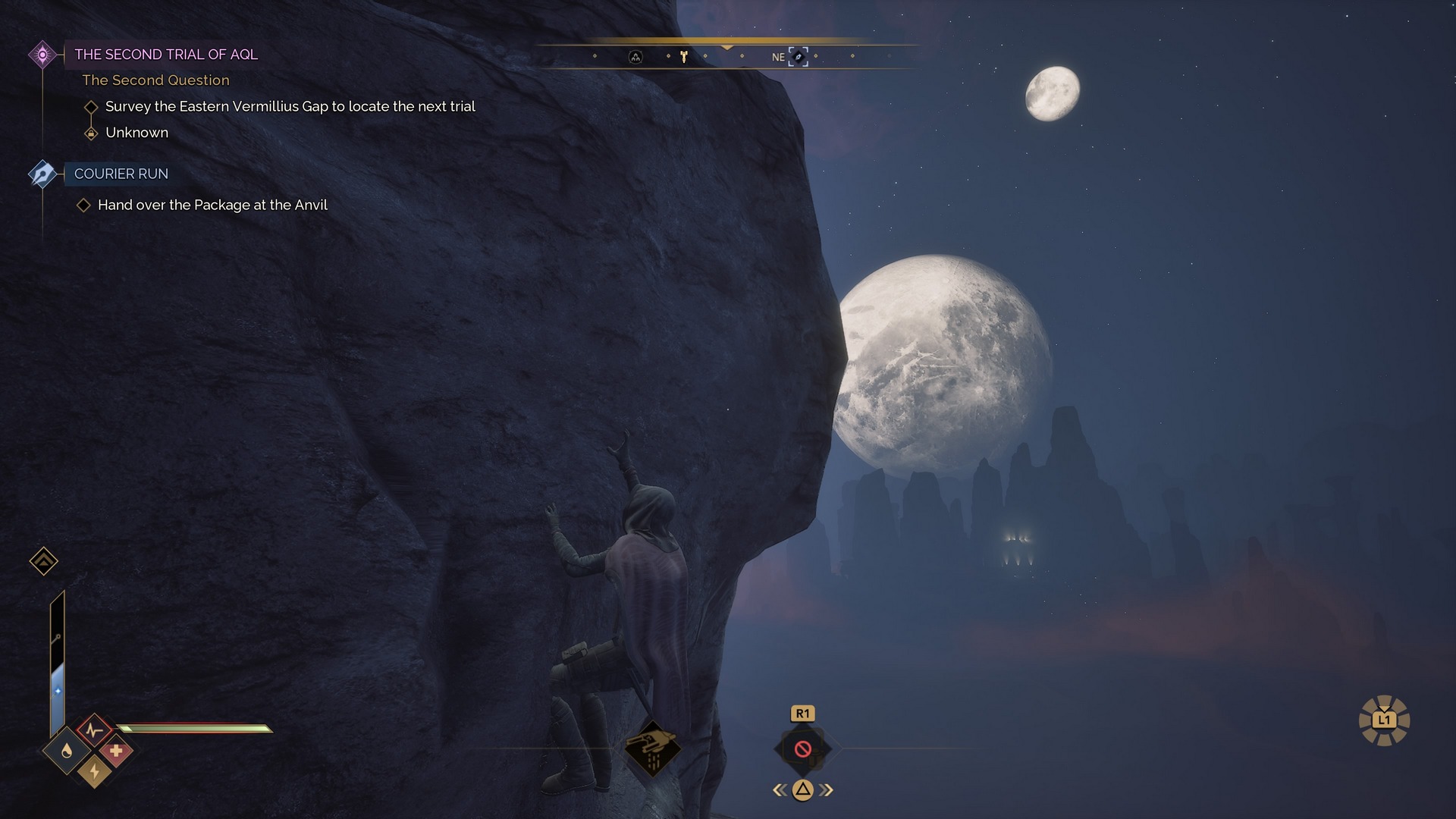
It’s the handover to the full experience that gt me a little lost. Once you make it past the South Hagga Basin and Zantara makes his dramatic exit, the tutorial stops and you have to actually interact with the Journey screen, which lists all your objectives to progress forward. But it’s from here on, you can really lose track of what’s progression and what’s not.
It’s so jarring, this transition. For the longest while I just blindly follow the quests, but now the quests that get auto-selected feel way more checklisty and less like a tutorial, even if it’s supposed to be introducing systems and mechanics as a tutorial. Take the quest that supposedly teaches you how to gather flour sand. I was completely lost in what to do as the game asks you to go to an open sand, when I was taught before that being on the open desert is a bad thing to do. It took me too long to discover how flour sand deposits look like, they do look really distinct now that I know what to look for but for the longest time I was led to believe that I need to scan the sands with the handheld scanner to reveal them (you don’t.) I was also given no assurance that how safe it is to do this, so I am just fumbling my inputs with the tool trying to get it trigger correct all while having the fear that I’m attracting the wrath of a god. It’s stressful, but in the wrong way: I should be stressed that I’m pushing my luck too much for gathering this long as the Shai-Hulud will sure pop up to eat me. But I’m stressed that I’m being put into a high-risk situation where I don’t know what I’m supposed to be doing! That’s less fun.
Once you acclimated with the Journey tab and how quests are presented, it makes some sense what’s progression and what you should just do whenever. There is one main questline to follow from here that is to keep following the trail of the Fremen and do all of the Trials of Aql (that’s your whole deal at the start—to track the Fremen that’s disappeared).
However, I found some quests that asks me to go to Arrakeen, which doesn’t seemed to be marked on the map at any place at all. As it goes, I just happen to stumble into it by talking to a ‘thopter pilot at a tradepost and saw the options to fly there. Apparently it’s a hub world that’s not connected to the main survival map in any way, to the point that all survival mechanics like thirst meter are suspended. Not having a quest of some sort to introduce this hub world might’ve been an oversight. Not introducing the concept of locations not located in the main map is also another oversight, I feel like.
Another silly thing I wish the tutorial would’ve hinted sooner is how I shouldn’t be carrying all the tools. I spent so much time rummaging through the inventory to swap between base building-related tools and weapons. Eight equippable slots are not enough, I figured. But once I figured out that I can just dump all the base-building related tools at the base, and only pick them up and equip when needed, there’s a lot less faffing about. Though if there’s a way to save and equip a specific loadout instead of having to manually slot in those items in and out of the quickbar, that would be nicer, but I’m speaking as someone who don’t play enough of these survival games or MMOs that uses hotbars, which would likely say this is just normal friction the genre provides. I’m too spoiled by Warframe’s infinitely scrolling equipment wheel.
The tutorial is good and all, but the transition into the full game is a little rough.
Decent Controller Support
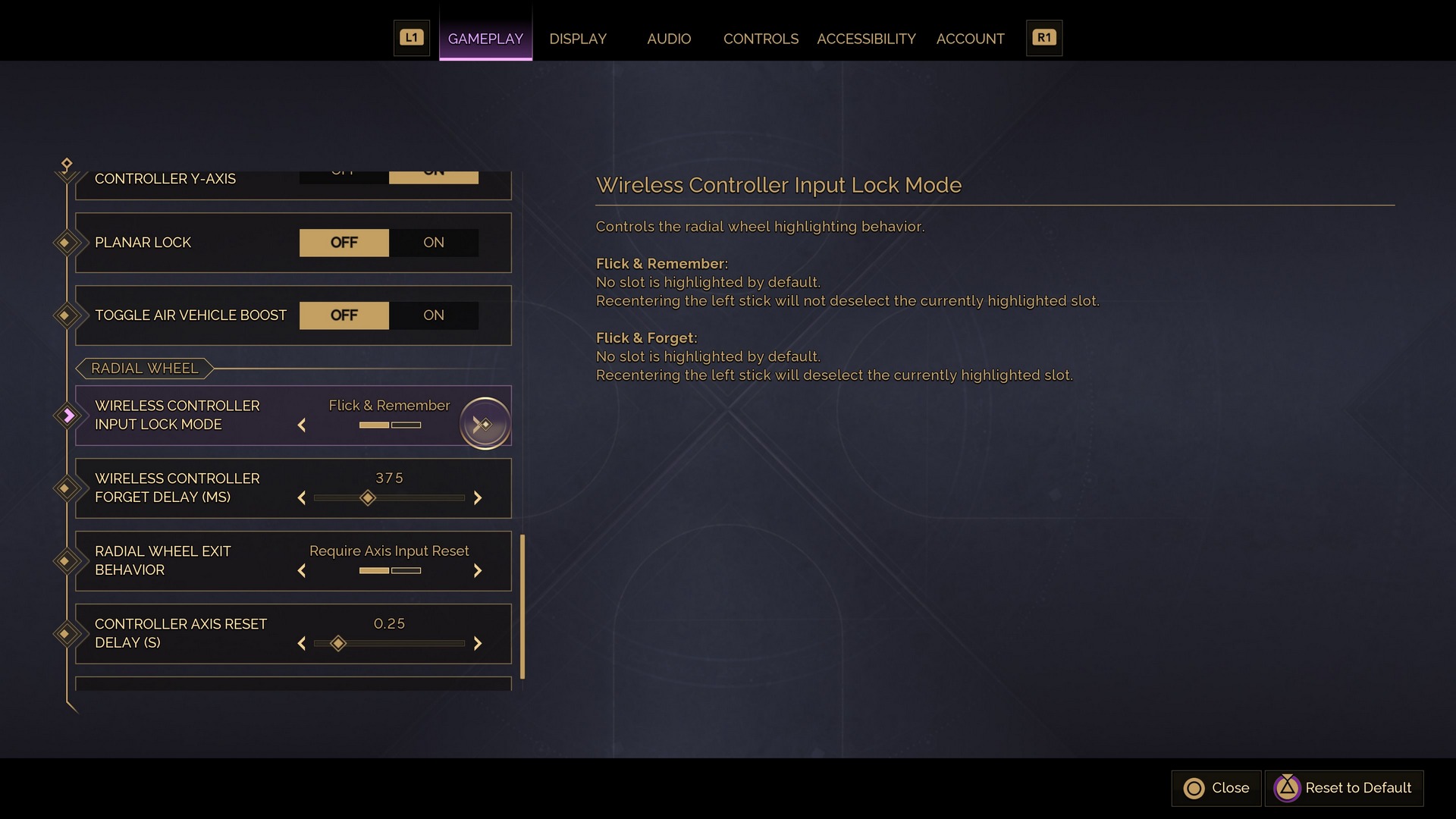
Speaking of the weapon wheel, I appreciate the effort in making playing Dune: Awakening on a controller a pleasant experience. While the UI is designed for mouse controls, a lot of it can be navigated by the D-pad and face buttons. You can opt to use the Destiny cursor as well, which doesn’t work as good for minor movements—it has a fixed movement speed, Destiny’s cursor slowly accelerates that makes it wieldy when you need to move the cursor just a smidge—but is very useable in most cases.
One particular option that fascinated me is the option to change how the equipment wheel confirms its selection. By default, you press L1 on the PS5 controller, then pick one of eight item corresponding the eight different segments on the wheel, let go of the stick then let go of L1. You can opt for different option where you must hold the stick direction and let go of L1 first to confirm. It’s very minor stuff, but the fact that some folks might prefer the weapon wheel confirm to be one way or the other, and having options to either, is something I have to applaud, even if I am more of a set-to-remember default kind of person.
Comfy, MMO-Like Soloing Experience
Dune: Awakening’s structure lends itself well as a single-player experience, in a way how MMOs can be played solo. Yes, the devs insisted that this isn’t an MMO, but there is still some MMO-style quest and dungeon designs here that has that theme park attraction feel to them.
Quests are of the checklist-ticking variety. You can go back to dungeons (the ones I encountered are abandoned test labs with oddly behaving people as enemies) over and over to farm for materials. It’s very comforting in a way. This is not to say all quests are brain dead—there’s at least one that called me out for just ticking the checklist and not paying attention.
But for the most part it operates in a way you can zone out, do the same thing again and again all while listening to the various radio stations you can tune in to, featuring talk shows, propaganda and even music from Dune: Spice Wars and the 1992 Dune game. Which Dune game was not specified, as apparently there are two Dune games (the adventure game Dune and the seminal RTS Dune II) released in 1992, but those are definitely retro music from a retro game.
Who is Dune: Awakening for? This might be weird to say, but it’s for folks who like a game that feels like Fallout 76. The option to turn on the radio instead of listening to the ambient sounds where sometimes music plays really reminded me of a Bethesda open world game. I know, I know, Fallout 76 has a bad rep, I have my share of criticisms of it, but that style of game has a loyal audience. These are pseudo-MMOs with simple and repeatable questing structure, good-enough combat system, some form of survival elements and an elaborate base building system. Not quite No Man’s Sky, as that game has a loose structure, but that’s also in the same ballpark.
What makes Dune: Awakening stands out from its peers is how immersive the experience can be. Funcom committed to the worldbuilding hard that you’re expected to do your homework in understanding the world of Dune before coming in, but there’s enough here to figure out how the world works through your own experience playing. The survival mechanics are pretty preem as well. The early game will see you struggle with getting enough water, as the abundantly available option, from drinking dews, can only top up to a third of your thirst meter. Having to carefully move in the shade and be aware that spending time in the menus don’t pause the game gives the game some good bite to it, which you would want out of a survival game. Over time, you get more options on how to maintain water supply, from super-cool sci-fi stillwater suits that recycles bodily fluids, to a humble a water jar locked behind a good amount of unlockable crafting recipes.
(A quick note on the pause menu, gameplay still runs in the background even in the single-player mode of Dune: Awakening. You can exit at any time and at any place if you need to AFK so to speak. But every enemy will respawn, so don’t do it while in the middle of a dungeon or you just cleared a group of enemies that hang out in front of a derelict ship. They will respawn and attack on sight.)
The sound design is incredible that really reminded me that this is indeed a sci-fi world despite it being grounded by the mystique inspired by Arabian deserts. And the map design is fantastic. For a game called Dune and where all you see is dunes, dunes, dunes, dunes and more dunes, there’s a lot of verticality involved, as you need to regularly climb up, Breath Of The Wild-style, to reach your destination. And on top of all that, the dialogue sequences, while infrequent in the early game, gives a lot of intrigue, giving the impression that the RPG aspects might have something cool going for it. The variety of accents and the good performances will hook you in.
Personally, I’m really intrigued by all this pseudo-Arabic babble they have going on. My religious upbringing made me loosely familiar with archaic or old Arabic speak, and it’s just interesting to figure out some actual Arabic words in the context of this world. In a weird sense, Dune reminded me of Bionicle in how they make use of some parts of existing culture into its fictional world. I’m in no position to judge if they’re in the clear or is it offensive, but consider me, who is still fascinated by the dormant line of Lego toys, fascinated by the world of Dune.
Closing Thoughts
One year since the initial launch on PC, Dune: Awakening now has a conclusion to the story. So now’s a good time to jump in and just play it solo, for the story. It’s going to be a time sink as you’ll be distracted with decorating your base or looking for materials to craft better tools, equipment and vehicles. But the survival and crafting mechanics are fun to engage with without being too complicated and having too much upkeep work.
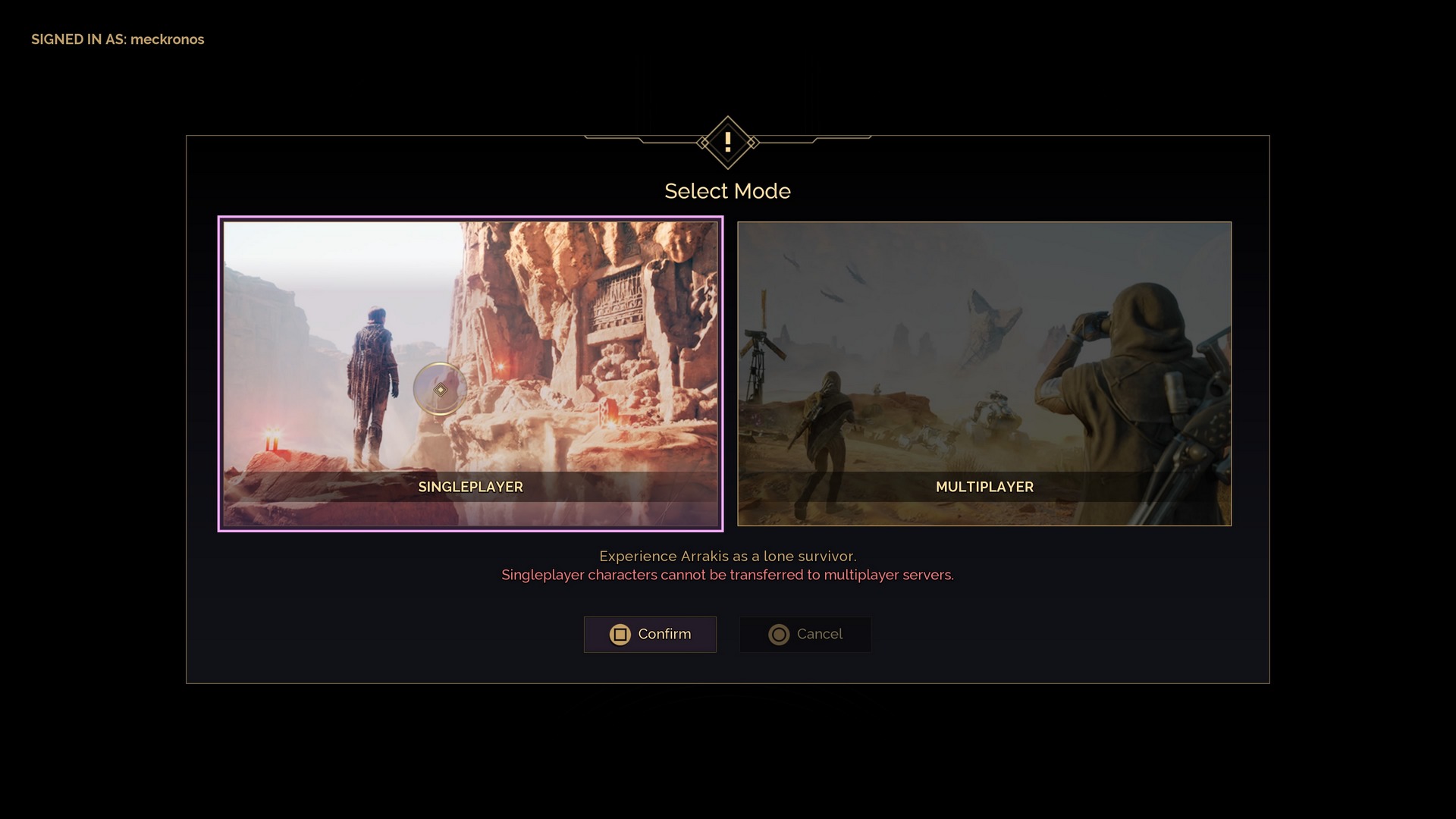
If you do plan to play with friends, or see experience the game with other players in Dune: Awakening, you have to start a new character. Single-player characters cannot be transferred to any multiplayer servers, they’re locked there. If you intend to play single-player only, that should be fine. But just know that you’ll probably need to make a few characters to experience all facets of the game.
Dune: Awakening’s single-player experience works fine. It has some rough edges but it expects you to fly after the training wheels are removed and you’re now falling over a cliff. It’s a very tall cliff though, enough time to figure out how to play the survival game on your own.
Once you figure it all out, the gameplay experience works perfect if you just want a game to sink a lot of time in, without being pressured into interacting with others.
Dune: Awakening will be adding single-player as a free update on September 22, arriving alongside its release on PS5 and Xbox Series X|S.
Played on base PS5. Access to review build provided by Level Infinite.