

The original Code Vein was an interesting game. It’s Bandai Namco Studios’ take on soulslike, which is peculiar given Bandai Namco Entertainment (the publisher) is the publisher behind FromSoftware’s Dark Souls series. But the team that previously made the God Eater series, Bandai Namco Studio’s take on Monster Hunter, sure were confident enough to take on a bigger prey, with mixed success.
So, seven years since Code Vein, in a world where more developers have chipped in and make their take on a punishing action-RPG, we have Code Vein II.
The sequel is bigger, more ambitious, yet still managed to retain the code of Code Vein in its vein. It’s a shame their technical capabilities can’t muster a properly smooth graphics performance, and the game feel still has lingering issues—it has a bit of a bite to it, so to speak. Outside of the glaring flaws, just about every other aspect of Code Vein II has either improved for the better, or at least has sucked less.

Presentation
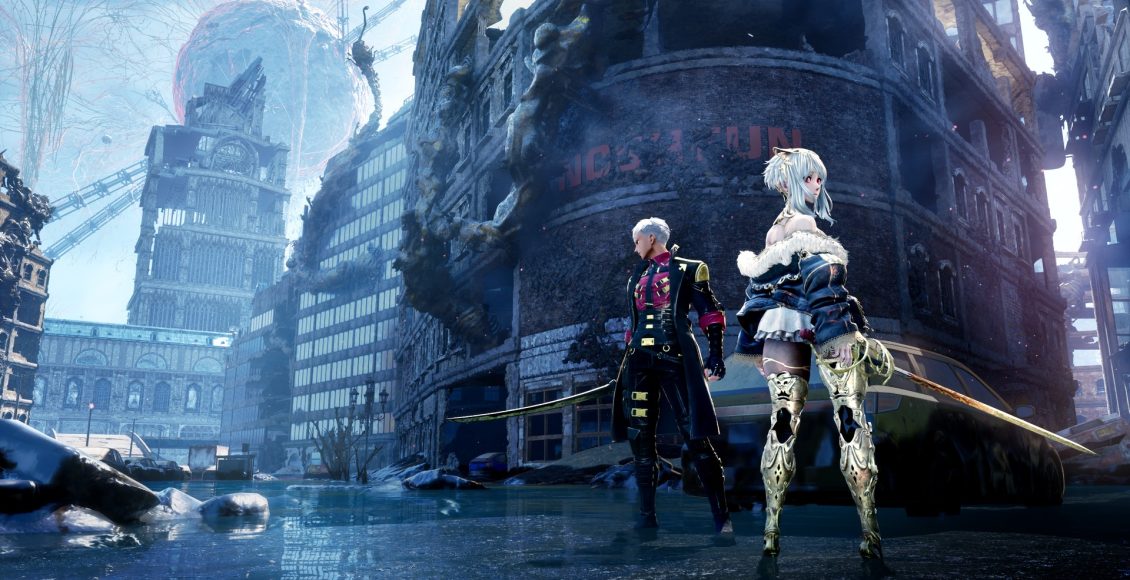
The most straightforward way one would describe Code Vein II, just like its predecessor, is that it’s “that anime soulslike game.” Well, at least the characters do appeal to the anime fans in that they are of that style. Big eyes, exaggerated proportions—more so this time as the not-vampire “revenants” look lankier with some body features more accentuated.
While the only way to differentiate between a human and a revenant in Code Vein was by them telling you so, revenants in Code Vein II have body parts missing, gold scars evoking the kintsugi aesthetic, red eyes, and even fangs. They’re all intricately detailed. At least one character has visible nostrils. When the main cast is on screen, they have presence.
As for how they sound, it’s what you’d expect from an anime game. There’s a specific way and cadence that anime English dub is written and spoken, which is undeniably present here. A lot of prescriptive dialogue. It doesn’t come off weird or cringe as much as there’s not much downtime and slice-of-life happenings are in the game. Both the Japanese and English voice cast are made of prominent names in the anime and anime games space, so these are the best of the best in the biz.

The most disappointing aspect of Code Vein II’s presentation is twofold, the environment and the graphical performance. You will find out why on the Gameplay section later why it also negatively affects the moment-to-moment gameplay, but from a presentation standpoint, these two aspects took a massive downturn compared to the first title.
Sure, the world is bigger, but it looks drab, bland and worse, generic. The lighting can be awful. Draw distance are short with aggressive culling happening—spin the camera around fast enough and you can see objects struggling to pop in or out in time, all while the framerate is chugging.
One can say that a post-apocalyptic setting can look bland and generic by default, but it’s even worse in Code Vein II. Textures are awfully grimy not because it has a lot detailed grossness (which would be a good thing), but the gross detail regularly appear all pixelated like a jpeg being stretched too big at times. And you’ll see a lot of repeated textures that makes what should’ve been unique and cool locations feel uninspiring to explore.
I get that you have to work hard and efficient because no one would notice or want artists and modellers to create 20 different outposts with stairs all around them, but when a gamer sees two of the same lookout tower with stairs all around them, the immersion and illusion of a big world is shattered right then and there. Not a unique problem to Code Vein II, even the biggest open world games like Starfield can appear empty and unattractive to explore for some players. But still disappointing.


What I think is unique to Code Vein II’s weak environment design is that it has no sense of scale. Every time I stop at a ruin of an old city, which there are plenty, you’ll find objects with sizes that don’t make sense. The playground has adult-sized stairs on the side so that your character can walk on and also really wide for some reason, but then the generic sofa and coffee tables that breaks on slight contact are sized too small for adults. Some buildings have windows so high that my average-height female player character can only poke her head up to the window sill.
One can make the argument that this is to reflect the different sizes normal humans and revenants can be, but we’re talking about old ruins from humanity, designed by ancient normal humans, pre-revenants. Why would these sizes be disproportionate?
And there’s even that weird toilet design in one dilapidated restroom.
I feel like a lot of these assets are being created separately on different scales and the team decided to roll with it hoping no one notice. Unfortunately, I noticed it. And it really hurts the worldbuilding aspect of Code Vein II.
As for the performance, despite the game having what’s basically a performance and quality graphics options on consoles, there are barely any differences. Even on performance mode the game stutters and chugs framerate. Even cutscenes, all rendered in-game, stutter erratically. Only the smallest, dingiest dungeons far removed from the main map where it can hit 60-ish FPS. The original Code Vein, which never had current-gen port, runs smooth on a PS5 and looks okay. Code Vein II can look awful in places with even worse performance that it makes the PS4 predecessor look nicer in specific areas. Oof.


One of the coolest thing you can do with the environment is environmental storytelling: let players discover the world naturally by what they can see and hear, and have them piece together what’s going on. But when a player sees that the object and world design seems to just be thrown together, that makes players not care to look around and see.
There are legible texts that you can find which could be cool avenues for storytelling, including detailed maps, but they all come of… boring. There’s ads for a gaming magazine, for some reason and it feels like it was put together haphazardly. There are questionable food kiosks with questionable English names. I’m just going to assume “Kebabu” is supposed to be kebab but it’s poorly translated from Japanese, rather than it implies how pre-Collapse humans used to eat dish, which also implies it’s something akin to a Strangereal situation of a fictional real world.
There’s not enough love being poured in the environments, why should we go and inspect or stop and smell the roses?
It also brings an issue about the Code Vein series itself: it tries to be a bit Gothic horror, but also post-apocalypse with a military industrial complex sheen. It’s a mish-mash of so many conflicting vibes that I don’t think was melded properly together.
Sometimes I forgot that revenants are supposed to be vampires that suck on blood, and I think the game almost forgot it altogether but lo and behold, we see a revenant feeding on a human in a cutscene for what I believe is the first in the series. And it only appeared once.
Code Vein II had the perfect opportunity to forgo the post-apocalypse outbreak theme the original had, and the first few hours it seemed it has leaned all in into the Gothic horror aesthetic, get a bit more vampiric, but it was not meant to be. The execution of Code Vein II’s aesthetic theme greatly hurts its presentation. Look at the new UI. It’s nice to look at, but when you notice that there are more than three different fonts just for numbers all competing for your attention, all having disparte vibes as mentioned earlier, it just comes off distracting. The sum of these disparate parts amount to nothing, or even for the worse.
In the awful fog that is Code Vein II’s presentation, there is a silver lining in that its music score, just like its predecessor, is impeccable. Go Shiina and his team of musicians are at it again producing some of the most atmospheric, dramatic and memorable music ever made. Code Vein II’s cinematics are elevated with scenes that matched the crescendo of the music. The battle theme fading in and out seamlessly as if it’s been playing in the mix the whole time rather than having loop back at the start each time you engage in a long battle remains a brilliant choice. The original Code Vein’s theme is reprised for Code Vein II to great effect, with new rearrangements of the iconic tune. And the new material produced here are bolder and more dramatic in tone. The addition of new instruments that in turn produced music that has more Gothic and Japanese vibes are a great touch.
I always lamented the use of orchestra in video games score only for them to sound like generic heroic movie blockbuster music that is not only played out, but also ended up being as noticeable as muzak. Code Vein II’s stellar soundtrack is nothing like that. It demands attention and will grab it by force, and you will, like it or not, bask in its radiant melodic beauty. But it’s not hogging the stage alone, the soundtrack makes for a good supporting role, it embolden the drama—heart wrenching scenes hit harder with that beautiful blend of melancholy and innocence. The soundtrack punctuates Code Vein II’s storytelling with great aplomb.
It’s a shame the ambient soundtrack are short, repetitive loops. I thought the eerie ambience of the Undead Forest was building up something, only for the score to repeat the same bars over and over and over as it rots your brain, albeit at a slower and subtler way than a TikTok brainrot. Maybe a few different dungeon themes could’ve made the optional dungeons more fun and less cookie-cutter.
On that note, the audio design is weaksauce. The motorcycle sounds like a low-power lawnmower while the hit and slash impact sound effects don’t quite sell the oomph these attacks you do compared to the animation work exhibited.
Code Vein II suffers greatly in the presentation department. The unattractive environment and performance issues are such a downer. The UI still feels sleek but lacks some features (more on that later). But at least the anime characters and soundtrack remain as good, if not better, than its predecessor.

Gameplay
In Code Vein II, you are not a revenant, but a revenant hunter. A normal human. But you are tasked with the job to save the world. Five heroes slumber in cocoons for about a hundred years that must be slayed, but first you must break the cocoon’s seal, which you do so by travelling back in time and meet these heroes in person.
Code Vein II isn’t a narrative follow-up to the first game. In fact, it might as well be a whole new world that sort-of shares the same worldbuilding and lore. And even then, some lore points have been dropped or changed. Revenants don’t look like regular humans anymore, at least the main cast doesn’t. The Lost as a concept has been dropped, but now you’re killing revenants that have lost all sanity, though they still are referred to as the horrors in English. Think how Dark Souls and Dark Souls II are only loosely connected. Similarly, Code Vein II is a standalone experience you can enjoy without playing the first title.
And on that point, Code Vein II plays like a soulslike action-RPG. Combat is punishing and requires deliberate actions and calculated commitments to even land a hit. It’s punishing in that you can die from just three hits or less if you’re underprepared both in progression (you’re not levelling up enough or haven’t optimised your build) or in action (you’re not locked in and getting hit from mistimed dodges).

The core fundamental combat in the first Code Vein is okay at best, and in Code Vein II, it has made improvements. Marginally. But still forward progress.
In the first game, combat feels either a cakewalk where I can safely unga-bunga my way pressing buttons without care and somehow safely avoid repercussions, or be unjustifiably punished for not dodging this one particular attack that only has one way of avoiding damage which is perfect dodging in a game where the dodge rolls have a peculiar invincibility window not akin to usual soulslikes. In short, it can be either too easy or infuriatingly hard, no in-betweens.
Code Vein II thankfully ups the ante with its fights. Enemies feel more aggressive with shorter rest time between attacks. There are more instances of devious enemy placements (always check your blind spots and corners, someone’s gonna jump ya).
Boss fights have dramatically improved with more instances where I felt my victory was earned because I figured something out, and I lost because I haven’t figured out this one weird trick. One of the early fights I got stuck in taught me I should be rolling more than just once. A later fight in contrast punishes that behaviour with a crazy lunge, which taught me to be brave and be in their face as close as possible.
But there are still vestiges of Code Vein’s infuriating trick in there. What I mean by this is attacks where there’s seemingly one way to respond, and to successfully respond to it means having to perform a perfect dodge with so little room for error in its timing.
I still am traumatised by Mido’s bubble pops and that one boss that slides across the arena with a ridiculously short window to react—a literal blink and you get hit moment. Unfortunately, some fights still use this awful style of attack. My issue is that it appears that I don’t have options around it most of the time. I happily tank and take those hits and recover if I could, but there’s at least one boss fight that will make you tear your hair out for how punishing it could be. No one likes a boss that can heal, even more when they can heal back to full health.
The fix here shouldn’t be removing boss heals, but make it obvious how one could combat that through action (there’s definitely options from a buildcrafting point of view).


The camera hasn’t seen any improvements, however. By default, it always rises up and angle downwards when you’re locking on on an enemy. But with Code Vein II featuring even more huge bosses, things can get a little cramped and too tight, view-wise. If your back is behind a wall, even worse, you just have to pray that your weapon swings hit something and if you’re supposed to running out of dodge, well that’s a death sentence right then and there.
The camera could swing a lot looser and further when facing big bosses, honestly. As it is, you just have to learn to not lock on as regularly, especially when it’s safer to aim for other appendages that is not what the lock on target homes in on.
But let’s get back to changes rather than what stayed the same. The way Code Vein II feels better to play is how unique the feel of each weapon type are, more than ever. Hammers feel more sluggish with what feels like a longer wind-up animation before each swing, with the upswing of dealing bigger damage on hit. This sharply contrast the two-handed swords that might have fell in the same in the first game, but now its faster swings compared to the beefy hammer make it more clear what playstyle it has.
Players looking for dexterity builds have better options for weapons now with the addition of twin blades featuring consecutive hits good for status buildups. The bayonet, one of the most unique weapon types, have been reworked so now that it uses ammo instead of the game’s MP (ichor). A kind of downgrade if you ask me, now that you have to manage ammo use, and ammo doesn’t regular drop (you have to buy them, which are cheap, but you can only carry so much at a time). Rune blades is a good new weapon type to have, especially for magic builds.
Fans of other soulslikes shouldn’t expect to feel comfortable from the get-go. The button feel is a bit chewy, in that you sometimes need repeated button presses to register an action on the account that you’re still in the recovery frame despite looking like you’re standing straight. I have learned to double, sometimes triple-pressing the heal button upon falling down from a hit, as you just can’t tell from sight that the input has been registered or not. Not ideal for bayonet users who might also double or triple press the fire gun button, wasting precious ammo as a result. Code Vein II has a bit of a bite to it.

The most unique part of the Code Vein series compared to other soulslikes is that you don’t assign stat point upon level up. Stats are govern by Blood Codes, given by revenants you meet in your world-saving journey. They’re basically pre-built classes. No need to figure out the soft caps of each stat point and whether the amount of Vitality you have now is enough or not, just a pick a Blood Code and go from there.
However, Code Vein II has complicated things. In the first Code Vein, it’s easy to min-max your way into having the quickest dodge while still carrying a large weapon like the hammer. But it’s also nice you have basically loadouts for each class as you can slot in your active and passive abilities to fit each Blood Code and switch between them at any time.
Code Vein II doesn’t have a weight system, it now has a burden system. Rather than aggregating all the numbers into one weight stat, the items you equip in Code Vein II now has weight associated to the six stat points, a burden. To get quick dodge, you need to have the burden total on each stat to be less then half of the total stat. You can also get overburden, have two stats where the burden total goes beyond the stat number and you’re fat-rolling.
The idea is that the burden system should stop players from optimising to get quick dodges, but have builds that work around the different dodge types. There are now passives that only trigger when you have specific conditions applied. Interestingly, there are Blood Codes that have traits that encourages you to be fat-rolling to get some juicy passives.
It’s a neat idea, but it suffers from a user experience perspective. Code Vein II doesn’t have a loadout system. It also doesn’t have a breakdown of the gear or traits that are burdening each stat. Blood Codes can now be swapped independently without re-equipping passives (now called boosters), which exposed the problem of the game not having a loadout. It’s a pain whenever you feel like swapping to a new Blood Code and have to rearrange your boosters and weapons again and dread not remembering how to set it all back to the build you’re familiar with.
Having no way of seeing a breakdown of what exactly is burdening you without having to check each equipment slot is an oversight I wish the team saw and fix. Even in the late game I still struggle with buildcrafting, and the system was supposedly made to make buildcrafting more approachable!
The complication doesn’t end there, even the skills now has an added wrinkle with its own set of burden rules. You can’t just have the same four skills on any weapon you wield, not because some active skills are weapon-specific, but they also have burden. You can’t just put all of the four slots (yes, just four, a reduction from eight in the previous game) with the same kind of buffs. You have to spread your choice of skills (technically called formae but there’s too many things that are also considered formae that it’s confusing). You also need to have multiple copies of that same skill if you want to equip it on multiple weapons at the same time, otherwise it will be removed from the previous slotted weapon. The upside of this change is that skills can be made as loot, you can find them in chests as well as making purchasable weapons worth the investment, as they can carry skills that you can remove and equip on your weapon of choice. But the abundance of skills, a good mix of returning faves and new moves (Dive Bomb is absolutely killer) is juxtaposed by how limited you can equip them at a time, with more restrictions.
The idea of Code Vein’s buildcrafting system is that it makes it more accessible for the soulslike unfamiliar. Code Vein II has now turn buildcrafting into a jigsaw puzzle you need to solve, rather than a freeform experimentation with a hefty safety net. I don’t consider this outright bad, it’s more of a sidegrade, though undoubtedly more complicated. Code Vein II has a bit of a bite to it.
I appreciate that this entry has also added equippable shields that not only block attacks, you can also dedicate that for a parry (Demon’s Souls/Dark Souls/Bloodborne style, not Sekiro parry/deflect), or even a stronger dodge that consumes ichor. There’s also the new Bequeathed Forma slot which adds a power weapon slot, more or less. It starts with a longbow so any build will have access to a ranged attack with free aim that consumes ichor, but over time you’ll get crazier, falshier power weapons that can be a pinch in tough fights.

While the combat had some tweaks here and there, the major change in Code Vein II is the exploration. You’re not exploring supposedly interconnected levels anymore. You’re exploring an open world. They’ve just gone and Elden Ringed Code Vein.
And boy does this game copied the homework of Elden Ring. World divided into multiple regions with different biomes with very specific ways to access them? Check. One big iconic named boss in each region? Check. The ability to go in any direction but there’s a very specific order that’s ideal due to how enemies in those regions are scaled? Check. A specific location that grants permanent heal upgrades? Check. Merchants dotted around the world? Check. Optional dungeons? Check. Obscured map that makes the world feels much bigger than it really is? Check. Summonable mount that can take damage? A definite check.
On paper, Code Vein II looks to have the answer correct, but I don’t think it truly understand how Elden Ring got the answer, because their execution of an open world soulslike leaves a lot to be desired.

That long criticism I have with the environments? This is where Code Vein II stumbles and fumbles when Elden Ring soar high. The Lands Between, the world of Elden Ring, feels much more inviting to explore compared to Code Vein II’s frontier. And this is despite having perils of tough enemies peppered around. Elden Ring’s world looks nice and is filled with locations that catches the eye, that makes you want to head in that particular direction.
Code Vein II, a game made for the current 9th-gen consoles, pales in comparison to the aforementioned cross-gen title it attempts to imitate, with environment design so awful it hampers any enthusiasm to explore.
Why would you want to venture forth, anyway? It’s just going to be the same reused assets and maybe a chest for a new active skill, one that you probably can’t afford to slot in now that you can’t just slot in any skills and the slots have been reduced by half, if you’re lucky. Elden Ring has tough enemies, even field bosses, littered around but it’s compelling to fight and there’s enough room to run away. Code Vein II meanwhile likes to put extra tough enemies on the few road networks that are still left in the runs, and with nothing really catches the eye, you really don’t feel it’s worth traversing and running around an enemy that’ll decimate you on sight. Apparently you can encounter a specific enemy that spawns regularly at night, so strong that even when I reached the endgame it’s still a struggle of a fight.
Code Vein II has the right ingredients and seemed to follow the right recipe in making an open world soulslike, but didn’t realise there were so many undocumented tricks in making it work. One of them is sourcing the best ingredients (better investment in art direction and environment design).
The open world nature of the game does mean that the linear level sections have gotten even more linear and scaled down. These levels need to be at least presentable as a proper building, but I feel like the level design is being retroactively worked after the exterior was designed. Plenty of constraints, odd nooks and crannies that don’t to anything, less of that soulslike flavour.
Code Vein had its own take on the trademark falling-down-a-giant-dark-pit-safely gimmick that’s standard for a soulslike rather early on. Code Vein II only has one very late in the game and it’s gimped and tame.
On that note, the most memorable level sequences is seen in the late game with so many interesting twists and turns but it’s only notable because it’s this level where they introduced some of the toughest enemies. Most of what you see is generic military industrial complex architecture. Lame. And I argue it’s a downgrade from Code Vein. Code Vein II has less of those awful mazes and labyrinths, sure, but now all the levels feel bog standard rather than memorable (for the wrong reasons), which I consider is worse.

Despite the combat having a misstep and the exploration lacking, overall Code Vein II still feels fun to play. It’s a good enough soulslike that scratches that itch of surmounting seemingly insurmountable challenges.
The partner system, another central mechanic unique to the series, has been streamlined for the better. Your one NPC companion can’t carry the fight on their own as they now deal chip damage (which the enemy can recover if you stop applying pressure or you personally haven’t hit them which removes the recoverable health). They also don’t have a health bar anymore, and you don’t need to be doing those HP shares over and over and get mad that the AI failed to revive you.
On that note, you’ll always guaranteed a free revive upon losing HP the first time, which removes your partner from the field for a cooldown period. As long as you’re not slain while that cooldown is active, you’re back in the fight. Even better, you can opt to not have a partner on the field while still be able to benefit from the new revive system, it works when you’re solo. In fact, some partners only confer buffs and won’t appear to fight beside you, which is neat, you will be tested on how to play this soulslike solo.
Speaking of solo, Code Vein II is curiously a single-only player game. The original had online multiplayer where you can partner up with other player, but this entry skips that. It’s a fully offline game, yet it doesn’t have a true pause feature unless you count opening the photo mode as one. I personally never used the online features of the original, but these devs have been known to make co-op games (see God Eater) so it’s quite the surprise that this isn’t being said out loud when the game was revealed. But as explained earlier, the AI partner system won’t get in your way, and you still get the same perks should you wish they not be physically fighting alongside you.
Despite its faults, Code Vein II plays like a decent soulslike. You can’t question the development team’s ambition, but they have shown that still have more room to improve on. A case of good idea, not-so-good execution. But just good enough to have a fun time in.

Content
If you expect Code Vein II to feature the same melodrama as the first game, you’d be glad to know that it absolutely doubled down on that, with fruitful results. The way the story is set up is bound to cause some emotional strings pulled, even when you know what’s coming. It isn’t spelled out as loud, but the game did say what you’re supposed to do, and when it’s time for you to confront that reality, it really stings. A beautifully set tragedy.
While Code Vein’s flavour of tragedy and intrigue comes from its post-apocalypse setting and unraveling the mystery that brought the world into ruin, Code Vein II instead has you be invested in human-revenant politics. The intrigue here is less strong with so many details being left out right until the near end of the game, which I feel like a course correction from Code Vein having to repeat over and over how a revenant can die or other ancillary lore bits. But I love the shift of the main plot from following JRPG tropes (build a party, face a clearly irredeemable evil doer) into weave of plotlines where you grow bonds with each potential partner with no clear antagonists.
The game never really explains much about what is a revenant hunter and why they exists, and it’s so weird that you can easily get chummy with revenants despite your occupation. Imagine Dracula immediately welcomes Van Helsing, who appeared out of nowhere, into the crew just because he’s freelance and not associated with the government.
The personal struggles of the main cast, however, is still great. Code Vein II still uses the same trick of the first game where you literally walk in memory lane to uncover a person’s history. Code Vein II is so enamoured by the idea of learning about the past that its main story gimmick is having you go back into the past, with the possibility to alter the timeline.
Curiously, the timeline change feature has many warnings about how it can cause unexpected changes to the present. But in terms of gameplay systems, timeline changing isn’t a main feature, it’s an optional one. You can decide not to do them now, but you can do them later.
The original Code Vein has multiple endings, and what ending you get is based on how through you played the game. Code Vein II doesn’t want you to play the whole game multiple times just to see the multiple endings but still wants to reward players for thoroughly combing through its contents, and that’s why the timeline shift is a linear, checklist ticking objective rather than a conscious choice you make. This is no western-RPG in that way, which I find slightly disappointing. It would be really cool to see the many permutations you can get based on what timeline you opt to change and what you didn’t.

I reached the final boss of Code Vein II within 40 hours, and that’s to get the first ending. Expect to play a bit longer than that should you really want to see the better outcome to the story. The game makes it really clear that the first time you see the credits roll shouldn’t be the end of your journey.
The girth of the game is just nice, not too big and not too shallow, and the pacing picks up rapidly near the end. Once you’ve cleared the branching three paths (which you are highly recommended to tackle in order), you’re in the late game by then. The progression of how strong you get is nice, with just a few difficulty spikes but nothing that would force you to actively farm and grind for levels.
If you like the brand of storytelling the first Code Vein game has, you’ll love Code Vein II has to offer. The game is of an acceptable size in terms of content that will make it feel like you’re getting your money’s worth.

Personal Enjoyment
As a rather new soulsliker who happens to have completed Code Vein early this year, I see so many good improvements they’ve’ made form the original. The character customisation is much better with more ways to individualised your anime hero.
The sequel has added proper animations when your character goes up and down stairs. They even figured out how to get your partner to always be in the elevator when you activate them and not have them awkwardly respawn out of thin air (they made the ability for your partners to respawn lore-accurate by tying it with the Jail you have on the back). All of the companions that can appear physically with you have different ways of sitting behind you while riding a bike, highlighting their personality and character.
The little things they’ve made to improve how characters interact with the world shows that the team do care about this game they’re making. I’m not just saying this because Bandai Namco Studios Malaysia is involved with the project by contributing in animation, but it just so happens that this particular aspect of the sequel has greatly been improved on, even if these are less important features in the grand scheme of things. I can clearly see love is being poured in this aspect.
Combat feels more rewarding. Some of the changes to the buildcrafting are smart ones. Your partner is never a burden anymore, and if you hate that they’re drawing aggro you can turn them off at any time. Whatever the means that inform the development team to make these changes (direct player feedback, reviews from press and creators, or the telemetry data they collect from the previous game), that was the right call. It’s a good iteration of an interesting idea that wasn’t executed as well on the first go.
If Code Vein II was a safe sequel that just improves on all the aspects of the previous game, I think I would’ve rated higher. The team has gotten better overall and I want to reward the development team’s development over the years.
Alas, Code Vein II tried to take big swings and bit more than it could bite, let alone chew. Making the game open world brings so many flaws, from the miserable technical performance to the miserable environment art that lacks direction so much that it’s detrimental to the open world adventure experience.
Like how I build my character, Code Vein II brought a big hammer to a boss fight so it can swing big hoping that the balance stat is high enough that it can tank through the damage and still land a good hit. But more often than not, this strategy doesn’t work and will send the poor character flying backwards as punishment for each poorly time hammer swing. That should sum up how I feel about Code Vein II: not afraid to dream big, even if means falling flat, because the occasional home runs are worth it.

Verdict
Code Vein II is an overall improvement compared to the first instalment, with almost every feature retweaked and reworked for this soulslike action-RPG. However, its ambition in turning it into an open world game has been mostly detrimental, exposing the game to poor technical performance and awful environment art design.
Fans of Code Vein will certainly be happy, though it’s not recommended to soulslike fans who are used to a higher standard of games in this genre. Code Vein II isn’t bad, it’s just that it’s either good enough for fans of the anime aesthetic, but not good enough to really challenge the genre mainstays.
Code Vein II has a bit of a bite to it.
Played on base PS5. Review copy provided by the publisher.
Code Vein II
Fans of Code Vein will certainly be happy, though it's not recommended to soulslike fans who are used to a higher standard of games in this genre. Code Vein II isn't bad, it's just that it's either good enough for fans of the anime aesthetic, but not good enough to really challenge the genre mainstays.
- Presentation 7
- Gameplay 7.5
- Content 8.5
- Personal Enjoyment 8