

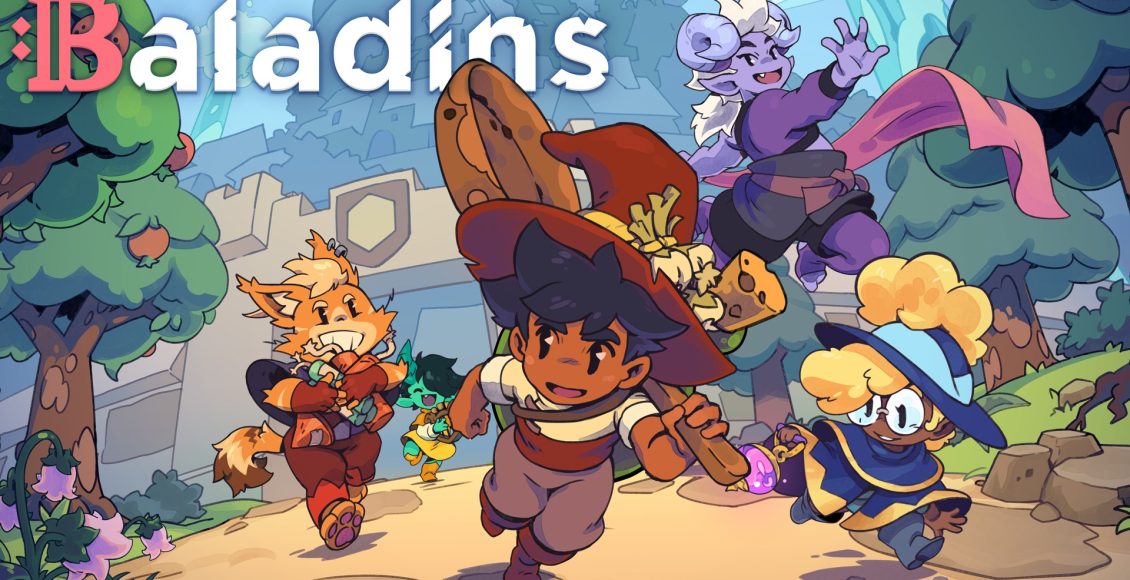
The first time I heard about Baladins, spelt with a B, I was immediately sold. A co-op-focused RPG where there are skill checks but no combat system, and operates on a time loop. Intriguing!
Not to mention it has the cosy and wholesome aesthetic blanket wrapped around it. It’s one of those game pitches that you usually expect to see mostly in the indie games space.
How does it work in practice? It can be fun, even when playing solo. As long as you’re willing to put up with the tedium that is associated with a time loop game structure, Baladins will charm you with its wonderful world and story expressed eloquently via witty writing and robust game mechanics.
Presentation
Baladins is such a charmer. The game presents characters as 2D paper cut-out drawings with only key frame animations. The world is essentially a big board game with 3D diorama of various buildings and locales around the country of Gatherac. The UI uses round, soft typefaces and slickly laid out making it easy to use and get around the menus.
And then there’s the little details. Each baladin class gets a different audio stinger when it’s their turn, like an off-key strum of a stringed instrument when the bard’s turn comes up. They have different sounds when moving, like the gentle clanging of two iron cast skillets the chef has. There’s even music stingers for when a quest is complete to reflect what ending you have gotten.
And my goodness the music is amazing. The handful of music somehow manages to bring that air of an epic adventure with the feel-good vibe of a Saturday morning cartoon where sweeping orchestra-y instruments dance together with whimsy synths. It’s masterful.
Screenshots of the Baladins presents the game to feel like a small game made by a small team with little budget. The event encounter takes up a small space around a very empty screen. But seeing the game plays and you can feel the many parts of it where it was crafted and fine-tuned. This game is not only built with love, but with confidence.
That said, it’s not without some slight issues. I find that the some music tracks, like the ones that reflect the current region you’re in, don’t play as often as other songs. If you move the camera around and then decided to just enter the building on the tile you are in, getting the “enter” prompt to reappear requires some fanagling of the camera rather than just a simple button press (I assumed the baladin portraits on the screen are clickable to have the camera centers back to the clicked baladin but apparently it isn’t).
There isn’t any voice overs in Baladins, which is fine. You’ll be skipping the dialogue a lot as it keeps repeating over and over again, by design, anyway.
Overall, prepare to be charmed by Baladins’ cute yet slick presentation.
Gameplay
In Baladins, you play as the titular Baladins, heroes that roam around the country helping people and make them happy using various non-combat skills. In common RPG terms, the baladins are basically just bards, but being a bard is just one class of a baladin.
The baladins are trapped in a time loop thanks to Colobra, the time-eating dragon, forcing them to repeat the same six weeks until its hunger is satiated. So you must figure out how to break this time loop, and maybe help some people out along the way.
Essentially, Baladins has the movement mechanics of a board game, the stats and skill checks of an RPG, a dialogue system that is reminiscent of a visual novel, all presented in a time loop structure. You can play this solo, or ideally as a party of four players. There’s no local co-op, only online co-op.
After the tutorial (which set ups the main plot of the time loop), you’re free to explore the world of Gatherac, divided into four different regions. Each time loop consists of six weeks, where each week is a turn for you to spend your Movement Points to move around the board and spend your Action Points to do tasks or talk to folks.
There are five Baladin classes which you can pick and change before the start of each loop, each having a specialised stat.
Dancers start with higher physique allowing them to pass skill checks where you need to open a jar (which may or may not contain a spirit) or lift a cart. Luxomancers start with higher knowledge allowing them to pass trivia challenges and present good points when debating about workers rights. Pyros are pros at pyrotechnics (no, I don’t think arson is something you can do in this game).
Any baladin can improve their stats by doing jobs, completing challenges, through random encounters and by carrying or consuming items from the inventory. Though they will all revert to their starting stats at the start of each loop.
The only visible dice rolls you have in Baladins are the skill checks, where the dice roll plus your stat determines the outcome of the event. In multiplayer, multiple players can stand on the same tile and pool their stats together for skill checks- handy for encounters that require multiple skills. From my experience the dice rolls have been generally been generous. Too generous even. There’s not enough fail states, and the game doesn’t have enough fails states where failing is the preferred outcome either.
Throughout your adventures you’ll be collecting items. Some are required to progress a quest, adventure-game style. Some can be consumed for a temporary bonus. Some just confer buffs (or debuffs) simply by having them in the inventory. Though by the end of each loop, Colobra will gobble up all items in your inventory, but each Baladin can carry over one item to the next time loop.
The game will give you a clear idea how exactly do you break the loop, and without spoiling anything, you’re free to try any route or quest you’d think might do the trick. Along the way, there will be quests where you can help make someone’s day, or absolutely crush it.
There are multiple ways for a quest to resolve, some are considered good endings some are bad- very visual novel-esque here. It’s always clear-cut what constitutes a “good” or “bad” ending- and it’s something related to the story, though you can obviously get why you meddling with a couple argument which ends up with them being apart is a bad end.
And since it’s a time loop game, you can always go back and try a different route, assuming you know how exactly to unlock those routes is.
As a time loop game, Baladins is all about gathering information. And gathering info around Gatherac can be a bit cumbersome, as it relies a little bit of RNG.
You can hear rumours that reveal new quests or hints for existing ones after completing jobs, if you’re lucky. You might stumble into a new character during a random encounter which will make them appear permanently in some part of town, if you’re lucky. The dice-throwing skill checks may be generous, but this hidden randomness can really sting. At first it’s fine, it is nice to just be stumbling into new info randomly. But by the 30th loop or so where you want to get things done, having some progress requiring a good RNG roll can get annoying.
It’s a double-edged sword, like many other elements of Baladins. Another aspect that can be fun or annoying is when you are figuring out solutions to the many quests. Some quests have multiple solutions but results in the same ending. Which is really fun to see at first. But once you start testing the limits of the quests it becomes apparently more point-and-click adventure than it is an immersive sim, as some quests require specific items for them to progress.
“What constitutes as a candy?” is a question I just couldn’t get answered despite playing through this game over and over again.
The game gets progressively less fun once you’ve exhausted off all the options that you know of, like most time loop games. But the first 10 loops or so it feels magical. It feels like there are so many things to discover, so many ways you can play out the events.
And that fun-ness that comes from the discoveries you make in Baladins is further bolstered by the excellent writing. It balances being whimsy with tackling mature themes, presenting this fun fantasy world with real, relatable social issues. The world is also pretty pro-socialist and isn’t pretending to be subtle about it.
The writing can get a bit preachy- not on the politics but on morals- as the game’s story has a specific message to convey which requires such tone for it to work. But it does let you do sketchy things and plays it out for laughs before it calls you out on what you just did. There’s one specific questline about two distant family members where the solution is comically funny yet so, so evil that it makes sure that should you do it, it will be remembered across time loops.
The overall tone of the story still fits in the cosy/wholesome theme. So should you persist through the time loops, you’ll be getting a feel-good ending. But even if you don’t reach the ending, it’s fine. The real fun of Baladins it the friends we made along the way, as they say. You’ll love the various characters in Gatherac, loveable yet flawed just as us humans are.
Content
I completed a solo playthrough of Baladins for this review. It took me over 44 loops, but it was surprisingly only 10 hours long. The start-and-stop nature of time loop games might’ve made the game feel longer than expected. You will be seeing some scenes over and over again, that repetitiveness did set in by the late game.
As mentioned previously, the writing of Baladins really carries this game, as it should. The various struggles and problems the diverse individuals of Gatherac has is fun to discover, and if you love worldbuilding, you’ll start to pick up on the rich lore the world has. Plenty of specific nouns to remember and concepts to piece together.
Baladins can be played entirely solo, though it’s designed to be played with multiple players. I suspect the game’s pace to be dramatically slower as each player has to take their turns. And looking at the game’s patch notes post-launch, there’s plenty of fixes being made on the multiplayer feature. So maybe don’t expect the game to work perfectly with friends.
Personal Enjoyment
I love the idea of time loop games. Whether that be Deathloop, Outer Wilds or even Hitman, I love playing a game over and over again up to a certain point where I can safely say I’ve seen it all and be done with it.
Baladins provided that same high for me, so it’s a great time loop game in that sense.
Though I do find the game rather unagreeable at times. The game has a few hidden mechanics that you only will start to figure out on repeated play. Some characters requiring you to have done a good deed or trust you before you can begin their questline (plenty of people in Hortegarde is like that, apparently).
Some characters can only appear in random encounters, including quest-specific ones. Class-specific interactions and choices are such a game-changer that it can also trigger endings, and if you’ve been playing as one particular class a lot you might be missing out.
The Cook can cook up solutions by simply… cooking. And there’s a lot of problems where you can just let the Cook cook.
There were time loops where I accomplish essentially nothing, which is normal for time loop games but it always sucks. And that feeling gets worse as I inch closely into getting that true ending and get the credits to roll, as by that time I’ve exhausted most of my options that I know of.
I would’ve love the game more if it nudges you in the right direction when you’re close to reaching that true ending. As by loop 30 or so I’ve run out of options, or so I think, The game keeps repeating the same events, and I am this close to fill up that one bar so I keep running around gathering whatever item I could to feed that dragon.
The game has a progression tracker at the end of each run showing how many endings, items and rumours you have yet to discover. Which is good. But it’s still not enough to nudge me into finding that one last rumour or encounter a few more NPCs which I never even see across the 44 time loops I did to beat the game.
Verdict
Baladins delivers in its interesting premise. Its world and story is fun and wonderful. The RPG gameplay works as intended. The fun of discovering new knowledge and ending routes is exactly what you wanted out of a time loop game.
It also inherits the many flaws of a time loop game. Repeated loops becomes less fun as you slowly run of options and discoveries. And that looping nature of its gameplay loop can be exhausting.
Other than minor and technical issues, in particularly the multiplayer, Baladins is a fantastic time loop game. The game mechanics is simple yet it is robust enough to support the wholesome journey of non-combative heroes in their merry quest, over and over again.
If you love time loop games, Baladins is not to be missed. This is a gem of a game that only an indie team with the support of loyal backers, in this case via Kickstarter, can create. And we should be cherishing such gems.
Played on PC. Review code provided by the publisher.
Baladins
Baladins delivers in its interesting premise. Its world and story is fun and wonderful. The RPG gameplay works as intended. The fun of discovering new knowledge and ending routes is exactly what you wanted out of a time loop game.
If you love time loop games, Baladins is not to be missed. This is a gem of a game.
- Presentation 9.5
- Gameplay 8
- Content 8.5
- Personal Enjoyment 10