

“What is a man?” Lord Dracula (He/Him) once said. “A miserable pile of secrets.”
For the longest time, that was the long and end of my exposure to Castlevania. Konami’s venerated series is one half of what we dub today as metroidvania, a specific genre of games where exploration is as important, if not more, than the action. Some call it search-action, or exploration-action games.
What’s more interesting is that Castlevania never was purely a metroidvania, it had titles where it was a linear side-scrolling platformer. But it was the titles where you explore intricately design levels, filled with secrets that may be beneath Dracula, but truly rewarding for players, that really made the series what it is today, inspiring a new generation of game makers to riff on the foundations Castlevania set forth.
So what if said new generation of game makers got handed the keys to the castle, by Konami themselves, to go make a new Castlevania?
That’s how Castlevania: Belmont’s Curse came to be. French developers Evil Empire and Motion Twin made Dead Cells, the much-loved roguelike metroidvania and once approached Konami for a collaboration DLC. And before you know it, these indie developers, with support from Konami’s own internal staff, are getting more than what they initially asked.
But is this new entry still a Castlevania game?
Since launch, opinions are mixed, and unfortunately I have no way to weigh in on this as, as wild as this may sound, this is my first Castlevania game. I’m approaching Belmont’s Curse from a newcomer’s perspective. So this review won’t be answering that question.
But is Belmont’s Curse the right entry point to Castlevania? Not exactly. Despite offering a lot of accessibility options, the game still expects more out of you. The early-game challenges feel like a gauntlet of frustration for those unfamiliar with the trappings of a metroidvania. However, should you stick through it, by the end of your playthrough, it should open your eyes to the wonderful adventures a game in this genre can provide.
Presentation
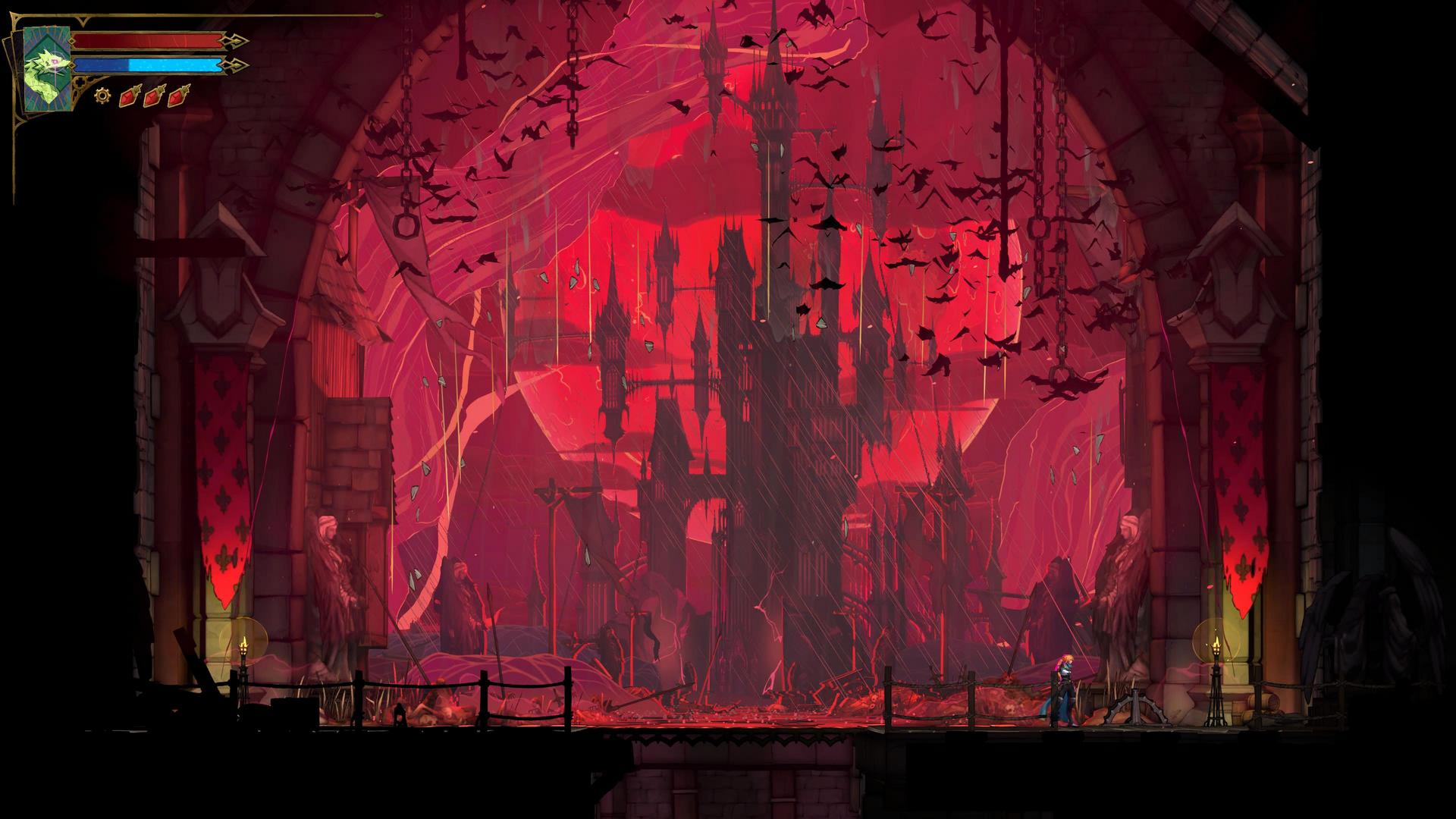
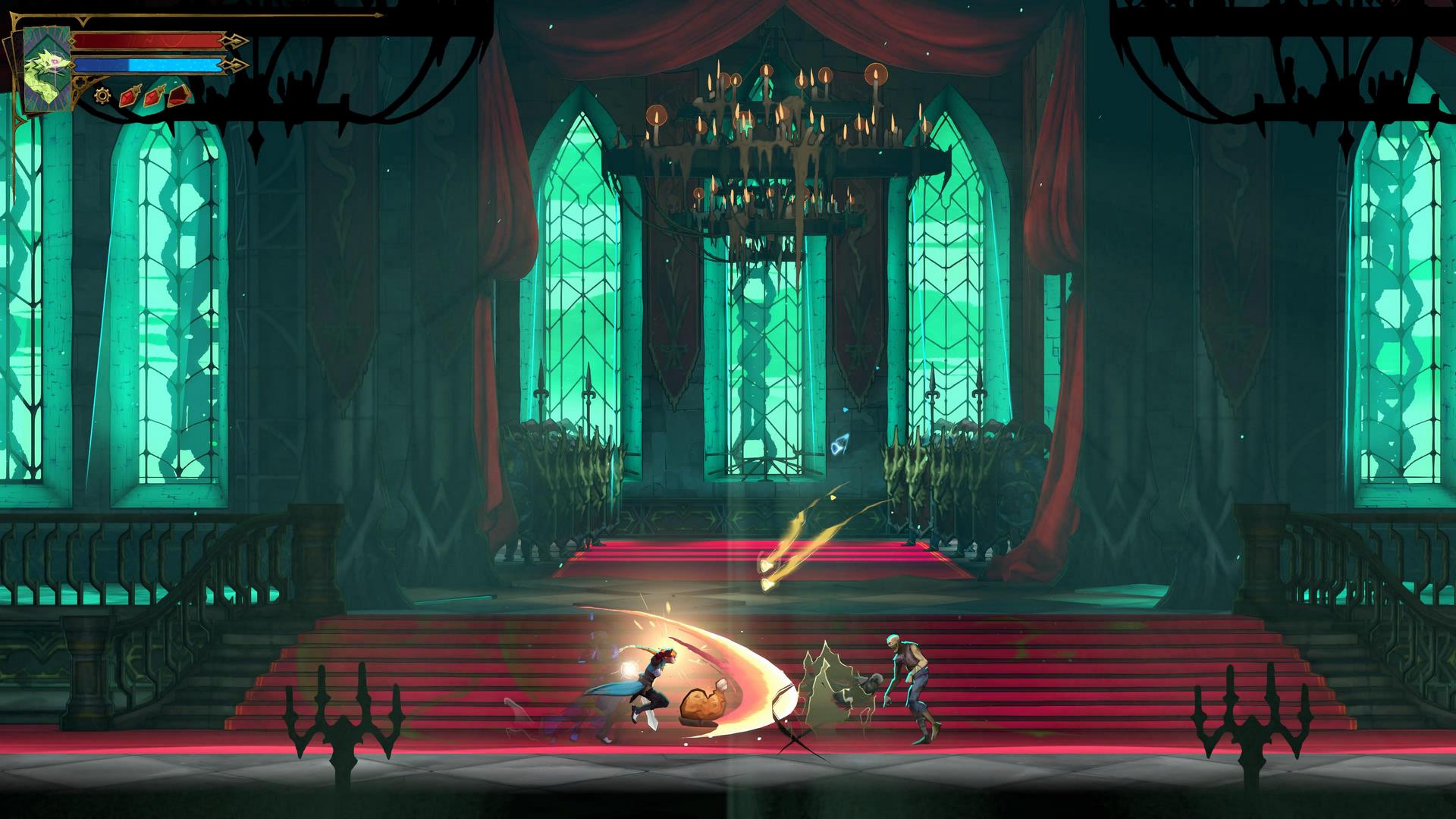
Castlevania: Belmont’s Curse knows what it supposed to look like. It has an aesthetic. Very stylised. Characters and foreground elements are rendered in 3D while background art are 2D layers. The animation work, similar to Dead Cells and The Rogue Prince Of Persia, is absolutely sublime to behold. Protagonist Rose moves and schmoves in a way that feels natural and real—like it was motion captured—but also can be snappy and follow the rule of animation cool with its hitstops, impact frames and fast motions. There’s a rhythm to the movement and action and the animation work helps amplify that sensation.
While the art style looks good and mostly well-executed (the textures and models come off very pixelated when it goes for those zoomed-in close-ups), fans can argue it looks nothing like a Castlevania game of yore. No sprite work here. The character design also has more of a typical Western animation look to them. The character portraits would fit in a game like Hades and its sequel. I have no qualms of the “safe horny” look, but I understand why the designs might not resonate as strongly to other folks who resented this art style.
I do love the background art in Belmont’s Curse. It really gives the levels more aura. The crimson skies in the streets of Paris where rows of rows of housing can be seen as the Notre Dame stands tall amongst them. The copious amount of paintings that littered the walls of Dracula’s Castle. It’s all very colourful, vibrant, and captivating. The one issue I have is that it has regularly made me forgot that this is supposed to be night time. Things are just so bright! If it weren’t for the glowing (and breakable) candelabras I wouldn’t have thought otherwise! But there is at least one sequence in the game that makes use of the shadows and darkness in a cool way.
Another possibly contentious change with Belmont’s Curse is the soundtrack. Castlevania’s music lives beyond the games, enough that even I am familiar enough with Bloody Tears.
While most of the series music has that Gothic horror vibe going for it utilising period-appropriate instruments, Belmont’s Curse is a bit more explorative. Composer Asadi (not relation to the Malaysian shoe brand, but is the very same composer behind the other French-made metroidvania of recent times, Prince Of Persia: The Lost Crown) worked magic here by making electronic synths sound so broody, nasty, but also vibey. There is still your expected organs, choir and Gothic-sounding arrangements in the soundtrack, yet the brooding synths gives it a different kind of mellowness.
The remixed Bloody Tears for Belmont’s Curse is pretty cool at first, but when you’re stuck in the Main Hall for hours the song starts wearing down its appeal. Not to say it’s a downgrade, just that some songs are not a grower and the short-ish loops can get repetitive. One of my faves is the one the average player might have missed, the haunting tunes of Mirror Trap. The other is the one everyone who at least tried the demo, Streets Of Fire, that plays in the Paris Streets zone. These songs really make use of the composer’s specific style of instrument arrangement while honouring and respecting the tone Castlevania is going for. I want more of electronic music in video games composed this way, with deftness and a strong sense of taste, not just a trap remix.
While I personally have not that strong of an opinion on this, I do have to point out that some folks really don’t like the whole trap beat electronica the soundtrack has. So your mileage may vary, but I do insist that it’s not as terrible. This is nothing like the early 2010s EDM that people think it’s cringe today. It’s a bit more tasteful, but even a taste of it may be enough for detractors to gag.
I do have mixed feelings on the English voice acting. It’s not that it’s incompetent, but the quality of them differs. The Belmonts all have strict American accents, but in this setting where most folks speak with a French accent and in this time setting it just sounds jarring. Rose feels like a character in a theatre rather than a person to me. The folks who do speak in some French accent are not consistent enough with their faux-French that takes me out from believing they are supposed to be English-speaking people from France. The way the “R” is rolled doesn’t add up most of the time.
It’s definitely a challenge to make characters that speak in older times sound natural to a modern audience who might just find them cringe by default. I tried my best not to think to much and remind myself that the game used to have corny dialogue (see the opening quote, which only appeared in the original PS1 version of Castlevania: Symphony Of The Night as the PSP port redubbed and punched up the script to be slightly less corny.) It’s fine. They did the best with what is provided.
The UI flourish in Castlevania: Belmont’s Curse is just over the top in the best way. There are so many lavish animations, just like the characters. The way the tarot cards move about when highlighted and the way they flip when selected. The way the health and mana bar expands when you earn enough of the unlocks to do so. little clicks and cranks when pressing buttons. Thankfully, none of it makes the user experience clunky. You know what you where everything is, and it’s easy to do just browse and select things. So the flourishes are totally fine additions, the bases have been appropriately covered. My only complaint is that the room name uses a very small font when that is the more important part of the UX when the pop-up appears, compared to the huge icon that comes with it. I only remember the room names when I have to check the map and look up guides online!
The presentation aspect of Castlevania: Belmont’s Curse is fine, design-wise. It may not be what OG Castlevania fans expected of the series, but this is what you’d expect from the development team based on their previous works.
That said, there is a specific odd note to add here: in long play sessions Belmont’s Curse starts to stutter every time you load into a new room, even the songs skip a few beats, which is an annoying bug that I hope the team has time to go about fixing.
Castlevania: Belmont’s Curse doesn’t carry the typical presentation style of a Castlevania title, but the developers have a strong sense of style that the art style choice, music genre and user experience come out excellent and wonderful. The English voice acting has room for improvement.
Gameplay
Castlevania: Belmont’s Curse is a direct follow up to Castlevania III: Dracula’s Curse. That’s the game where Trevor Belmont successfully killed Dracula. Set a few years later in Paris, the Belmonts find themselves summoned there to stop a plot to resurrect the Dark Lord. Players take on the role of Rose Belmont, who must continue the family tradition of hunting the night and hopefully kill Dracula.
Belmont’s Curse is a 2D platformer and you are expected to be good at it. You will be jumping, swinging, air dashing, ground pounding and double jumping a lot. Paris and Dracula’s Castle are a nightmare for the immobile, as any mistake in traversing can spell peril that includes falling off of high places to landing on a pile of spikes. Maybe not a game over death, but losing health for a mistimed jump, or a wrong button press, adds up over time. Over the course of the game, you will be challenged to improve your precision platforming skills in various ways.
One of the hard lessons I had learn is that I shouldn’t be double-jumping all the time, and consider jump, air dash, then double jump more often. I thought this was silly at first before I remember that this is the exact fundamental skill I learned in my favourite 3D platformer series Spyro. You jump, glide (air dash) and then hover (double jump).
While platforming will challenge the noobs and newcomers, Belmont’s Curse bigger hurdle for me was the combat. There’s a very specific game feel when it comes to hitting people in a Motion Twin/Evil Empire game thanks to its meticulous animations, where it can feel long and flowy but also fast and snappy, tethering between the lumberiness you’d agonise in a Red Dead Redemption 2 to a by-the-beat quickness of a Devil May Cry 5.
More pertinent however is that the combat has a parry system. It’s introduced much later, but knowing that there is one makes for all the frustrations I had in the opening first few hours made more sense, though no less frustrating. Some projectiles and attacks can only be reacted to in a split second, hence the inclusion of a parry (which projects a Smash Bros.-esque shield made of light that doubles as a traversal mechanic). Trying to jump over, slide or backdash them feels too hard to pull off consistently for me. Some of them feels impossible to even avoid.
I should emphasise again that I don’t play 2D platformers and metroidvanias a lot, so it could just be me not picking up established genre norms and best practices, so this isn’t me complaining that the combat is objectively bad.
Rather, it doesn’t feel as intuitive as it should be. It didn’t take me long in figuring out how combat in soulslike like Bloodborne was supposed to function (without the experience of playing Demon’s Souls and Dark Souls before it) because all the exploration before it prepped me beforehand. I don’t beat those bosses on first try, but I know what I’m doing wrong and where my blunders were. Can’t say the same with Belmont’s Curse’s boss fight. The first two bosses have way too much homing and tracking that I have no idea what the answer is to every attack. Can’t just jump over and keep at a distance most of the time like it’s Hollow Knight, the other metroidvania/soulslike I had some experience with.
I resorted to make use of the accessibility options to make the fights easier as I just couldn’t be bothered mastering it, as a response to how the game couldn’t be bothered easing me into the concepts and mechanics that I should have been taking notes for during exploration before the taking on the exam that tests my knowledge on this, the boss fight.
Thankfully, the boss fights have enough variety in their gimmicks and in fights where it’s not about having to deal with aggressive bosses that homes into you at every breath, I can clear them with no issue, no fiddling with the custom difficulty sliders required. The bosses where it plays more like a 2D platformer boss fight, where you are supposed to keep moving around the arena and are able to have some space and distance from them without the fear of them immediately homing to bait you into parrying, are amazing.
I may be a parry-or-die connoisseur, but Belmont’s Curse didn’t do it for me. I am also chalking this as another personal skill issue problem, because timing parries in a 2D game where your character is not always at the center of the screen is a whole different set of skill I just don’t have it in me. I can barely even keep track where Rose is sometimes!
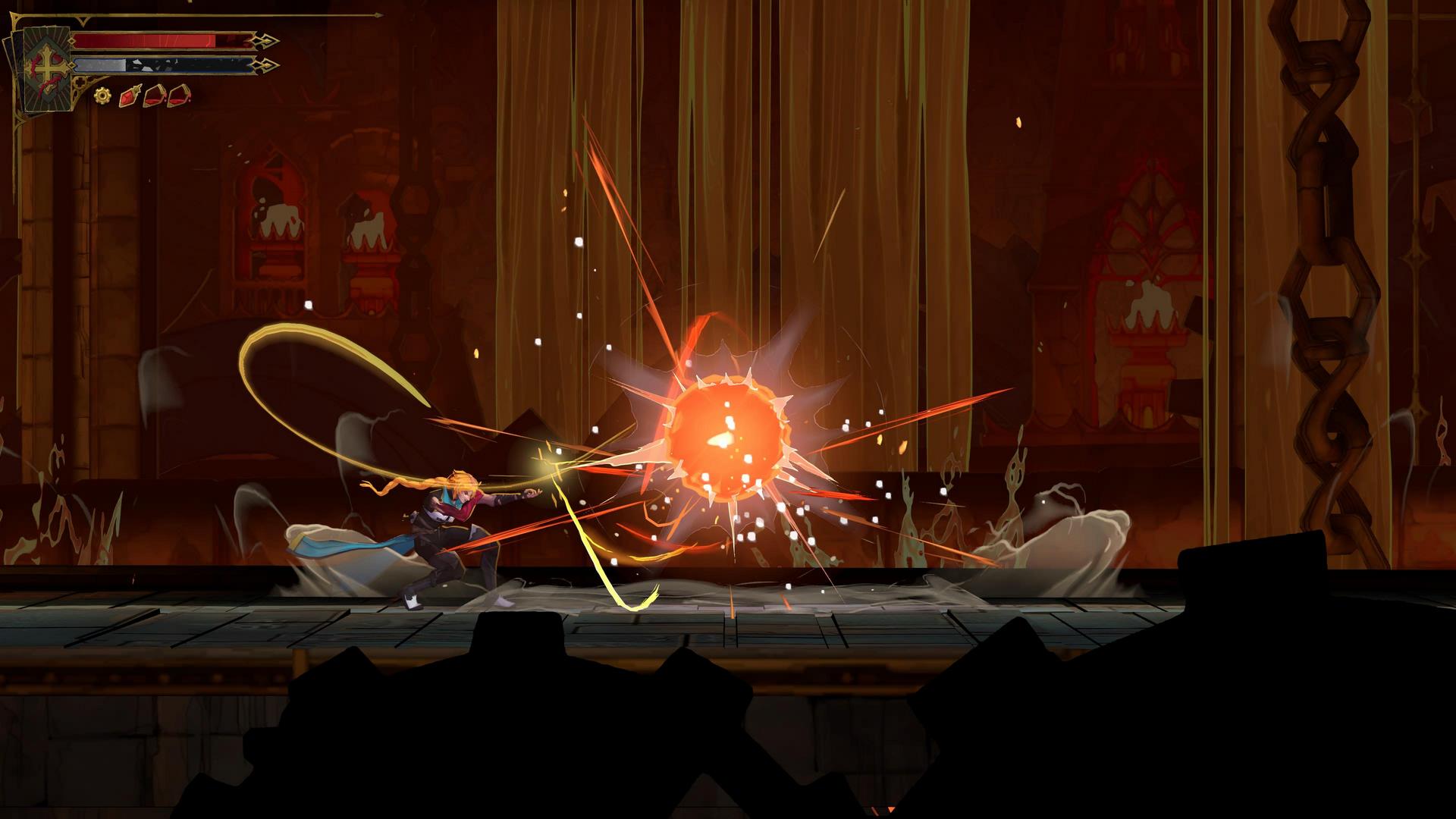
Castlevania: Belmont’s Curse offers players some choices on how to approach the combat with a selection of seven different weapon archetypes each with different playstyles. The starting longsword for example rewards backdashes and sliding as you do more damage immediately after doing those. The greatswords requires commitment, holding the button long enough to charge and deal more damage while risking yourself getting hurt while charging. Gauntlets are for the button mashers. Dual longswords are for the elegant button mashers who press buttons at a consistent rhythm. But let’s be real, most will gravitate towards the whip, which deals the most damage when it hits an enemy at the tip. With the whip, you are encouraged to keep at a distance, can deal with aerial enemies without having to grapple toward them, and is just reliable in any other situations. It’s the traditional Castlevania weapon after all. Even the game shows its biases a bit by having the most powerful variant of the whip found through the critical path instead of hiding it in some secret room.
That being said, switching up the weapons from time to time for the sake of it is fun. It’s one of the few carryovers from Dead Cells which also featured a good selection of weapon types.
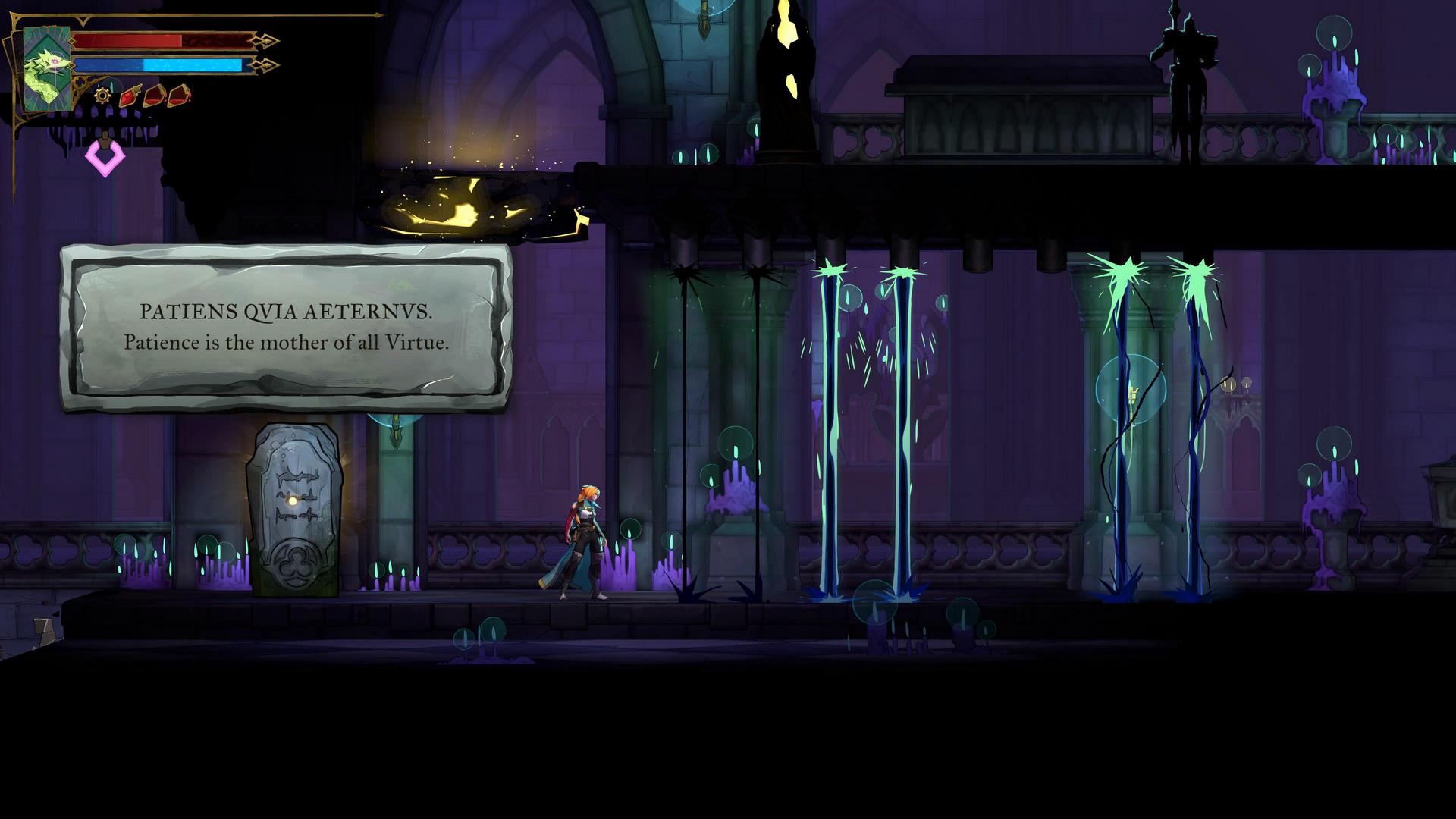
Instead of sub-weapons, Rose has access to magic (that more or less function like sub-weapons) thanks to her mother’s tarot cards. The spells, 20 of them, are all interesting, though some more situational than others. From the humble toss of a cross that boomerangs back to you (a Castlevania staple from what I understand) to inflicting poison. From temporarily freezing time to temporarily freezing enemies (in stone or ice forms). There are a lot of spells to choose from, a lot of them are optional and missable. They can be upgraded too by fulfilling specified objectives. My only gripe with the spells is that there are too many of them. You probably won’t have enough of an excuse to use them all before the game ends, unless you purposely wander through those already explored rooms over and over.
While I may not be that hot for the combat, which is bummer given how that was Dead Cells’ main acclaim was that flowy combat it had, the exploration aspects of Castlevania: Belmont’s Curse is fantastic. You do get a feel that the game slowly introduces you to more and more platforming shenaniganry as you play. Room layout complexity is increased over time. It gently starts you with the Streets Of Paris being more horizontal in layout than it is vertical. But by the time you reach Dracula’s Castle, you are expected to jump at an angle, knowing exactly when to air dash or double jump to safely get across a deadly chasm.
The traversal gimmicks are nothing new in this genre space, but the execution is well done. You can grapple to designated spots to swing and zip to, but also to close in on your enemies, handy for short-ranged weapons when fighting aerial threats. This phantom whip is a universal move, unlike the equippable whip weapon type. Two seperate things.
The previously mentioned parry mechanic doubles as a way to phase in and phase out certain platforms, so you have cases where you need to phase out a wall to jump through it, and then have it be phased in as a physical object again so you can cling to it for a wall jump. More than one occasion that it requires you do to so in one go, on the same wall. There are timed rooms where it will test your precision platforming skills requiring you to do a very specific set of jumps and actions to get through a closing wall where a tantalising treasure chest sits tauntingly pretty on the other side. Of all the tricky platforming challenges, only one had me curse to the heavens—for those who played, it’s the one that requires a ground pound that only opens a shortcut to a save room, which can be made harder if you don’t know about the secret puzzle. Most of them has the right reward for the difficulty of the sequences it has.
The exploration aspects is what you’re really here for in a Castlevania game. Granted, not all games in the series are of the exploration-action/search-action (metroidvania) variety, but still. Belmont’s Curse has a good miserable piles of secrets to unearth. Every blacked part of the screen may lie a hidden room. Every wall edge should be checked if it smashable or can be slided down. Every clue is a hint towards something.
The exploration is emphasised much more by how open-ended the Belmont’s Curse feels like. Well, it’s not truly open-ended, as you’ll come across a lot of untraversable rooms that you should be backtracking to later. But the objectives, the main thing you need to do, is left pretty vague and open. You are left to explore and just stumble through the main quest progress. The world truly opens up when you reached Dracula’s Castle, as three whole levels can be explored with no specific order, but it doesn’t let you get lost too much. There’s always a hidden funnel that will guide you to the next big plot beat. If it doesn’t, than that means it’s an optional secret thing you can skip if you don’t want to bother.
I implore you not to skip those secret things. Castlevania: Belmont’s Curse has some good secrets that feels so rewarding when you discover it for the first time. My opinion of the game dramatically changed after discovering that one big secret. Some of the secrets unfortunately are not as good. I got through the Library much faster when I was mostly jumping on those platforms only for some secret thing to happen, compared to actually knowing what triggers it and trying to intentionally do those jumps.
Like what you expect from games of this genre, expect to do some form of backtracking. The game doesn’t have a fast travel button on the map, but for reasons I shall not say here, I don’t find this to be any issue whatsoever. It can be tedious going through long stretches of rooms, having to do some of those platforming sequences again and again (at least the challenging ones for treasure chest rewards often have shortcuts). Take a break once in a while at the save room, have a long lie down.
The secrets here makes Belmont’s Curse having some elements of a knowledge-based game. Throughout the game, you’ll be collecting clues to find all the spells in your tarot card deck. Some clues you just stumble naturally through gameplay. Some clues you can totally miss. What’s more interesting is that the clues gathered are nothing more than pre-written notes, it is not a prerequisite to unlock certain sequences. I managed to stumbled into a secret spell purely through guesswork and exploration, connecting the dots naturally, only to later find out room that I did enter but forgot to check the corners. Once you know these secrets, the only way to have it be a special revelation is to wipe your brain from such memories, you’re spoiled, which is like how most knowledge-based games are. It’s real cool, but nothing game-changing or game-defining. It’s added here as a nice sprinkle to the exploration elements, rather than a defining feature. That said, not every secret is tied to the clues you gain, so you still have to pay attention a bit more, or look up a guide, to really find all the hidden secrets. Even those lore texts that are not saved into the menus like a codex may be hinting at something.
Between the exploration and the action, Castlevania: Belmont’s Curse fits the bill of what I think a Castlevania game should play like. But the game feels more like an ode to Castlevania rather than it is an evolutionary new step for the series. As some large language model might put it: a throwback, not a step forward (this sentence, and the entire review, is purely written by a human). I don’t see any of the ideas and mechanics here that will change the metroidvania genre in any way. It’s another one of those. I understand why Castlevania, which haven’t had a new entry for some time, need another one of those entries. But I hope Konami treats Castlevania with the royal gravitas it deserves, with bigger, bolder scope for future games.
Content
Speaking of scope, Castlevania: Belmont’s Curse is scoped to match its price point of RM100 in Malaysia. That’s a perfect price for a smaller game usually made by an independent developer. The game can be beaten in under 10 hours, though the completionist would take about 20 hours or so to find all the secrets. I reached the first available ending in hour 8, and have the credits roll again at 99.4% completion on hour 23.
Belmont’s Curse has good pacing. It knows when to lock you to a linear path and when to give you the freedom to explore and let the critical path diverge. I never felt like I was stuck in one place for too long that was not of my own personal choice (the Main Hall is much bigger than it looks.)
Story-wise, it’s okay. Belmont’s Curse weaves in historical figures in France into this tale, and it’s not afraid to make use of the religious themes that surround this tale of light versus dark, which some may find unpleasant, but I don’t think it’s anything too controversial.
I personally am not as sold on Rose’s character arc, but I see what they were doing. We’re playing as the budding new Belmont who’s next in line to kill Lord Dracula now that he reemerges. But despite talking the talk, the young little flower (as Dracula’s minions tease her) isn’t walking the walk yet.
My issue is that I don’t resonate with Rose’s plight. She seems to have everything under control and she knows what she’s doing. But the few lapses she has is supposed to expose her unreadiness and inexperience yet I don’t feel like it’s not much of a blunder. It’s not like a character arc where she’s a overconfident brat that over time mellows out and matured into a stoically confident warrior, she’s already a stoically confident warrior from the get go! And her character arc concludes by her finding inner strength instead of just relying on the physical strength she has had from training. So she’s still appears as stoically confident warrior like the Belmonts before her at the end. The curse on her arm seemed to be hinting at something, but I treated it as nothing and I don’t think anything was lost.
Maybe it’s just me not feeling much about stoic characters, but Rose to me is a baguette to me: plain and too sturdy in this form, but brimming with potential. I don’t mind seeing her again, but that baguette needed to be served as an ingredient of a more grandiose dish. A plain baguette is fine, but you can only appreciate bread so much.
And no, I don’t want her to start quipping or having odd quirks. I just want Rose to feel like a human with struggles I understand. As it is, I don’t think the Belmont’s curse is her red arm, but the curse of having to be bland, having to follow the training regiment of a vampire hunter all her life makes her a dull woman to be around with.
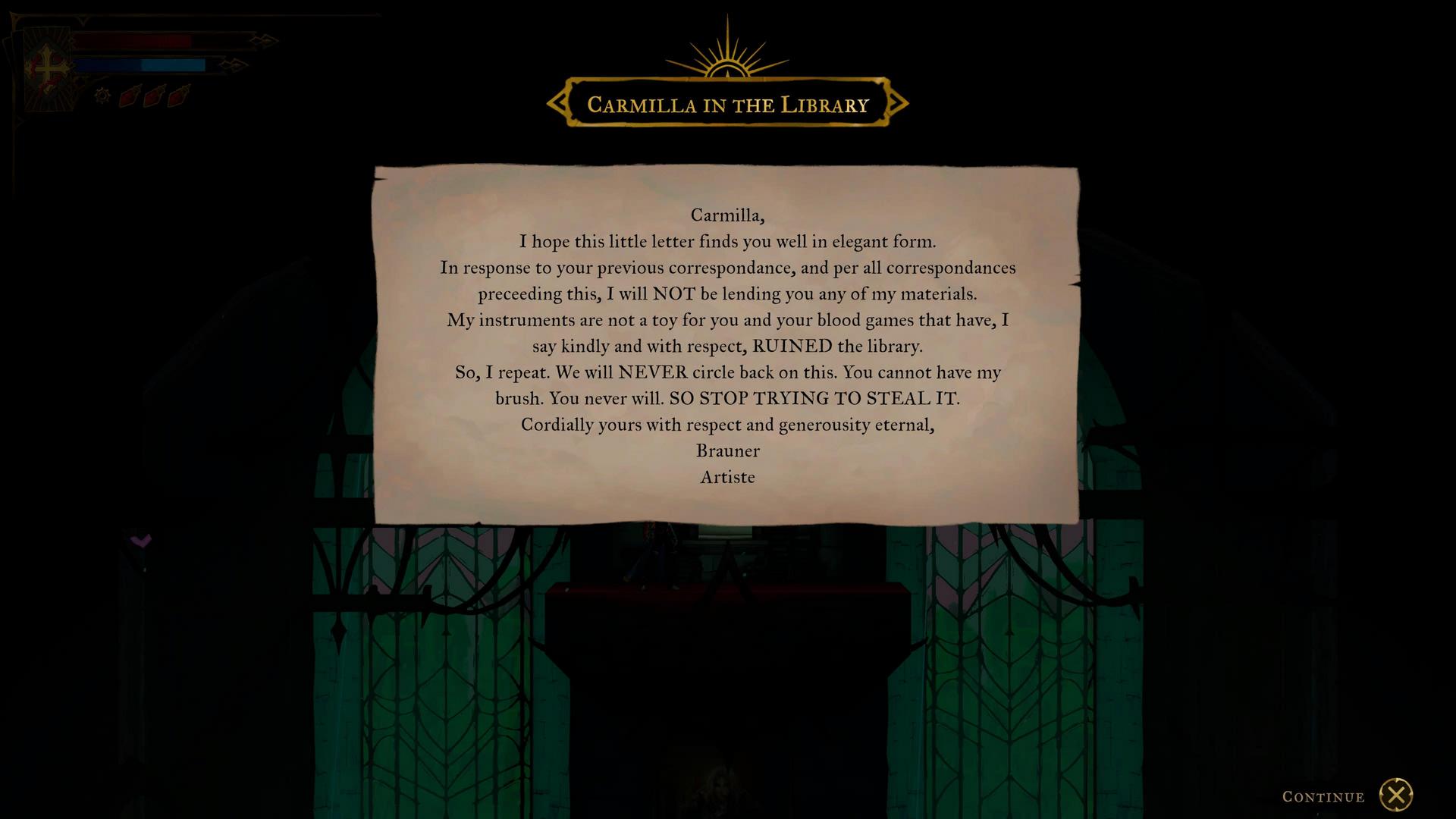
There’s another mixed feeling I have with the worldbuilding is that some of the lore texts makes use of modern lingo. What do you mean the folks then say “circle back”? That sort of incongruity wouldn’t pass if the team really committed to the time setting, but given the script and English voice acting is also just passable, this shouldn’t be a surprise.
If anything, I find that Belmont’s Curse fits the storytelling of what I think Castlevania is all about.
Castlevania: Belmont’s Curse won’t rock your world with its story, but it’s serviceable. The game has enough content for such a story, and doesn’t feel too bloated or too slim. Just the right amount of levels with good pacing, challenge, and secrets to keep you interested until the end.
Personal Enjoyment
I’ve mentioned this many a times in this review already, but Belmont’s Curse is my first proper Castlevania game. Granted it’s not my first metroidvania (shout out to Guacamelee! for introducing me this), and I am familiar with the various game that are directly or indirectly inspired by it.
It’s safe to say I enjoy most of my time with Belmont’s Curse. It’s an eye-opener moment to me when I finally reconciled that metroidvania games are full open-ended, they have some linear structure to guide the progression in some parts. Yet I still enjoy discovering and exploring what the game has to offer, and it’s a lot. The platforming is something I love, in spite of various sequences that makes me fuming for not being able to press the right buttons. The action is something I wished I loved more, but I’m too used to 3D games that makes use of the same mechanics like parrying that it didn’t do it for me in 2D.
But the real deal-sealer for me that made me love Belmont’s Curse is the secret level and everything that surrounds it. How to get there. The ramifications of getting there. The level’s big gimmick. Nothing that I want to explain in detail for this review. But what I will say that it was some of the best platforming sequences in the game are in this, the best music is in this level, and the best exploration moments are in this level. I would have scored this game lower if I decided not to pursue this secret level. The game gatekeeps the best level for only the true die-hards to experience it and I find that brave, funny and cool all at the same time.
Belmont’s Curse is good enough that I will now pay more attention to the metroidvania space moving forward. Heck, I might check out some of the old Castlevania games, and even the spiritual successor Bloodstained.
Verdict
Castlevania: Belmont’s Curse is an ode to the venerated series by a new generation of developers that grew up loving it. This does mean that it’s a throwback rather than a evolutionary step forward for the series. It’s not pushing the envelope, it was never trying to be that. That said, said envelope does contain a love letter, and I think fans, and more importantly Konami, should get the memo by now.
Castlevania must live on another night. To truly honour the series’ legacy for inspiring a whole generation of games and gamers, A grander and bolder entry must come forward.
Castlevania: Belmont’s Curse is the strong opener to usher in Lord Dracula once more into the night, and for a new generation to continue to hunt, as they always do.
Reviewed on PS5. Review code provided by the publisher.
Castlevania: Belmont's Curse
Castlevania: Belmont's Curse is an ode to the venerated series by a new generation of developers that grew up loving it. This does mean that it's a throwback rather than a evolutionary step forward for the series. It's not pushing the envelope, it was never trying to be that. That said, said envelope does contain a love letter, and I think fans, and more importantly Konami, should get the memo by now.
- Presentation 8.5
- Gameplay 8.5
- Content 9
- Personal Enjoyment 8