

Remember Theme Hospital? It was Bullfrog’s follow-up to Theme Park, a game where you build and manage theme parks, to a game where you build and manage hospitals, with a humorous twist.
Almost 20 years later after the 1997 game, a group of ex-Bullfrog and ex-Lionhead (which were formed by former Bullfrog devs) formed Two Point Studios and created the spiritual successor to Theme Hospital, Two Point Hospital.
That was in 2018, and in 2020 the PC game was ported to previous-generation consoles. And now in 2026, a definitive edition for current-gen consoles with all of the DLCs is now available in the form of Two Point Hospital: Full Health Collection.
Fans of the original Theme Hospital as well as new players have supported Two Point Hospital, which now has spawned follow-ups in the form of Two Point Campus and Two Point Museum. But if you just jumped in to the series and haven’t tried Two Point Hospital, what does it like to play the game that started this particular franchise, long after the game has since released now in its supposed definitive form? On a PS5, particularly?
It has a bit of the case of the sniffles, but another than a few performance-related niggles and unfixed visual glitches, but the prognosis for Two Point Hospital: Full Health Collection is positive.
Presentation
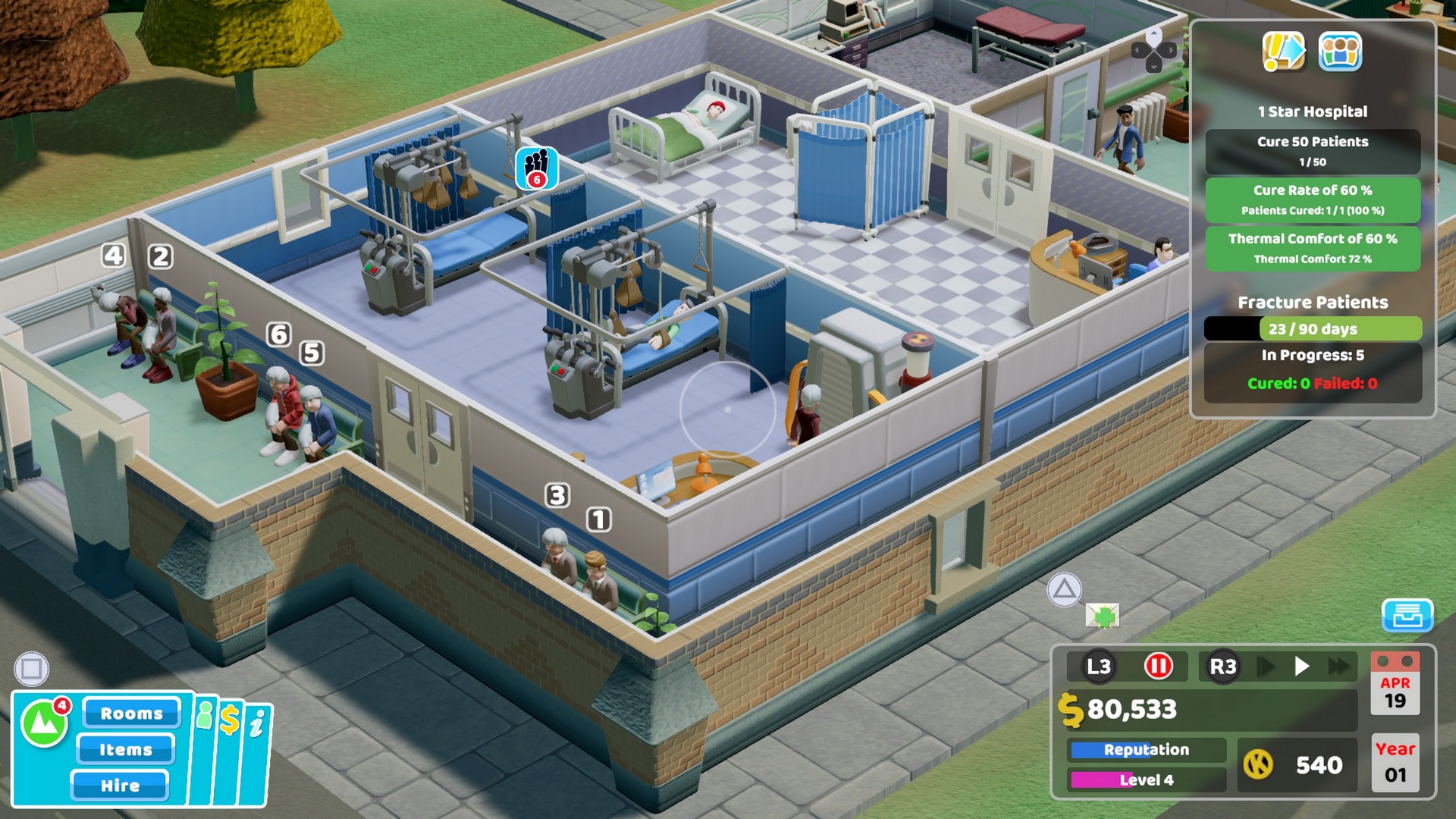
Two Point Hospital is the first game to introduce what is now the trademark Two Point aesthetic: it’s unequivocally British. Two Point County, the setting, doesn’t make any mention of the UK or Great Britain or the countries in that’s in the British Isles, but this is basically a fictional, satirical take of that part of the world, inspired by cultures of that part of the world, though not exclusively so. Characters that look like they’re made for a claymation that could pass off as extras in Wallace and Gromit. The dry sass and sarcasm. Very colourful, very cartoony. Fonts with very soft edges. Warm, inviting but can sting your funny bone if you’re into its specific style of humour.
The art style is strong, as even more than five years since its 2018 release Two Point Hospital looks charming as ever, and not a lick outdated. That’s the power of good art style that trumps the pursuit of photorealism where such games would need to be labelled as remasters for a new release like this.
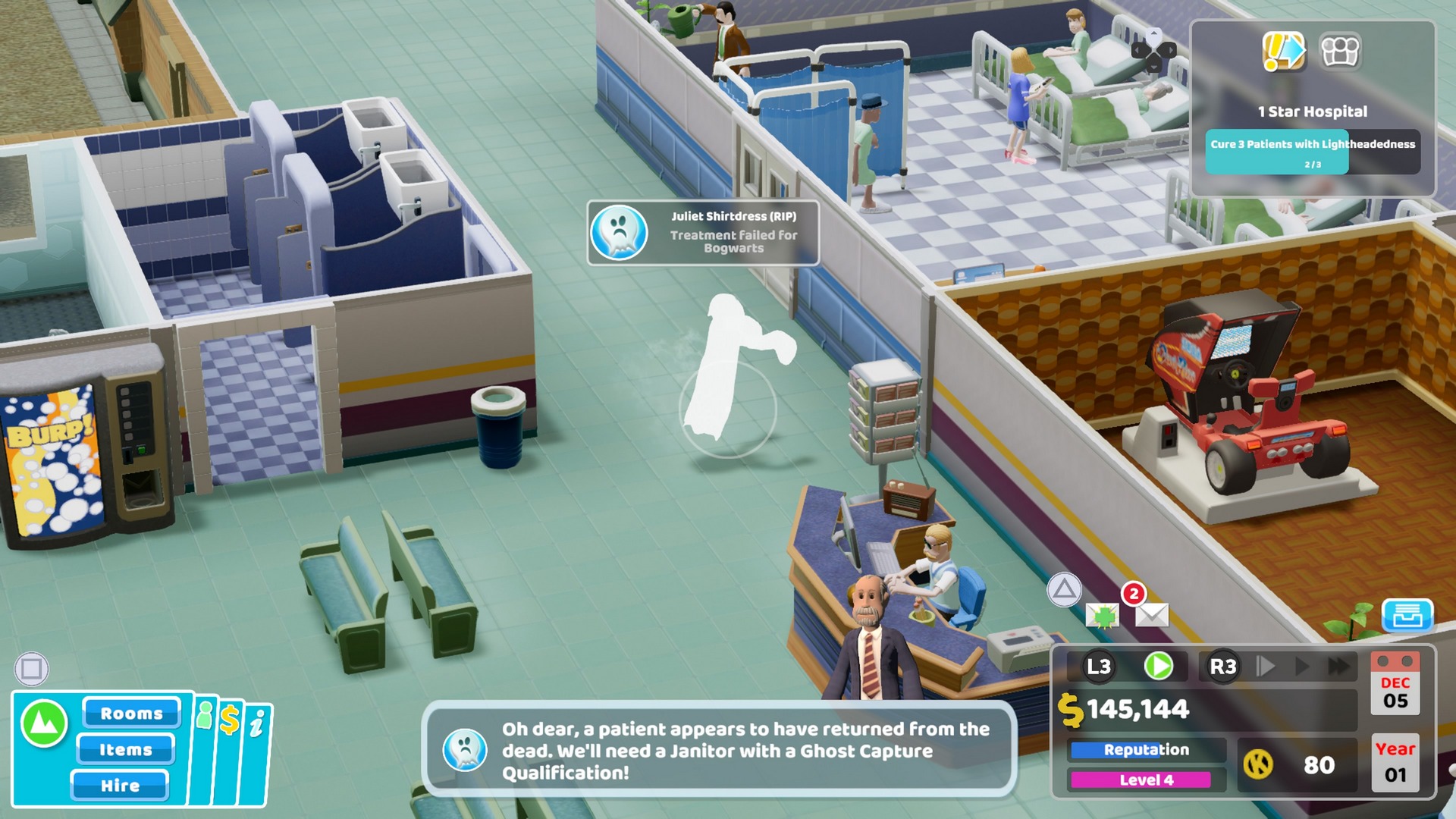
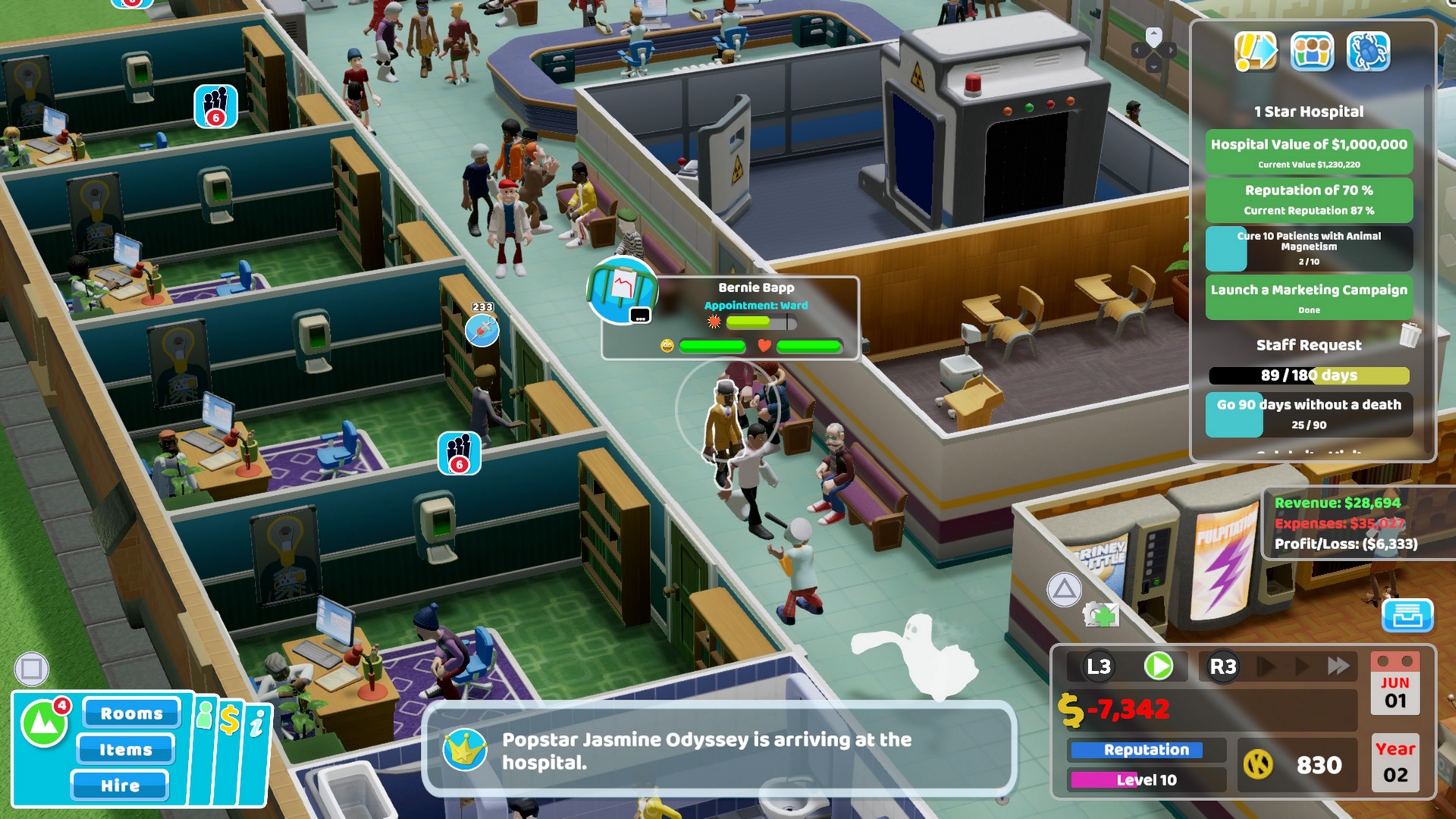
And it’s not just the lower-poly look that makes Two Point Hospital charming. It’s the bounciness of it all. Once you confirm a building blueprint is ready to build the walls and objects juts out upwards like it’s so happy to finally exist. Character movements are ridiculously exaggerated so you can see the swagger of a Mock Star, the dramatic sadness of someone in the middle of a Mime Crisis, or someone who’s on the death’s door because they’re waited too long in line for treatment and now’s contemplating to haunt the hospital as revenge.
Not all of them are good choices, though. The wordy intro that pops up in every start of a level can feel overwhelming to read but it’s just a throwback to how Theme Hospital starts its levels, but I don’t think that flies today. Some of the font and icon sizes are too small even on consoles. The interface doesn’t scale well. The UI, when it comes to usability is all well and good, but on PS5 the game stutters as it struggles to load in the database of all your staff, it stutters per line of new staff you scroll down to, which makes micromanaging a little more tedious than it should. Also, why is the save icon that appears briefly when loading a level in not properly placed in the corner of the screen?
The game itself runs smoothly at what my eyes perceive as 60 FPS, even with a hundred people stuck in line in an understaffed hospital that’s metaphorically and literally on fire. Even when there is so much chaos going on it didn’t drop a frame, until I open the stats screen. What a peculiar quirk.
As someone who only play Theme Hospital as a console game, I was excited to play Two Point Hospital again with a controller, and the implementation here is bang on. It’s easy to pick up, it’s intuitive to learn, I know exactly why I messed up when I pressed the wrong button. Selecting and deselecting the item menu when building always trips me up, but the buttons are labelled properly and there was never a moment where I don’t how to do a thing with the buttons. All of the interface are navigable with the d-pad, no cursor required. The only niggle I have with the controller implementation is that trying to shoot those pesky monobrows don’t trigger as well. You need to button mash a bit to get the shot in, and you’ll always run the risk of clicking to the closest intractable person and/or object instead.
There are also minor visual bugs that can still appear, like some characters not properly disposing their dish tray at the cafe so now they’re working around the clock with it.
Sonically-speaking, and no there is no Sonic The Hedgehog music here (but there are Sonic-themed decorations and outfits), Two Point Hospital nails the vibe it was going for. The instrumental songs are whimsy, jaunty, and would fit the score for some sitcom. In fact, one of the songs by the in-world band Credits Sequins is basically that. There are two songs with vocals in the soundtrack that by default are turned off, the singles by the in-world pop star Jasmine Odyssey that you can hear in full as teased in the Two Point Radio commercials. Oh, there’s an in-world radio with a rotating cast of DJs each with different bits they cycle around, sometimes interjected with commentary of actual news based on the happenings you experience, like when the mayor visits your hospital. A lot of nonsense in-world ads that really sells the silliness of Two Point County. Thankfully, not everyone speaks with Received Pronunciation British, there’s a DJ “from across the pond” that speaks with an American accent as they babble conspiracy theories and promote a corporate-sponsored kids segment.
All lovely stuff, and in case you haven’t gotten the memo thus far, Two Point Hospital is in love with building out its world, and has puns for days and weeks and years on end.
Two Point Hospital Full Health Collection runs well enough on a PS5 (for the most part) and is perfectly playable on a controller. Its charming presentation still stands strong even today that it doesn’t need to be remastered, remade or any of that malarkey. I do wish it had gotten another pass of polish to iron out these little kinks the game still has left since it stopped active development in 2021, as this version doesn’t feel as definitive as it should’ve been at this state.
Gameplay
In Two Point Hospital, you take charge of a private hospital business in Two Point County. The game will see you jumping from one hospital to another as you progress to make a name for yourself, and make money. It’s a private hospital business after all, the stats screen shows your hospital value and stock value.
The folks at Two Point County sure are sick, as each hospital location introduces you to various different challenges from new diseases to special modifiers that limit what you can do. Cure them as best as you can, earn money, and get at least one star before proceeding to the next hospital. The spirit of Theme Hospital’s level-based design is there, now layered on top of a modern three-star objectives system.
One of the most standout features of Two Point Hospital is how it brought back that specific style of building mechanics seen in Theme Hospital. You pick a room to build, specify the size, and then lay down the prerequisite objects. From there, you can add more objects, style it as you see fit, or hit confirm immediately and run with the bare minimum. The system makes you think a lot of how you should place your buildings as the outer walls of the hospital cannot be embiggen, so you’re playing a bit of jigsaw puzzles and your rooms are the puzzle pieces. Where would you plop down a 4×3 room? How much space do you leave for the corridors? Would it be a waste of space to build the room here, or invest in converting a plot of land into new hospital grounds where you have more space to work with? It’s a fun series of decisions that you’ll make with every new hospital, and it never gets old, even if you decide to build each of the rooms by hand every time. Though thankfully you can speed things up by saving rooms as templates, or copy-pasting existing ones if you need dupes of them.
While the decision-making puzzles will tickle the brain of the gameplay-centric gamers, there’s also room to just decorate the room as you see fit. It’s even encouraged, through the room prestige system. The more attractive objects or items the room has, and the bigger the room is, the higher the prestige level it gets, which boosts hospital attraction, which means more patients, which means more money. More objects can be unlocked by spending Kudosh, a different currency specific for unlocking unlocks, gained from completing in-game challenges.
From time-to-time, you’ll get in-game challenges that rewards you for completing it. Can you handle an influx of patients of a specific disease? Can you impress the mayor, the celebrity pop star, or the rival hospital company CEO as they come to visit? Can you impress your own staff members by building a high-level room, or earn a lot of cash under a time limit? There’s always something to achieve on top of the usual day-to-day hustle of ensuring patients get diagnosed properly and be sent to the right treatment and hope they won’t die along the way. Otherwise, that’s money lost.
And money is king in Two Point Hospital. Budget is tight and if you don’t play the management game and not look at the management side of things, you’ll easily get in the red. You can take up loans, of course, but still, you can end up in the red and with loans if you don’t play the game like it expects you.
Don’t rush and assume a specific disease will pop up in this part of town, you wait until they come and start building the treatment room as they appear. Speaking from experience being stuck in the red while on loan for a couple of in-game years.
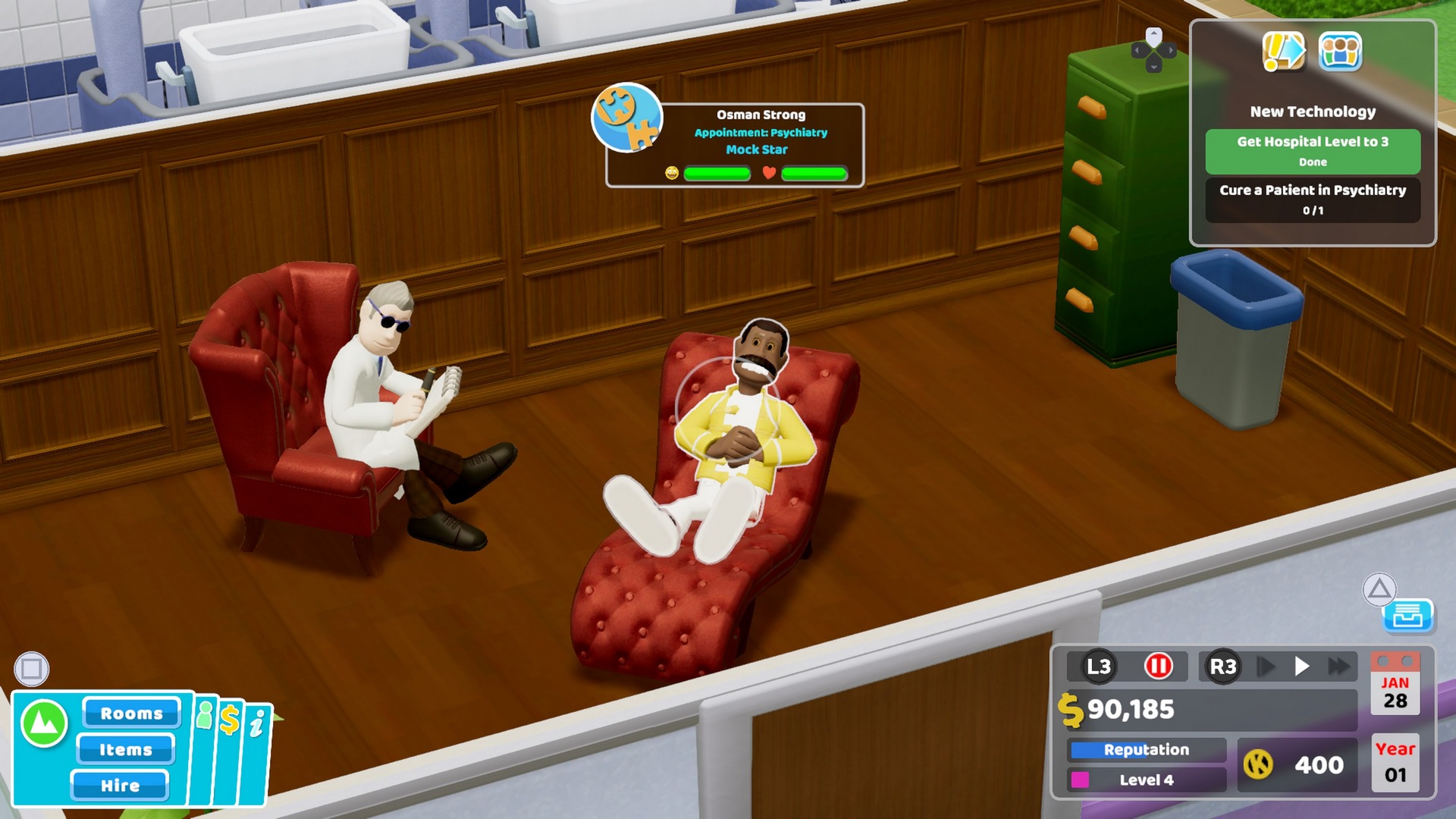
Has it been really this long in a Two Point Hospital review to yet talk about the diseases? Because boy they sure are funny, punny if you will. These jokes aren’t out of those silly “medical jokes/puns that will tickle your funny bone” compilation, which makes them even more absurd in the best way. Lightheadedness genuinely makes one’s head a lightbulb, and you need to get them to a De-lux-O-luxe to de-lux them and screw their head back on, to their delight. The aforementioned Mime Crisis only works as a pun if you play video games. Grey Anatomy, the disease where one gets the colours sucked out of them, only works if you are aware of the hit TV series about medics. People having pans stuck on their head is called a Pandemic, a joke that probably was funny before, well, an actual pandemic hit. Though thankfully no one diagnosed with a pan in the head can spread it, or require quarantine. Though they do get treated at a Pans Lab, which I guess is a play on 2006 film? Some other deep cuts include Floppy Discs—the bone disc getting floppy, requiring surgery—and the more obvious Humourous Bones, which the patients having to step inside a freaking casket to put on and put off casts don’t find, in any way, funny.
And this to name a few, there’s so many of these diseases that are wordplays of some kind. It’s not limited to just the disease, a lot of the world is made of puns, some of them require some familiarity with British culture to get the humour. One of the reporters from the county radio has the surname Figblanket, which I suppose is what you’d make a halal and vegan take of a pig’s blanket.
While there is depth to Two Point Hospital’s management game, I feel it never was deep enough. You can dictate each staff’s job scope by selecting specific rooms they should work, so you can optimise having the best doctors and nurses with the diagnosing skills stick to the GP office and general diagnosis room respectively. But you can’t rank them in order of importance.
While there’s not a lot levers to pull when it comes to management, the consequences of poor management is as dire you expect from a proper management game. You can find yourself into a budget deficit that can be hard to claw back out. A vicious downward spiral can occur if you spent all that money on a treatment room where none of the patients show up, and the ones that do you have to send them home as you don’t have the budget to spend on another treatment room. If there’s a long queue at the GP’s office as you can’t diagnose patients fast enough, the answer isn’t to hire more doctors.
There’s a very specific way to play Two Point Hospital that will not lead you to financial ruin, and unfortunately it also involves a bit of meta gaming, learning through outside means what the trends of patient that will pop up in some levels that usually sticks to a specific pattern each level.
Once you start raking that money in and having all kinds of treatment rooms set up, it’s hard to stop the virtuous cycle from ever hitting a bump, let alone stop it entirely from making infinite wealth. You basically “solved” the level, but still have to put in real time just to see all those objectives tick off to earn that star. You can optimise to get it done faster, but just doing nothing will take you to the destination anyway. And so the game’s main gameplay loop starts unravelling, like a worn out timing belt in an engine, the fun completely snaps when you hit that moment when the game has run out of interesting decisions for you to make.
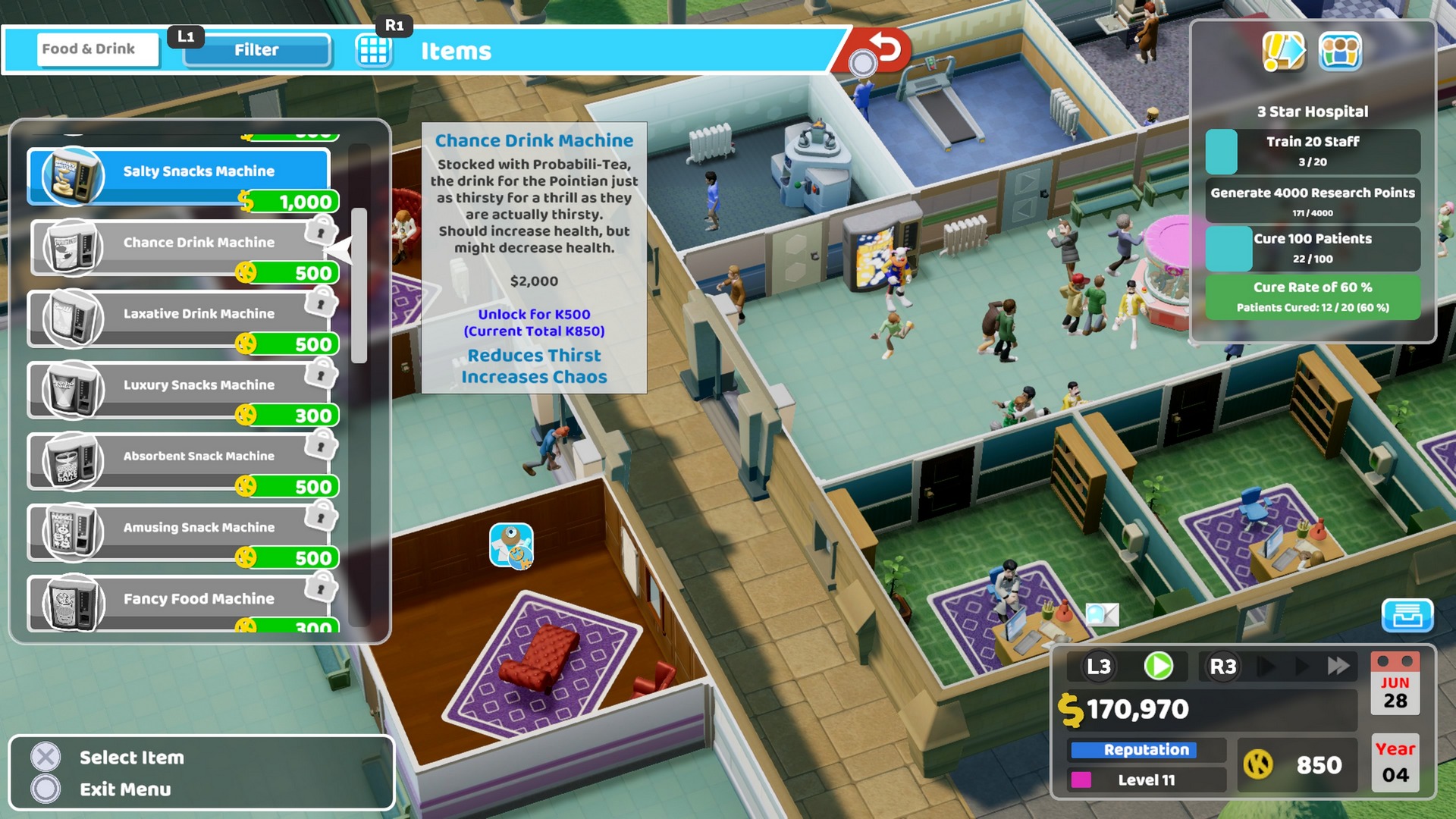
The freedom of being able to decorate each room to your liking contradicts and conflicts with the gameplay aspect of increasing room prestige. The latter is a little obtuse in that you can’t tell how much an object adds to the prestige bar so that it levels up, so rather than min-maxing what objects can level up the most, players that don’t consult a guide would end up just placing random deco items in hopes that it’s enough to reach level 4. A clearer way to optimise this would have made room decoration a worthwhile investment in time to tinker with. A clearer pathway of unlocking objects, like having them placed in tiers of effectiveness would have been a better way to get players interact with the many decorations, rather than having them all available through Kudosh. With all the DLC items, the objects screen has so much stuff but so little info on what they do. And for those who wish to just interact with the base game’s set of items, you can’t tell whether those items are DLC or not unless you check the filters applied to them.
On that note, please don’t just display all the items in a long grid or list. Have them categorised. It makes sense to have the items all in one menu when you’re first building a room from scratch, so you can get the essential objects without sifting through a whole bunch of stuff. But further interaction from there should default to having these objects categorised in menus.
Yes, I specifically want the object menu to replicate the Buy/Build menu in The Sims, complete with DLC object labelling.
(Side note: some DLC objects will cause the game to freeze for a few seconds when selected to be placed in a room, specifically the food platter items.)
But knowing that the gameplay loop unravels itself when played in long sessions, and the other quirks the gameplay has, Two Point Hospital is still a hoot. There’s a fun joy seeing a whimsy hospital with wacky patients queue up in understaffed, under-budgeted private hospitals. The sharp satire of the privatisation of healthcare is presented in a cheeky manner, with an inviting take on hospitals that the sequemish folks who fear such places can enjoy and have a laugh at.
The worldbuilding of Two Point County is fun to make heads or tails of (surely the big joke here is that despite it being called a “county” the locale is operating at the scale of a “country”). The jaunty music is a fun change of pace in a world where super serious and dramatic games are the mainstream experience. It’s a silly game about building silly hospitals, but unlike some “simulator” games, it’s serious in making the experience worth being serious about. The mechanics may not be perfect, but it is built so that you make interesting decisions, to test how well you can manage your budget, and whether you can make the most out of the weird layout of each hospital.
While not perfect, Two Point Hospital’s core gameplay is good fun, and does enough to tickle the side of the brain that makes you love city builders, colony builders, and management games. It doesn’t lend itself well as a fun time sink where you easily lose hours and can be a slog, though.
Content
Two Point Hospital Complete Health has all the DLCs included, and you’re looking at about double the amount of levels. The base game is already a lot to dig in, more than 20 hours worth just to one-star the 18 levels.
The base game isn’t something you binge through. The gameplay loop gets tiring in long sessions. It’s definitely more fun in bursts spread out in weeks or months. Once you got out of the hole of having to take on loans to get more money to spend on more on the hospital so it can make more money, you’re all set. The two-star and three-star goals doesn’t feel challenging, more like a time sink whether you can keep doing what you’re doing for longer.
That’s not to say Two Point Hospital doesn’t throw you a curveball. One of the more memorable levels is where you have to run a public hospital, so you don’t make money at all other than completing randomly thrown KPIs. As long as you can keep up the pace, don’t just make decisions willy-nilly (save up those promotions!) and you should be able to clear it, but a single slip up where you don’t complete a goal within a month, it’s going to be a rough ride. I now understand the pain of underpaid, understaffed public hospitals.
The DLC levels thankfully shake up the monotony even more than the few curveballs right by the end of the base game, some even add new mechanics like emergency services. So there’s a lot to do in Two Point Hospital, it’s a matter of whether you do want to see and do it all. The gameplay loop remains the same each time.
The amount of DLC levels does made it so that it obscures the critical path of 15 levels by a bit. A few of the DLC levels are unlocked early, but the rest are accessible after completing that one public hospital level and now you get to operate hospitals in a movie set, in some tropical island that’s somehow still in the same timezone, the far reaches on the opposite side of the mountains where mythical creatures are afoot, and even a hospital that exists beyond time and space. The DLC levels get real wacky, in a good, fun, way.
You can opt to play in a complete sandbox, treating Two Point Hospital as a full-on colony builder free to grow your one and only hospital.
It’s nice that there are so much to go and do here, especially with all the DLC additions, but I personally don’t find them different enough to continue putting time in and see. When you figured out the optimal way to play, or have successfully completed what you set out to do, you’re not compelled to keep on doing it as much unlike other games of its ilk. It’s easy to get full from the content available here. But if they way you play games is by regularly checking in now and then, Two Point Hospital fits perfect for you. It is unfortunately not bingeable, it becomes tedious when consumed in such a way.
Personal Enjoyment
Somehow, I managed to play Theme Hospital as a kid, in particular the PS1 port. I didn’t know what I was doing most of the time but hey, look at that silly sick people having silly diseases! The FMV of each level transition, and the fact that you have to start over from scratch over and over, made a lasting impression to this day.
While we never reviewed Two Point Hospital at launch on Gamer Matters before, I personally did put some time when it was out on Game Pass off the clock, and found it as charming as its spiritual predecessor. I get a good giggle out of British dry wit on the occasion, so I had a stonker in the first few hours. But then, I had enough.
There’s something about Two Point Hospital, and Two Point Campus for that matter, where their gameplay loop becomes less and less fun the longer you play. Most strategy games have that “one more turn” syndrome where players can’t stop playing, you want to keep going until the sun rises or set again. But Two Point Hospital’s loop has diminishing returns. I want to keep going and play more, but I have to put so much conscious effort to plow through, rather than something that just effortlessly done.
If only the game can keep itself fun and interesting while not making itself tedious. If only the decisions you make still feels powerful, important, and lead to even more interesting consequences the longer you play.
Don’t get me wrong, Two Point Hospital was set up to be a new Theme Hospital game in some way, and it definitely did that. But should Two Point Studios ever revisit the medical theme again, we can certainly shake up the formula even more the next go around, stray beyond the constraints of living up to its predecessor. The studio has carved itself its own identity now with three games in, the devs should try and go do more wild stuff, like Two Point Museum.
Verdict
Two Point Hospital Complete Health is supposed to be the definitive package for the 2018 hit hospital builder and management game on consoles. Though it still has odd performance issues and visual bugs that one would thought to have been patched out after all these years.
While it may lack the sheen polish one would expect from complete bundle release like this, it is perfectly playable on consoles, running well enough in most scenarios, and works fine with a controller. It still has specific performance issues and visual bugs, but the prognosis is positive.
Two Point Hospital is still a fantastic game after all these years, and its brand of humour remains funny for those who adores excellent wordplay that combines nerd humour and medical puns in ways that doctors who don’t game will be all confused in their diagnosis.
Even today, eight years since its original release, Two Point Hospital remains worthwhile to play, recommended in short dosages.
Played on base PS5. Review copy provided by the publisher.
Two Point Hospital: Full Health Collection
Two Point Hospital is still a fantastic game, and its brand of humour remains funny for those who adores excellent wordplay that combines nerd humour and medical puns in ways doctors who don't game all confused in their diagnosis. Even today, eight years since its original release, Two Point Hospital remains worthwhile to play, recommended in short dosages.
- Presentation 8
- Gameplay 8.5
- Content 9
- Personal Enjoyment 8