

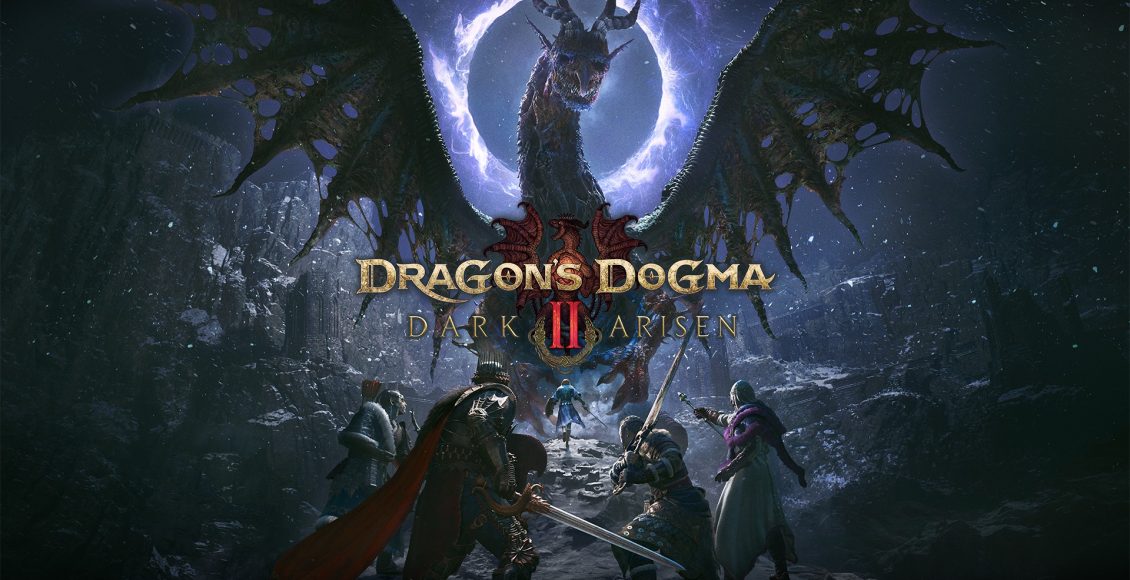
“The wind is pushing me.”
This is how I surmise my experience of 2012’s Dragon’s Dogma, Capcom’s rather unorthodox take on a high-fantasy action RPG.
The phrase is the lyrics to the original game’s title theme, “Into Free -Dangan” by Japanese band B’z. The song itself is reflective of the unorthodox nature of the game: what appears to be a soothing operatic ballad in the first couple of seconds quickly amps up into a heavy metal anthem which may feel incongruous on first listen, but makes so much sense when you realise the body of heavy metal music inspired by the medieval era and associated fantasy literature inspired by the time period.
Outside of its poetic meaning in the song, “the wind is pushing me” is what the original Dragon’s Dogma metaphorically, and in one instance literally, provided. It zags when experienced players expected games of its ilk to zig. It goes against conventions in expected game design. It’s also comfortable in making its players uncomfortable. Dragon’s Dogma’s operating word, to quote another B’z song, is Friction.
While the original base game wasn’t a big hit at launch, the subsequent release of the expansion Dark Arisen, has turned Dragon’s Dogma into a proper cult hit.
When Capcom finally ran in back to make a sequel to Dragon’s Dogma more than 10 years later, I didn’t expect Dragon’s Dogma 2 to be Dragon’s Dogma, take 2. The title screen only saying Dragon’s Dogma until you reach the near end of the base game is crazy work. Even crazier is that Capcom has decided to follow-up Dragon’s Dogma 2 with an expansion also called Dark Arisen. It’s as if this is a cycle, if you know what I mean, and if you know what I mean, this is totally intentional.
Dragon’s Dogma 2: Dark Arisen arrives at a curious time. Right now in the discourse we are against games that hold our hands too tight with non-togglable waypoints and non-consensual hints. But then there’s Dragon’s Dogma 2 where fast travel, initially, was a rare and limited resource. It’s also a game where you can have quests that don’t point at the next thing you need to do as the game expects you to figure it out yourselves through the game mechanics available at your disposal. It’s also a game where you can find yourself in a battle against monsters that clearly outclasses you, but you can die trying to make the combat system and physics interaction work in your favour. But these design decisions, despite being the antithesis of hand-holdy games that such vocal gamers berate, had mixed reception back when Dragon’s Dogma 2 launched.
(Admittedly, there are other reasons why Dragon’s Dogma 2 had a rough reception, from performance woes to microtransactions.)
Two years since launch, Dragon’s Dogma 2, the base game, has since backed down on some of its more divisive design choices, reducing a tad of friction. Now with two years of post-launch updates and a new expansion, Dragon’s Dogma 2 is in a better form, a little bit welcoming but still as quirky, unorthodox, and weird as it should be.
Dragon’s Dogma 2: Dark Arisen, in particular the new content that comes with the expansion, stands out from the pack of open world RPGs for simply being true to what it is: have players explore a harsh world full of peril with rewarding adventure, unique systems and grand ideas that while not executed perfectly, are still alluring and rewarding to interact with.
Note: As Gamer Matters didn’t have a review of Dragon’s Dogma 2, the base game, at launch, this review covers both the experience of Dragon’s Dogma 2 as it is now presented with Title Update 4.0, and the Dark Arisen expansion.
Presentation
On launch, one of the gravest points against Dragon’s Dogma 2 is its dogwater performance across platforms. The game chugs, couldn’t keep a steady 30 FPS, let alone 60. If it was the prettiest game ever to release at the time, it might be understandable, but alas, it was just awful.
Two years later, Capcom has got it together and figured out how to optimise its proprietary REach for the moon Engine (RE Engine) for open world games. Dragon’s Dogma 2 was the first to chug, but after Monster Hunter Wilds suffered the same fate, and the publisher’s unwavering support for the less-powerful but influential Switch 2 platform, the development team has just gone and did the black magic that they were supposed to do: make the open world games on the RE Engine run well. The first sign of this improvement this year was the excellent Onimusha: Way Of The Sword, but it looks like all games across the publisher’s board should have decent performance without having to wait for post-launch updates.
But how does Dragon’s Dogma 2 specifically hit the target 60 FPS on performance mode on PS5 without ever flinching outside of the most rarest of cases? The way the game loads in NPCs might be one of them. I now notice that they are only loaded in a few seconds after you teleported to a new location. Teleport into the major town of Vernworth and if you start sprinting around immediately, you’ll get bumped by phantom NPCs that’s just about to materialise in the middle of what looks to be an empty road. The illusion of Dragon’s Dogma 2 as a living, breathing world even when you’re not present is effectively shattered, but it’s a fair trade-off. Maybe the tech to keep all the scheduling of NPCs running without the performance overhead hasn’t been reached yet. The moon hasn’t been reached yet, so to speak.
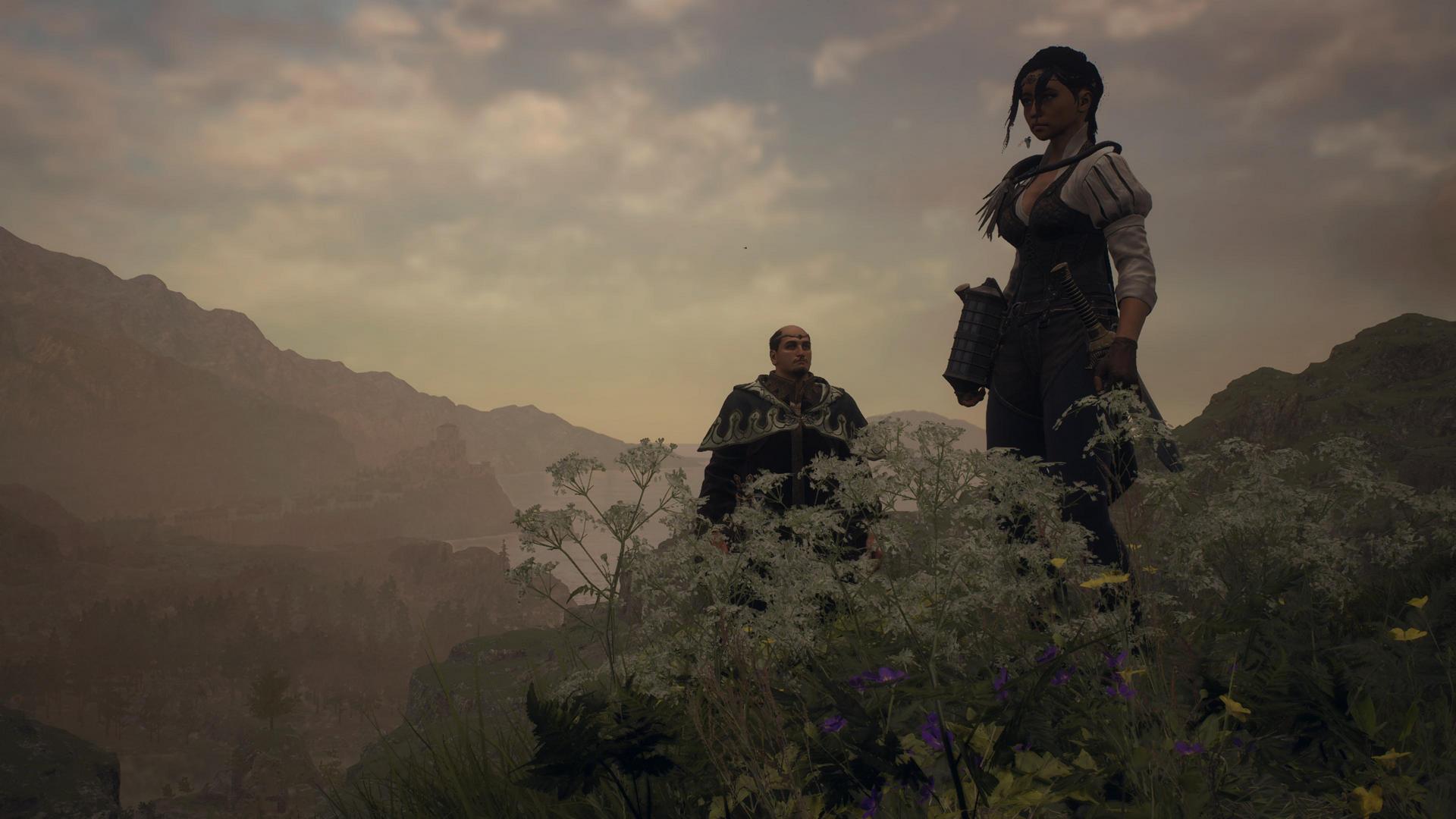
While I may have lampshaded about Dragon’s Dogma 2 graphics, I’m not necessarily saying the game isn’t pretty to look at. There are some great views and jaw-dropping vistas out in the open world with a decent enough draw distance and let the world feel big. There are also intricate, grimy details on the various armour and clothing that can be worn. But I wouldn’t say its grounded high-fantasy art style pops out as some of the most distinctive and beautiful aesthetic choice in gaming. The greenery of Vermund feels like the lush grounds of a European forest, while the arid canyons of Battahl just reminds me of the various desert biomes I’ve seen in other video games.
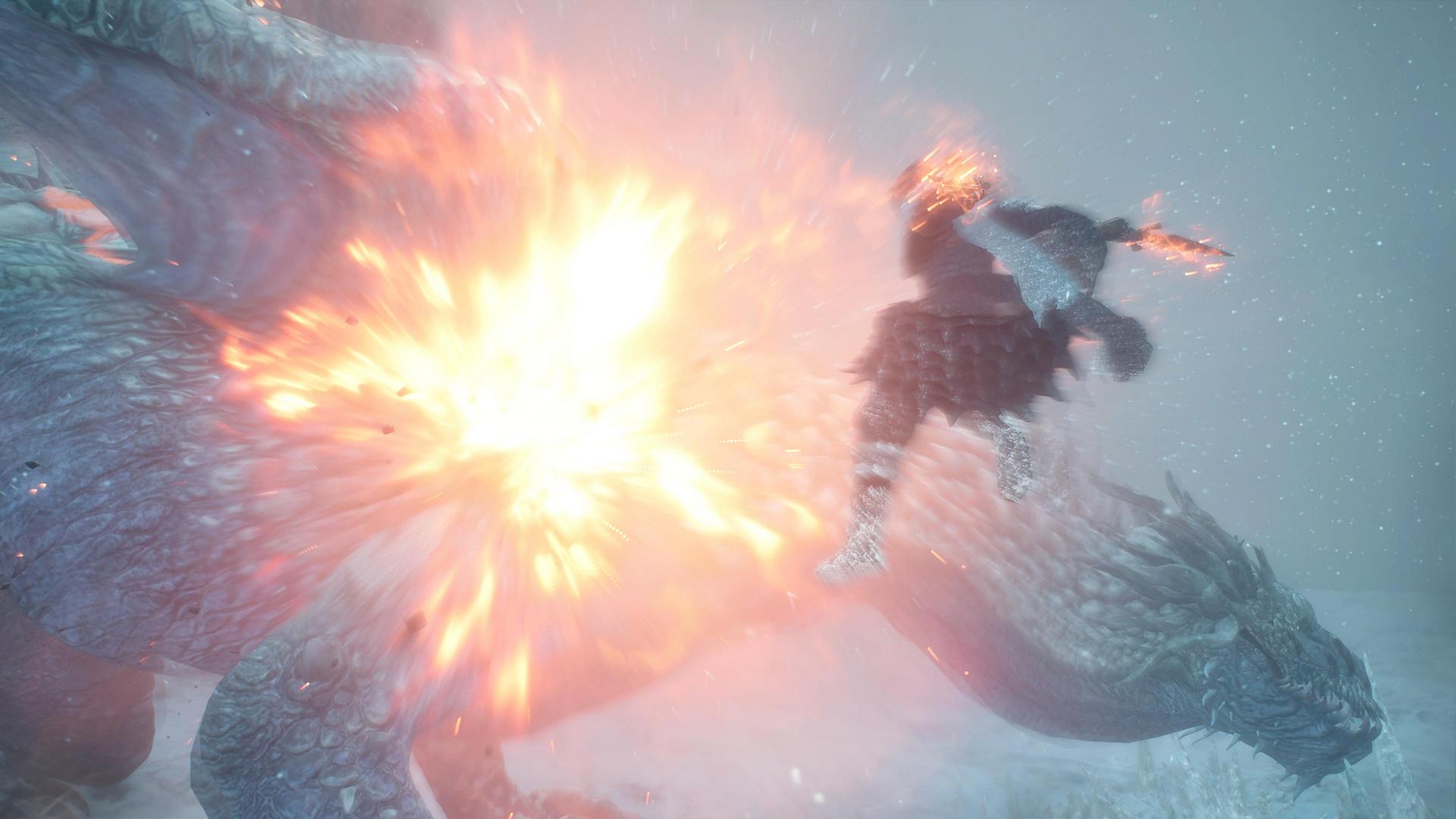
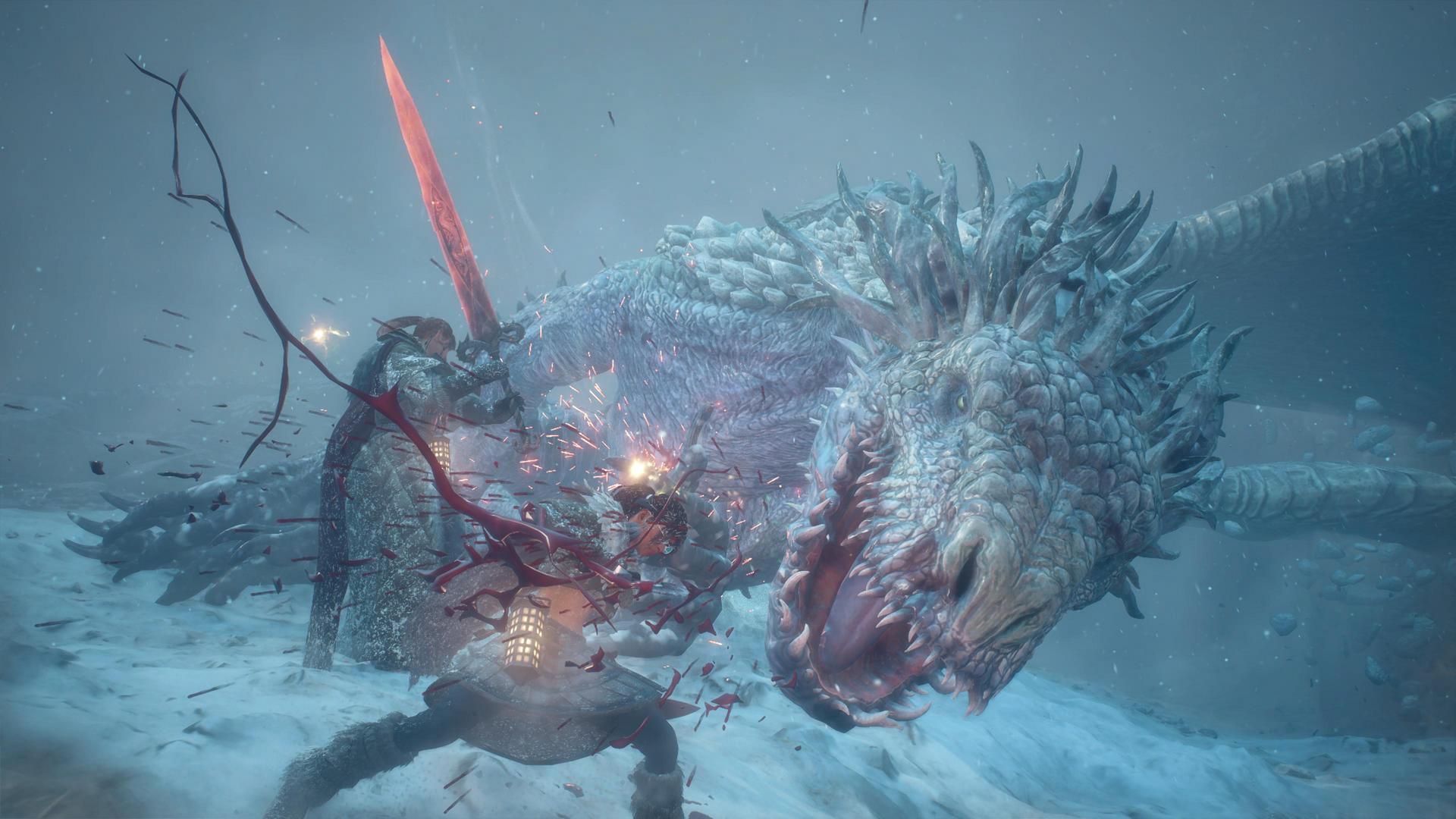
Even Norgan, the new region added with the Dark Arisen expansion, feels like what you expect from an arctic snowy region. I even dare to say that it looks like Skyrim, not that it copies the other game’s art style, but they are derived from the same source and inspiration. But play long enough and you’ll get to appreciate the amount of work done here to really make Norgan feel like a harsh clime. From the blinding whiteouts that hampers visibility so much that you’d be surprised to come back to the same area once the weather clears to see full-on unmissable buildings standing there. The snow tracks you leave is a nice visual effect. The way the region is laid out makes for some breathtaking, in awe and in fear, adventuring with even more exceptional vistas and viewpoints to lay your eyes on.
The more grounded take on this sword-and-sworcery setting Dragon’s Dogma 2 is taking just leads to its world can feel like various other generic high-fantasy world, and that’s by design. It looks like this pastiche of the various fantasy epics boiled down to its necessities. As such, there’s not much brave designs at work here. Even the hideous monsters, from cyclops to chimeras, are all plucked out of lorebooks of yore so even if they are intimidatingly rendered, it feels intentionally familiar.
Okay, so some of the armour and gear design obey the rule of cool where skimpier ones have better stats, but it’s still nothing too out of ordinary.
Speaking of familiar, the English voice over has a specific kind of cadence and vocabulary for all the native tongue speakers in Dragon’s Dogma 2. The dropping of the letter “v” in words like “ever” and “however” leading them to say “e’er” and “howe’er” respectively, “betwixt” instead of “between,” and my favourite, “aught” and “naught” substituting “something” and “nothing.” It’s all consistent in that those specific words are said and pronounced as old timely as it could, though I doubt all of the used English words are properly using a variant of old English, just enough old English words and accents from the British Isles to hone down that ye olde medieval feel to its characters.
For better or worse, most of the dialogue is voiced. Everyone is chatty if you take time to talk to them. And that includes the Pawns, the nomads that can cross between worlds that has not much free will other than to serve the players, the Arisen, as party members. Unlike Dragon’s Dogma which had Pawns say the same lines so often that it becomes ingrained like an earworm, there’s enough variety of voice lines, and less obnoxious ones that none can match the ironically iconic “wolves hunt in packs!” line from the the predecessor game. Pawns don’t feel like they’re a complete homunculi this time, they have a personality that players can set, and the interaction between these differing personalities has a bit more of that RPG party banter rather than the experience being you surrounded by 1-3 hive-minded slaves ready to do your every bidding. Which is good progress!
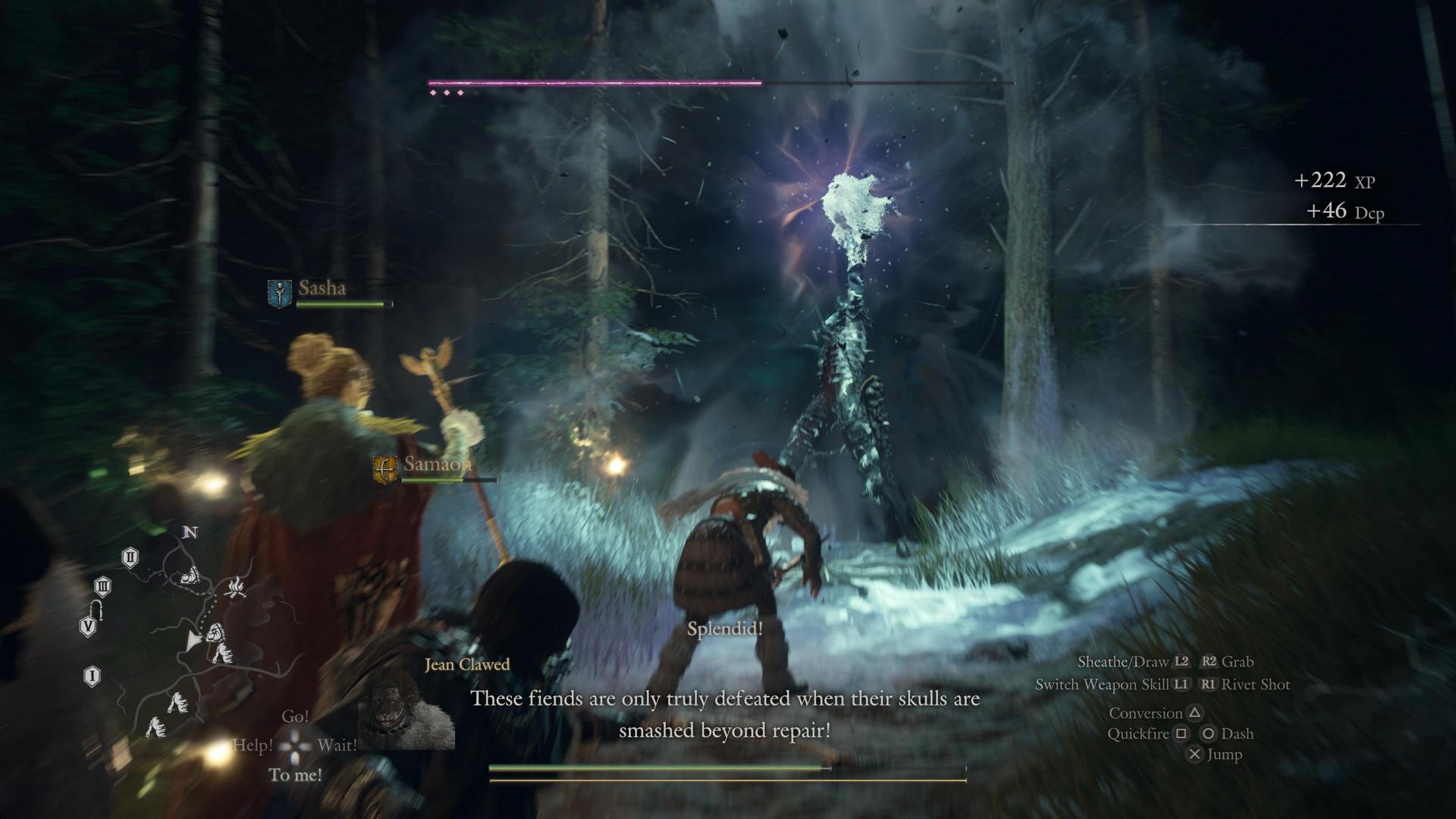
That said, I do wish the Pawns in Dragon’s Dogma 2 have their personalities develop over time. As characters, they don’t have any growth other than from the stats they levelled up. So with enough time, these Pawns can feel stagnant as they only react to the state of the world as defined by your quest progress, but does little to reflect on their own growth as characters. Not to say they don’t acknowledge them outright, there are some heartwarming banters where your Main Pawn sort of implies they remember the past and your past actions (like what vocation they used the most, or what vocation you used the most). I do want more of that interaction that develops over time.
On the topic of voice overs, there’s one incongruity in the Dark Arisen expansion as one of the existing characters, Ser Waldhar, has a new English voice actor as the original actor has passed away. The delivery of the lines are way, way different so you can tell which ones are added with the expansion. On another note, while Pawns do a good job not to say the same thing over and over again this time around, the hint to speak to Ser Waldhar before departing for Norgan will repeat over and over and over again until you actually enter the new DLC region. However, all the new voice lines from the Pawns for the new expansion content feel like the voice actors just picked up where they left off and completely blend in with the previously recorded line deliveries. Seamless.
One thing I feel like Dragon’s Dogma 2 is a step backwards is the music. While the original had the vision to throw in a metal band in the orchestra at the right moment, the instrumentals in Dragon’s Dogma 2 is all traditional orchestra. While the songs themselves are not terrible, they don’t stand out. The one piece of music that perked my ears the most is a new mix of a song that was made for the first Dragon’s Dogma: “End Of The Struggle.” The new arrangement lacks the punchy electric guitars and thumping bass drum kicks, yet the melody is so iconic that this better be this game’s version of “Proof Of A Hero.” It comes with a great victory jingle as well. That a reprise of the original soundtrack made more of an emotional impact to me is saying a lot about base game Dragon’s Dogma 2’s soundtrack.
Thankfully, the music in Dragon’s Dogma 2: Dark Arisen, kicks it up a notch. Not by much, but still a bit better. The new boss fights have new songs and they are befitting—the final boss theme if you will is sublime. Also, Capcom has made one of the songs from the base game, in particular the theme of the fight against a Dullahan, cooler by commissioning regular heater beats maker Casey Edwards to create an ode to Dragon’s Dogma 2: Dark Arisen that channels a bit of that heavy metal energy that Into Free had, and makes use of existing melodies from the soundtrack as a new anthem. The song “Burn The Sky” isn’t officially in the game, but it should be.
The UI in Dragon’s Dogma 2 is snappy when it matters, and intentionally not to stop you from making rage-induced terrible decisions. The long pause before the menus when your character dies is one such brilliant example, and often gives me enough time for that anger to subside before making the crucial decision of whether I want to use a rare and expendable resource to revive, or to roll back to a save that may be as far as a few hours ago.
The UI was not designed to handle the loot system introduced in Dark Arisen (more on that later). Managing loot, like what to keep and what to sell, is a mess as you can only compare the selected item with the one a character has in the same slot. This shouldn’t be a problem in most games, but Dragon’s Dogma 2 has nine different vocations (classes) and you can only equip one at a time, and there’s no way to mark a certain item in your inventory from a vocation that isn’t in the party to compare stats with the new loot. So what ended up happening is that I just store all of the loot and put off sorting that inventory for another day. Thankfully the inventory slots are plentiful enough that I don’t need to stop what I’m doing and sort my stuff for having gained too much loot. But in the long run, that’s something that must be sorted, by the players and developers, if loot is to be a core system and not just bound to the Dark Arisen expansion.
Dragon’s Dogma 2’s artstyle is intentionally grounded so it doesn’t stand out as much. The music lacked oomph from the original as the base game sticks to traditional instrumentations to score the soundtrack. The UI is serviceable but it’s not good enough for the new system the Dark Arisen expansion has brought in.
While the presentation package of Dragon’s Dogma 2 is not stellar, intentionally so in some regards, at least by the release of Dark Arisen, the game is now running better than ever with barely any framerate drop, with only minor drawbacks to make that happen.
Gameplay
In Dragon’s Dogma 2, you are the Arisen, a person whose fate is intertwined with the Dragon, in that it stole your beating heart and leaves you a scar in the chest. Like Dragon’s Dogma, the main goal is to slay The Dragon, but the setup of the world in Dragon’s Dogma 2 is an interesting one as you start out in a conspiracy as a fake Arisen has claimed the throne, and you need to uncover what’s going on.
If one thing you need to know about Dragon’s Dogma 2 is that the combat is simply peak. While there are talents behind the Devil May Cry series that worked on the Dragon’s Dogma series, the series isn’t necessarily a character action game. It’s still an action RPG, but the action here feels so good and so different to any comparable game of the same genre.
The crux of the battle system is vocations, Dragon’s Dogma’s job system/classes. The player character can pick a vocation to specialise in a specific combat style and they all play different. With Dragon’s Dogma 2, the traditional trinity of tank (Fighter), rogue (Strider) and mage (well… Mage) has become four, with the Strider in the predecessor essentially being split into two different vocations that is Thief (fights with daggers and has the most mobility compared to other vocations) and the Archer (fights with a bow and arrow that can freely aim and shoot arrows from a distance). Yes, the previous game had the Strider be ridiculously flexible, so splitting this in two in Dragon’s Dogma 2 makes so much sense.
Each of the vocations here have a different game plan, different movesets and as such, a different role to play in the part. The Fighter can be specced to double down on its tanking duties by having a skill that draws aggro from mobs to them. The Mage provides free healing so you don’t need to stock up on supplies as much. The Thief can chase fast enemies and deal massive damage on massive, climbable foes. The Archer can hang back and slowly but surely pick off targets with precision aim.
There is something about how the combat feel that just feels right. Enemies can overwhelm you, but you don’t need a dedicated dodge button for every vocation as you still can disengage properly by simply running away. You still need to understand spacing to ensure your hit combos land, but you’re not committed to most attack animations and can cancel out to run away. The weightiness of each hit feels balanced to the amount of commitment it takes to do an attack. A really powerful magick spell, or a really strong blow from the Warrior, has a good oomph to them when they land. Meanwhile the Thief and Archer needs to chip away consistently, dealing strike after strike, to really put a dent to a boss’ health bar compensated by how ridiculous you look when you keep firing arrows or swinging those daggers. The fact that physics plays a part to it also gives it additional weight. When a Griffon is shot down and fallen to its side, you feel the rumble of the ground. When you topple that Cyclops and hit a Minotaur, who you are also fighting at the same time, it just feels visceral in a good way when they collide. Having them fall to death, by gravity or by drowning, may be anticlimactic, but it’s just hilarious that it’s possible for it to just end in a whimper.
You’re not journeying alone. As the Arisen, you are eternally linked to a Pawn. This is basically an extra NPC that is bound to you in loyalty, with limited free will. Bots, if you will, but with some personality. An old-school AI companion that isn’t to be confused by the latest Large Language Model trite billion dollar corporations are pedaling to our faces right now. You can journey solo if you’d like, or be accompanied only by your main Pawn. Of course, you can indeed recruit two more accompanying Pawns, made by other players or from an official pool of Pawns created by the developers, to complete a four-person party.
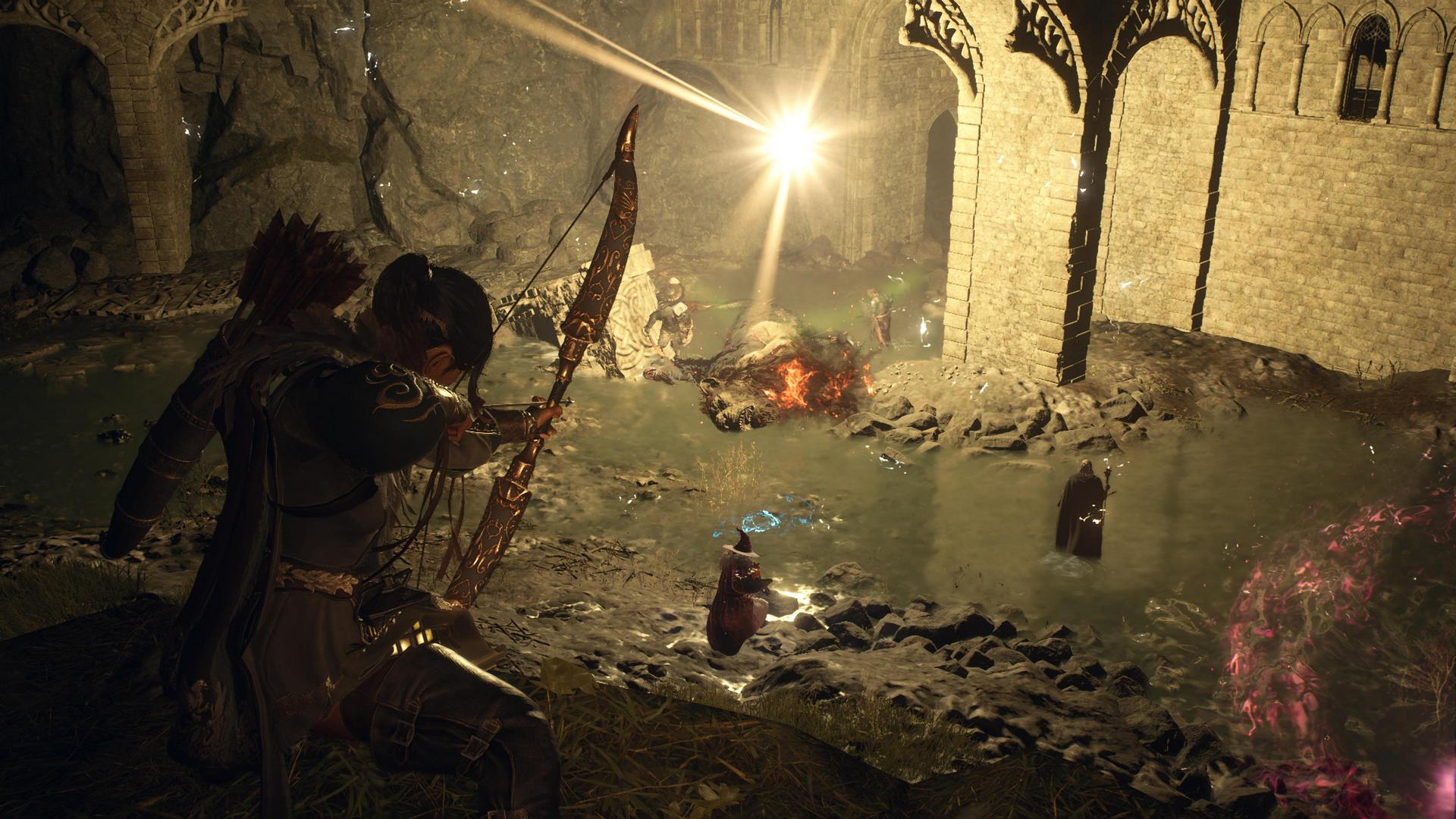
Dragon’s Dogma 2 is a single-player experience, but with some asymmetric multiplayer qualities, in that your Pawns might be having its own adventure in some other worlds as they got recruited by another Arisen in their game, and can bring back gifts provided by other players. You too can do the same, hire Pawns from your friends’ list and gift them something in return as a token of gratitude. Or to troll them by sending out rotten meat.
Having a full party fighting for their lives in Dragon’s Dogma 2 is just the best experience you can get in a high-fantasy action-RPG. While the vocations all have different playstyles, they can be complimentary. A Thief can throw smoke bombs to remove aggro from a Mage being surrounded by a pack of wolves, in case the Fighter isn’t in the party. Fighters can give the Thief a boost with their shield to get them climb up a monster faster so they can use their special skills only applicable when mounted on a monster. The Mage can fling out buffs for the rest of the party including elemental magic to their weapons, in case one Mage in the party isn’t enough to cope with the many ghosts that can phase through steel.
How you create your party composition is up to you. A balanced party with everyone a different vocation is the safe way to go, covering all bases and such, but not only does the game not stop you for having an imbalanced party, it also encourages. The Sorcerer, an advanced version of the Mage, can cast advance magicks but they take so long to incant. But having multiple Sorcerers can speed up the process if they pull together to help cast it. Imagine having four Sorcerers, now that’s a glass cannon build that, if you’re smart enough to make it work, would be really fun and funny to run with. Or roller with a full group of Archers, a firing squad that can overwhelm enemies before they can touch you, but things will get dicey when they do.
New to Dragon’s Dogma 2, compared to the original, are new Advanced Vocations. The previous game has hybrid classes and a level-up version of the three base vocations, very Kingdoms Of Amalur in that regard. Dragon’s Dogma 2 shakes it up a bit with job classes exclusive to the player, because the gimmick and playstyle would probably be too much for an AI CPU to handle, or at least that’s what the game wants you to believe.
The Mystic Spearhand is a magic/strength hybrid class where you use a duospear with telekinetic powers. I see some folks describe it as basically the Jedi class, which tracks. The Mystic Archer is an Archer variant that fires multiple arrows like it’s a multi-lock missile system from Armored Core, plus with skills that can heal party members, adding more reason to hang back from afar. Meanwhile the Trickster says screw it, we’re not a hybrid of anything, we’re just messing with the enemy AI for slapstick funsies. You deal no damage at all with the censer, but it draws aggro. And that rage can be used to trick these braindead enemies into falling off cliffs (by projecting fake floors for them to comedically step on) and let your Pawns do the dirty work by buffing them with increased damage output to the point that they can still fight even if they’re supposed to be dead as long as the spell is still on. Being a middle manager that adds little direct contribution can be fun, apparently.
All the vocations are fun to play as, and the game encourages you to not specialise and try out all the ones available. Levelling up vocations not only unlock new skills, but also Augments, passives that works across vocations once unlocked. You might want to play as the Mage if you feel like being a Thief for most of the game, just to unlock that passive Augment that boosts Stamina, for example. The only downside of regularly switching vocations is you have to equip the right gear again every time. Equipment pieces, including weapons obviously, are locked to certain classes, so most of the time you’ll have to rummage through the inventory to equip the right gear before you head off. It’s a little unwieldy, and even with the ability to equip items from your stored inventory immediately when switching vocations, it’s still a whole hassle having to do this every time. If there’s a way to save a loadout, so the game would immediately equip your character or Pawn to the set equipment when changing vocations, it’ll make changing vocations less of a commitment. Better yet, make the menu when equipping gear from the inventory less fiddly. It feels more cumbersome that it needs to be.
All these systems for the combat sound interesting, but how does it feel?
It’s like an addiction.
I relish for a fight in Dragon’s Dogma 2. There’s something deeply satisfying about the combat system regardless of the vocation you have on. The Fighter and Warrior should be most folks’ go-to choice, and that baseline experience where you have punch skills, enemies that require some thought to put them out quick and may take longer if you don’t have the specific vocation that can counter them, is impeccable. The game doesn’t need a parry and a dodge action to be mandatory movesets, and yet it still has freaking good action. It also doesn’t require players to be methodical and commit to long-winding moves on the regular like a Monster Hunter or the various soulslikes.
Dragon’s Dogma 2 is an action game that doesn’t abide to the character action cliches. Not that I think character action systems are boring or played out, but the fact that it boldly declines to use the same trick Devil May Cry has, despite having more or less the staff that worked on the series on this development team, is one hell of a flex.
But as fun as the combat system is, unfortunately a lot of the systems, like the wind, is pushing it back, in particular in the base game.
The exploration in Dragon’s Dogma 2 is fun, more on that in a bit, but the game picked what we now know as a design decision (as Dark Arisen has do away with it) by making the world be mostly a series of long, winding paths with little to no shortcuts in between major towns and cities. The design idea is cool, but not the execution.
One of the big things you will do early on in Dragon’s Dogma 2 is embark on a journey to the main town of Vernworth from the small town of Melve. It’s an arduous journey. It’s your introduction to how people in this world travel, very dangerously as the road is full of enemies out to kill you. It’s likely the first time you encounter a boss with a big health bar, featuring the first of many set-piece moments composed entirely out of multiple systems interacting with each other. And it’s a really, really, long road. Quite the struggle to get to what will be the main hub you are based in for the first act of the story.
The problem is, that was the only road there.
If you ever need to get back to Melve or any parts north of the Vermund region, then it’s going to be a long walk, interspersed way too often with fights. It’s too many fights. I feel like I only walked ten steps and the combat music is back on. What supposed to be trepidation, where a battle for your life can happen any time, becomes tedium as battles happen every time, without missing a beat.
Dragon’s Dogma 2 is a game where fast travel is a rare, and more importantly expendable, resource. You don’t earn a lot of Ferrystones, and you better make it count when and where you need to fast travel. And in most cases, you going to have to place your own Portcrystal, an item that acts as a waypoint you can fast travel to. There’s a lot of meticulous planning and forethought require to enable fast travel. Fast travel isn’t a quality-of-life feature, but a game-changer. Otherwise, you have to either walk, or hire an oxcart which you can sit on as it moves slower than your party can normally jog.
Everything in the last paragraph had me feel giddy. That’s such a cool thing to do!
Alas, not only did fans pushed back on this, so too did the developers. Thanks to a post-launch update, you can now use an Eternal Ferrystone which makes fast travel a quality-of-life feature again as, as the name implies, that thing’s not a consumable and can be reused over and over. I am slightly miffed, but I get it.
You see, there will be a point in Dragon’s Dogma 2 where combat loses all its meaning. You will reach a plateau in your level, as you’ve basically outclassed the enemies of this region. At this point, you basically gain nothing from your fights other than just for the fun of it, and like many things, too much of a good thing can be bad for you, especially meaningless combat. There are quests where you need to do a to-and-fro commute between major towns where said commute is horrendously plagued with too many enemy encounters. Even in the day, even on the main road that in my mind should at least be the safer route outside of random chance of a bandit attack. If only the combat encounter on the main roads were not this ridiculously overtuned, and the sights you see as you make the trek from one big town to the next more interesting, that would have made not having a fast travel less of a problem. I get making one walk the long road to feel like a journey, but it should at least not be something that’s just there to piss you off and get rewarded nothing by doing it.
My initial guess of the world design needed to have long roads instead of a fully open world where you can traverse through the environment freely was due to the Pawn system. Pawns can guide you to things like hidden treasures, locations and quests objectives, so the game needs to have paths that should make the pathfinding system not do silly things. But in the Dark Arisen expansion, the region of Norgan is more free form like most open world games where you can take find your own paths that are not just the ones marked on the map. I honestly preferred this new design choice compared to the long, windy paths one the base game tried. Not only do I have more freedom in determining how to get to the place I need to go, there are also just more ways to get lost, and less boredom for having to follow the same path over and over and expecting the same played out enemy encounters appearing on the regular. At least the enemy groups in Norgan are placed further apart from each other, more breathing room before your next battle with the choice of not engaging with them at all by giving a wide berth, something you don’t get to do as much in the base game.
There’s another issue with Dragon’s Dogma 2 which hampered the base game, and it’s the quest design. Again, it’s the case of “I like the idea, not the execution” deal. Dragon’s Dogma 2 truly feel like an RPG when you start to follow questlines, in that it can present you with some dilemmas and choices that you need to commit to. The game goes a step further by making some of these quests less about following a marker to the next destination, and have you figure out what to do next. Even wilder, some of these quests come with a timer, you’re on the clock and if you took too long, it’s gone.
However, the game also does a poor job at making you invested in whichever outcome the quest may lead, which results to most players resorting to guides out of fear of missing out. You can screw up quests in Dragon’s Dogma 2, which is cool, but also you don’t know if you screw up most of the time, which is not cool.
There is a built-in hints system, where you can talk to a fortune teller, a real ball knower supposedly, as they can look at their ball, for a price, and offer you a piece of info that can help you move forward with said quest. Unfortunately, there are enough moments where you try to do this and the fortune teller brings a vaguepost of a note to put you off spending money on such trite. Spoiling oneself through an online guide is faster and more effective than the built-in solution to this problem. Technically it’s not a problem, it’s an intended feature, but the interaction with said feature is not worth the hassle.
Pawns are another baked-in solution to this, as those who have completed this quest in another world (another player did that quest with them) can offer a guide on what to do next, incessantly requesting that you follow them to the destination. This also falls flat when the ones you can figure out yourself (i.e. go to the destination marked on your map) is the one they really, really like to bother you with (I wish there’s an option to never guide me to a particular part of a quest so they stop prompting me to show the way) while the more brain-scratching quests the best they do is repeat back the vague hints you were given previously.
Some of the quests feel like they missed a trick or two. There are quests where your Pawns are effectively not in play because they can’t access certain locations (I think there are lore reasons for this, but I wish it was made clear that Pawns won’t follow you through such locations and why). So you won’t get any hints from Pawns about it.
There’s one quest that involves a suspicious person’s presence in town but once you reach to a certain point of the game said person won’t be in town anymore so it’s supposed to be failed. But, thanks to the power of interacting systems, you can lift and carry said person who now resides somewhere else all the way to the place where the quest you’ve been ignoring took place, which triggers the quest to run normally again, despite making no story sense that all conversation with said lifted and carried person should be played as such because of said previous story progress. You know who they truly are by then. This is an oversight where a bug becomes a feature, and I have mixed feelings about this. Another point on Dragon’s Dogma 2’s embracing system-based mechanics, another knock on the quest design.
I think with proper investment in fine-tuning the quests to ensure the hints and Pawns systems, and any other supporting system, work to deliver the experience these quests were designed to do, this would have been another shining feature Dragon’s Dogma 2 that other contemporaries don’t. Unfortunately, I don’t think the base game got that.
Dark Arisen scraps this ambition by making quests less ambitious, but also less ambiguous. When a moral quandary appears or when a quest starts to offer a choice, I feel more confident that I have an answer for it. When the game tries to be coy with what you’re supposed to do, you know who to ask for hints and said hints make it clear what you need to go and do without being too direct about it.
The one thing I do like in regards to the quest system in Dragon’s Dogma 2 is forgeries. You can make a copy of key items and turn those over for quest completion so that you still have access to them. There is a drawback in that some forged items won’t work as it supposed to. But the fact that you can game the system so you can keep some overpowered item that was only supposed to be with you for a short period of time, or deny someone said item by fooling them with a fake, is powerful stuff.
The quests in the base game of Dragon’s Dogma 2 feels like a seperate whole, less good game when you compare it to the sublime gameplay loop of adventuring and combat. If you play Dragon’s Dogma 2 (and the Dark Arisen expansion) like a Bethesda open world game where you simply wander around, follow what tickles your fancy and hope to stumble into some interesting cave/dungeon/horrors on your own, it’s a fantastic experience. Similar to a Bethesda open world game (maybe outside of Starfield—I genuinely liked the main quest on that one!), the main quests in the base game feel like a step below. It’s not as good.
Content
Dragon’s Dogma 2 is a big, long game. With the Dark Arisen expansion, it’s a bigger, longer game. It took me over 60 hours before I reached the point of the game where I can venture into the expansion content, which is recommended to be attempted in the late game.
The base game has a lot to offer. The two regions of Vermund and Batthal are genuinely huge and full of discoveries. The more you explore the more rewarding it gets. A lot of problems can be solved by just wandering around aimlessly. You’ll naturally get good loot and gain experience to tackle the harder encounters by not really engaging with the quests.
The base game’s story is a bit iffy. The premise at the start is sound, you start off investigating a conspiracy of a fake Arisen being installed into the kingdom and you, the real Arisen, will be unravelling it. But by the time you reach Battahl the story went to a whole different direction and start questioning its peculiar worldbuilding back to the player. What seems to be a gameplay-first feature where the lore justifying its presence is flimsy at best is now a central point.
The storytelling in Dark Arisen meanwhile, feels much more focused and dialled in. Dark Arisen explores the peculiar worldbuilding through another angle, and I feel it’s much better done this way. The focus on having a smaller group of characters, from the fact that the region is sparsely populated, gives every NPC a spotlight with their own little side quest that you can complete. And these characters feel more compelling that I naturally want to help them out and see where the story goes from there.
I still am unsure if the world of Dragon’s Dogma should really be focusing on the meta story of what it means to be an Arisen, what Pawns are, and what the Arisen’s relationship with The Dragon is supposed to be. But that is the Dragon’s Dogma. Given that I like Starfield’s take on the cycle of life I should be more receptive of Dragon’s Dogma 2’s take on it, but I don’t. I feel like I want the world this particular cycle revolves on matter more. Not that there isn’t any work done on making the region feel believable, but I think more can be done to not make it feel like a caricature of a medieval fantasy world. It needs to feel like a world I want to be in, living the moment, rather than just a backdrop to my adventures.
Base game Dragon’s Dogma 2 doesn’t have much to do once you complete the game, you can go back and do a New Game+ run and complete quests differently but that’s about it. The base game itself is loaded with content, although a bit front-loaded, the stuff in the later arc seems a little lacking and less coherent.
Dark Arisen, meanwhile, has a post-game. You can endlessly repeat some of the most challenging boss rushes to prepare yourself to fight the expansion’s big baddie again and again for loot. Loot and gear in the base game has the same stats for every copy of the same item, but not in Dark Arisen. You can get special passives, some even makes your skills an enhanced version. Dark Arisen made the loot system something plucked right out of Destiny 2, for the better. They even added a transmogrification system (tailoring) so you can play the real end game of a loot game: fashion. Make your Norgan-gained loot look like from the base game’s selection of armour if you prefer that.
This loot system addresses the shortcomings of the base game’s gameplay loop I criticised: at one point the combat starts not to matter and have no rewards so it becomes tedium. Here in Norgan, any fight can still be worth it if you’re in for the loot, and you gain a steady rate of experience to level up regularly. Later on you will start picking what fights are worth it, loot drops have a level system and by the endgame you want the level 4 drops so you’ll be avoiding lesser goons for the bigger payout.
Having the loot system in Norgan does mean that if you ever engaged with Dark Arisen, it’s likely you’ll be overpowered when you go back to the base game. In the base game you can plateau your level around level 40-50 before you reach the endgame. If you go on a beat Dark Arisen, itself a 20-hour campaign at the very least, you’ll have a character at level 100, easily.
That being said, your adventure in Norgan will render the economy to be worthless because you are just showered in gold and the previously rare Rift Crystals. The economy balancing in the base game used to be really, really tight that to gain just one piece of armour from the store in the early game I remember having to sell off a bunch of stuff just to get enough. Nowadays, just about every enemy drops gold, and you’ll be killing thousands of them. Less rarity loot can be turned into Rift Crystals, which should incentivised fighting lesser enemies in Norgan. But you just end up with way, way more Rift Crystals that I regularly can afford recruiting Pawns that are 20+ levels higher than me, which shouldn’t happen. The economy has been messed up with Dark Arisen, so the game unfortunately loses one piece of friction, disappointingly.
Also, the Lost Rites dungeons added with Dark Arisen are also pretty gnarly. These are some of the best dungeon designs in the game, designed to be challenging so that veteran players sweat. It’s amazing.
Dragon’s Dogma 2 as it is is already a big game, but the Dark Arisen expansion is a whole other game in and of itself. You will be rather busy playing this game if you’re committed to its quirky take on action-RPG.
Personal Enjoyment
Ever since I picked up Dragon’s Dogma, I know well that this game is made for freaks like me. The amount of systems interacting is so cool to see.
But what really sells it for me is the freedom to just go wander about. This is, to use a crude phrase, a
“dick around” game where you can just do whatever and something will likely happen. And what usually happen is something awesome.
The game gets it so right that every big boss battle is like a boulder of obstacle you need to overcome. The framing of it helps. You know exactly how much health a boss has, and when you’re in close to victory the music starts cheering on your side. You are now the boss. This is your victory lap, go on and score that dunk and dap your Pawn real good after a deserved triumph.
Dragon’s Dogma 2 is full of friction. There is a lot of systems that will make you feel annoyed at first. But that’s just make the game full of more interesting decisions. The fights I took on and the fights I ran from are intentional, thoughtful and feel important. Taking careful steps inside of a cave is a meaningful action because you can land yourself in a tight and bad spot if you don’t. Figuring out if a quest is worth doing, and how it should be done, is interesting, though I wish the tools at my disposal makes it more clear what I should be doing rather than having to resort to a guide online.
Dragon’s Dogma 2 isn’t afraid to punish you, even troll you sometimes. But when the wind is pushing me, I can endure and push back. For the most part, it feels like that, you do get moments of triumph over adversity, and it’s just the best feeling you can get out of a game like this that tries to screw you over in many ways.
That being said, that on riddle from the Sphinx will screw you over if you don’t read a guide and you will miss out on something. Screw that in particular. But everything else? I love this game very much.
Verdict
The original Dragon’s Dogma 2 is as ambitious as it is flawed. It is daring players to push out of their comfort zone, though sometimes it is done so sloppily.
The base game as it stands plays better than ever thanks to performance improvements, but the design flaws that plague the pacing of the game, and the underwhelming storytelling despite a strong start, remains. This is a game not many will love, but those who adore it deeply.
Dragon’s Dogma 2: Dark Arisen tidies up the base game in many ways, and its additional new content is worth paying for even if the marketing blurb doesn’t make it sound as appealing. The new Norgan region paints a new direction of where the Dragon’s Dogma series could go design-wise. The new loot-driven gameplay loop is incredibly satisfying, the removal of the rather separated in-town quests is for the better, and somehow, the combat system remains fun despite only having a few additional skills and enemy types to fight against.
Dark Arisen really elevated Dragon’s Dogma 2. While the base game is flawed, the new expansion is a perfectly executed campaign with a respectable scope. Less ambitious, but more polished and better presented.
There is a future for Dragon’s Dogma after all, and I hope Capcom continues to blow wind up my face and push me, and their limits, to deliver a medieval fantasy action RPG unlike any other. This is not the end of the struggle, not yet.
Played on PS5. Base game review copy purchased by the reviewer. Review copy of the expansion provided by the publisher.
Dragon's Dogma 2: Dark Arisen
Dragon's Dogma 2 as it stands plays better than ever thanks to performance improvements, but the design flaws that plague the pacing of the game, and the underwhelming storytelling despite a strong start, remains. This is a game not many will love, but those who adore it deeply.
Dark Arisen really elevated Dragon's Dogma 2. While the base game is flawed, the new expansion is a perfectly executed campaign with a respectable scope. Less ambitious, but more polished and better presented.
- Presentation 8
- Gameplay 9
- Content 8.5
- Personal Enjoyment 9.5